
 The Standard Group Plc is a multi-media organization with investments in media
platforms spanning newspaper print
operations, television, radio broadcasting, digital and online services. The
Standard Group is recognized as a
leading multi-media house in Kenya with a key influence in matters of national
and international interest.
The Standard Group Plc is a multi-media organization with investments in media
platforms spanning newspaper print
operations, television, radio broadcasting, digital and online services. The
Standard Group is recognized as a
leading multi-media house in Kenya with a key influence in matters of national
and international interest.

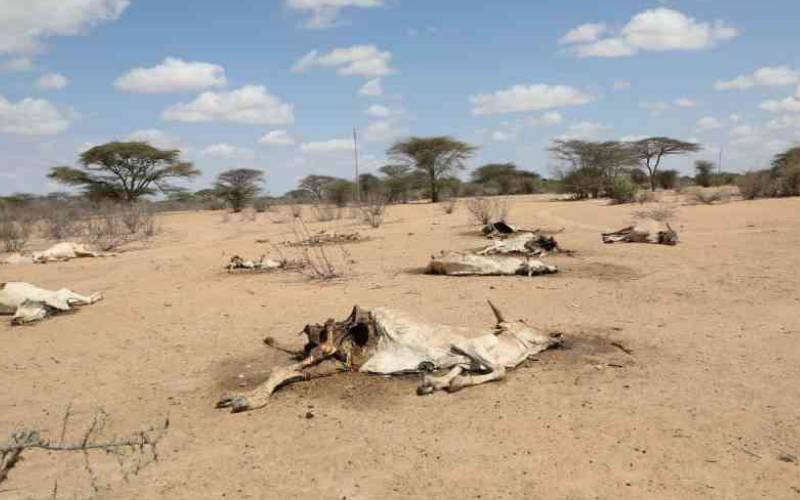
Carcasses of livestock in drought hit Liboi sub-county, Garissa. [File, Standard]
The cow lies on its side, ribs rising like a shipwreck from its sunken hide. Around it , the earth is dust. The sky is a relentless, bleaching blue.
The herder, a man named Abdi in Garbatulla, Isiolo County, has no words. He watches, his hand resting on the animal's heaving flank, as if willing his own breath into it.
"This is the last one," he mutters , almost to himself.
Across northern Kenyalies on its side, ribs rising like a shipwreck from its sunken hide, scenes like this have become routine. Pastoral communities that once r ebuilt her d s after a bad season now struggle to keep a single animal alive.
Droughts arrive closer together. Heat lasts longer. Rains fall hard, then vanish.
The climate clock is running faster than pastoral systems can reset.
Early 2026 has brought little relief. The Famine Early Warnin g Systems Ne twork (FEWS NET ) warned that the J anuary-March lean season wo uld be "particularly harsh," following the failure of the October-December rains and persistent heat. It noted that herders had begu n pushing animals over unusually long distances in search of p a sture and water.
- Climate shocks strain Kenya's health systems as stakeholders push for resilience and reform
Keep Reading
Milk production has dropped. So have sales. Households cut meals. Clinic visi ts are being delayed.
In F ebruary, Kenya's Meteorological Department forecast more heat for the north and east, with towns such as Lodwar, Mandera, and Wajir touching 38C, and only scattered rainfall in arid counties.
Edward Muriuki, the department's acting dir ector, said average rains would not repair months of deficits. "These areas require far more than average rainfall to recover," he warned.
Zachary Misiani, a senior climate scienti st at Kenya Red Cross, observed that f aster evaporation dries water pans before pasture regenerates, deepening livestock losses.
Recovery, even in good years, now takes "two to three rainy seasons, roughly one and a half years." For many families, the next drought arrives sooner.
"In many areas, households lose more than half their livestock," he explained. "Even when rains return, some animals die because their bodies cannot cope with sudden temperature changes."
The biological stress collides with economic reality.
Misiani explained that when drought tightens its grip, families sell animals early to buy food and water. Markets flood with thin cattle and goats. Prices slide. The strongest breeding stock disappears first.
That erodes the base needed for rebuilding.
FEWS NET reported that herd sizes a cross pastoral counties remain belo w normal, limiti ng sa les even when pr ices elsewhere look strong.
In Wajir and Mandera, deteriorating body conditions have already dragged goat prices 14 to 18 per cent below the five-ye ar average, while maize costs climbed up to 18 per cent above normal in some markets.
In Mandera County, the drought continues to destabilize livelihoods among pastoral communities, with livestock deaths rising sharply and the value of t hose remaining dwindling daily.
More than 25,000 livestock have died as of Jan uary 2026, with L afey, Banisa and Mandera North sub-counties recording the highest losses. The situation is worsening food insecuri ty and threatening livelihoods.
At livestock markets, desperation shows in every pen.
The animals on sale are visibly emaciated, m aking it harder to get favourable prices. They cite the example of goats once sold for up to Sh15,000, now fetching as little as Sh1,000.
Abdulah Mohammed, a trader in Mandera, said: "We have a big pro blem here. We don' t have animals. Many have died. Everyone is bringin g animals to the market. We are selling at a throw away price, making no prof it."
Charcoal burning rises. Firewood bundles appear along highways. Young men migrate for short-term labour. Remittances replace milk.
"These are not choices," said Fred Longenyek, a community elder i n Nkaron i village, Samburu County. "They are what is left."
He pointed to a kraal ringed with empty post s.
"We used to rest herds in drought. Now we sell everything. When rain comes, we start from zero."
"When the animals die, everything else follows," Longenyek said. His voice was a dry rasp, matching the land. "Before, a drought would take some, but the rains would return, and we could rebuild. Now the droughts are back-to-back. The land has no memory of grass. The animals have no strength left to give."
Food insecurity is no longer confined to the far north.
FEWS NET expects crisis-level conditions to expand into marginal farming counties such as Kitui, Makueni and Lamu after a third poor season, war ning that households ar e cutting meal frequency and dietary diversity, surviving mainly on grains and pulses.
The Kenya Red Cross says mo re than two million people face drought stress, with nutrition deteriorating fast est among children and pr egnant women. Safia Verjee, the organisation's deputy secretary general, said in some countries, 65 per cent of water sources have dried up, forcing treks of up to 10 kilometres for drinking water and 14 kilometres for livestock.
"We are seeing rapid pasture depletion, falling milk yields, and rising tensions over water," she said, urging authorities to convert early warnings into action.
In Mander a, emergency teams have scaled up li f e-savi ng oper ations as malnutrition spreads.
Mustafa Adan, a Kenya Red Cross official , said agencies had expanded water trucking, therapeutic feedi ng and livestock support across the worst-hit settlements .
"We are running very critically ininterventions," he said. "Water trucking. Food supplements. About 24 centres have been supported since December. We are also giving nutritional supplements and fortified forage."
Those measures keep families afloat, for now. They do not replace breeding herds.
Wildlife is not s pared. In January, buffaloes were filmed stranded in a dry water pan in Qarmadha v illage, Garissa an image tha t underlined how c ompletely surface water had vanished.
Seasona l forecasts still offer cautious hope.
Meteorologists expect the March -May long rains to be near average, which c ould allow gra s s to sprout and boreholes to recharge. But models show no strong signal either way, leaving planners uneasy.
Even good rains may not undo the damage. "The pr evious seasons did not perform well," Muriuki said. "These areas require much more than average rainfall."
Cabinet Secretary Deborah Barasa cal led for a "multifront" response combining forecast s, preparedness and advisory services to help communities make decisions under volatile conditions.
Misiani argues that timing now matters as much as totals. Short, intense storms run off hardened ground instead of soaking into soil. Heat lingers between seasons. The pause that once allowed animals to fatten a nd conceive has s hrunk.
"Pastoral systems depend on recover y windows," he said. "Those windows are c losing."
Government cash transf ers through the Hunger Saf ety Net Programme now reach more than 130,000 vulnerable households in eight northern counties, p aying 5,400 shillings every two months. FEWS NET cautions that delays could blunt their impact as the dry spell deepens.
Aid agencies are pre-positionin g fodder and trucking water. Counties circula te advi sories on where pasture may briefly regenerate. Wildlife rangers patrol flashpoints where livestock and elephants converge.
Misiani believes early moves can still reduce conflict. "If we provide water and pasture support early," he sa id, "we can lower human-human and human-wildlife clash es."
But he does not sugar-coat the scale of the shift underway. Each drought strips assets faster. Each recovery rebuilds less.
In Garba Tul a, Abdi finally ris es. The cow does not follow. He gestures toward the horizon, where heat haze blurs thorn trees into shadows.
"When this one goes," he says, "I don't know how w e start again."








 join
join