
 The Standard Group Plc is a multi-media organization with investments in media
platforms spanning newspaper print
operations, television, radio broadcasting, digital and online services. The
Standard Group is recognized as a
leading multi-media house in Kenya with a key influence in matters of national
and international interest.
The Standard Group Plc is a multi-media organization with investments in media
platforms spanning newspaper print
operations, television, radio broadcasting, digital and online services. The
Standard Group is recognized as a
leading multi-media house in Kenya with a key influence in matters of national
and international interest.

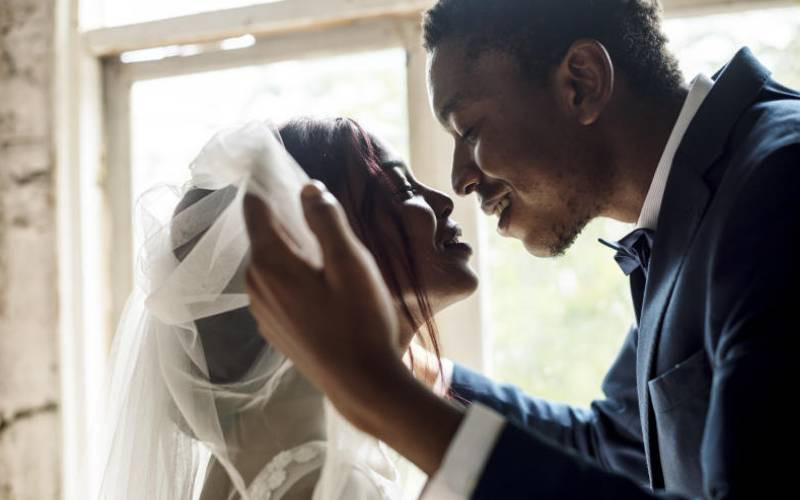
When Jane was 22, she dreamed of marriage the way poets dream of love, as something radiant, blissful, magical, certain, and everlasting. She pictured herself in a white dress, stepping into the glow of a bedecked altar, her beloved waiting, her future carved in joy.
Fifteen years later, sitting in her modest living room, she laughs softly, almost embarrassed by the memory. "Marriage isn't what I thought it would be," she says. "It's a lot harder... and somehow quieter too."
For many women today, marriage remains a dream. For others, it has become a question, a careful weighing of costs and meaning. Somewhere between laughter and lowered voices, a caution is voiced that chasing marriage without understanding may be a dangerous pursuit. It isn't a slogan yet, but it exists in half-said words. Something that comes from lived experience, from seeing friends give themselves over to promises they didn't fully choose.
Marriage has always held weight in African culture. It is a rite of passage, a marker of adulthood, a foundation on which many build their lives. But today the conversation around it is shifting.
Divorce rates are rising, gender roles are evolving, and younger generations are asking whether marriage should still be the ultimate goal. For some, it feels like a milestone to prove success. For others, it feels like a compromise of self. And for many, the worry is that we step into it without asking the hard questions about readiness, psychology, equality and intention.
Amina, 28, from Nairobi, speaks with a calm resolve. "I wanted marriage once. I thought it was everything, security, love, romance and belonging. But now I see friends who've given up careers, independence, and even themselves, for a life they didn't choose. I think we need to be honest with ourselves before we say 'yes'."
Wanjiku, 35, from Nakuru, has a different story. "Marriage gave me stability. It gave me someone to traverse through life with. It's not perfect, but nothing worth building ever is. The trick is to go into it with eyes open and hearts ready."
Grace, 31, from Mombasa, offers another perspective. "I'm somewhere in between. I love the idea of marriage, but I fear losing myself in it. It's not about saying no or yes, it's about choosing consciously. That's what makes the difference."
- Ways parents can help children set New Year resolutions
- How to parent purposefully this year
- Why structure is your child's greatest security
- Art of parenting highly sensitive children
Keep Reading
Marriage means different things to different people. For some, it is still a dream worth pursuing. For others, it has become a cautionary tale.
Carolyne Karanja, a Kiambu-based psychologist, sees this questioning of marriage as part of a larger shift in how relationships are viewed.
"Marriage is as much a social construct as it is a personal commitment," she says. "For generations, marriage has been presented as a given, a life stage to check off. But today, more women are asking whether they are marrying for themselves, or because it is expected."
She speaks of expectations; the ideals shaped by culture, tradition, religion and romantic stories: "Many enter marriage carrying those images rather than having grounded conversations. That gap creates disappointment."
She also points to gender roles as central to the conversation. Women often carry a heavier load in marriage, like emotional labour, household management, childbearing and rearing, and other unspoken sacrifices. For some, that reality fuels a growing hesitancy toward the institution.
Relationships today are not what they once were. Cohabitation is becoming more common, divorce is less taboo, and commitment is being defined outside the bounds of marriage.
The idea that marriage is the ultimate destination is being questioned. But rejection of marriage outright is not the same as rejection of commitment. For many, it is about making a conscious choice, one rooted in clarity and self-awareness rather than tradition or pressure.
For Jane, marriage was never the ending she imagined. It was a journey she didn't quite map out. But she learned something important along the way.
"Marriage changes you," she says. "Not because of the vows, but because of the questions you face inside it. The real wisdom is in knowing why you say yes, and what you're willing to give and receive."
Perhaps the question is not whether marriage is a dream or a delusion, but whether we step into it with eyes wide open. Because marriage, like love itself, is not a certainty. It is a choice. And its value lies in how consciously we make it.
Beyond the personal, the question of marriage taps into something deeply cultural. In many African cultures, marriage has been a cornerstone of community life for generations, a public celebration of union and continuity.
Weddings are not merely personal events; they are festivals of identity, of family, of belonging. They carry songs, blessings, and rites that bind people beyond the two who marry.
Yet as culture changes, so too does the meaning of those traditions. For some young women, the rituals are becoming symbols of expectation rather than joy. The conversation is no longer just about the act of marrying, but about the conditions under which we choose it.
This shift raises deeper questions about what we value as a society. If marriage remains the ultimate measure of personal success, what does that say about the ways we see ourselves and each other? If it becomes an option chosen freely and consciously, how might our relationships change?
In that choice lies the possibility for marriage to be more than tradition, to be a partnership built on mutual respect, equality and awareness.




 join
join