
 The Standard Group Plc is a multi-media organization with investments in media
platforms spanning newspaper print
operations, television, radio broadcasting, digital and online services. The
Standard Group is recognized as a
leading multi-media house in Kenya with a key influence in matters of national
and international interest.
The Standard Group Plc is a multi-media organization with investments in media
platforms spanning newspaper print
operations, television, radio broadcasting, digital and online services. The
Standard Group is recognized as a
leading multi-media house in Kenya with a key influence in matters of national
and international interest.

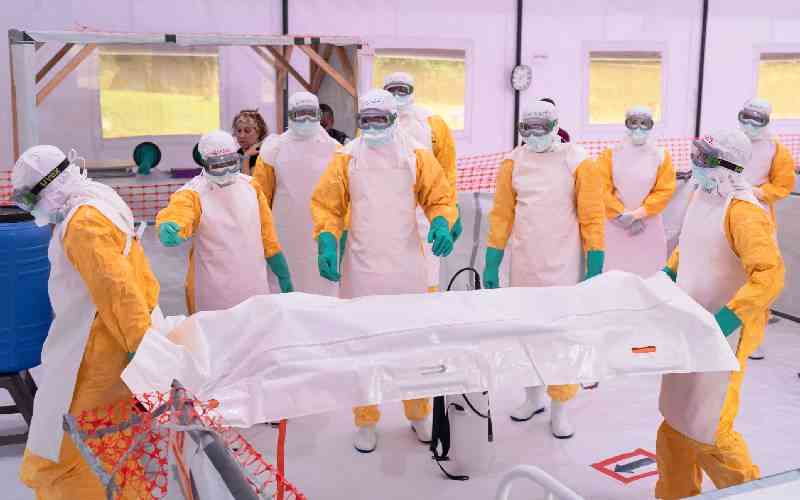
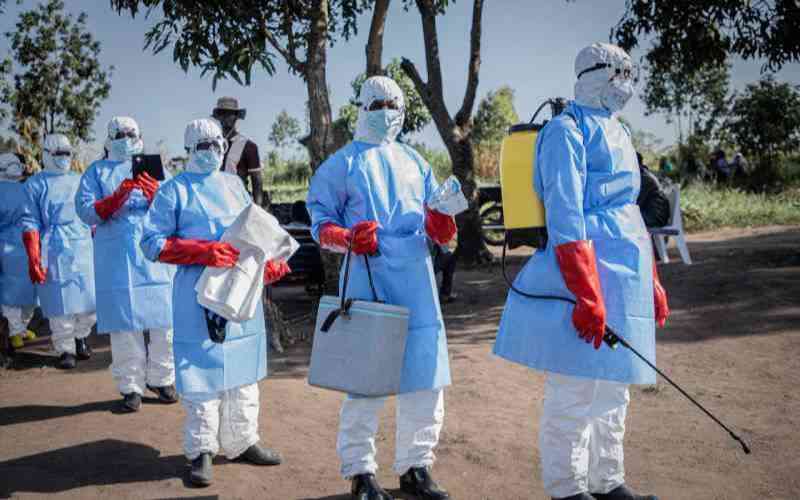
Health workers simulate evacuation protocols using a manikin for deceased victims of Ebola during a training by Médecins Sans Frontières (MSF) in Ongata Rongai, Kajiado County, on July 10, 2026. [AFP]
The Democratic Republic of Congo's (DRC) Bundibugyo Ebola outbreak is edging towards another grim milestone, with confirmed infections now fewer than 300 cases away from reaching 4,000.
Despite significant improvements in contact tracing, health authorities say transmission continues to outpace response efforts, highlighting the immense challenge of containing what is now the second-largest Ebola outbreak in history.
Now in its 78th day, the outbreak has recorded 3,748 confirmed cases, 1,657 deaths, and a case fatality rate of 44 per cent, meaning more than four in every 10 people infected have died.
"The outbreak is moving fast, and we are still playing catch-up," World Health Organisation (WHO) Director-General Tedros Adhanom Ghebreyesus warned.
In its latest epidemiological update, the WHO noted that "most of the increase reflects the expansion of the outbreak," indicating that rising case numbers are not merely the result of enhanced surveillance but ongoing transmission.
The current epidemic has already surpassed the 2018–2020 Zaire Ebola outbreak in eastern DRC, which lasted 99 weeks and ended with 3,470 cases, 2,287 deaths and 1,171 survivors The only larger Ebola epidemic remains the 2014–2016 West Africa outbreak, which infected more than 8,000 people across Guinea, Liberia and Sierra Leone.
- Duale: No Ebola in Kenya as DRC outbreak kills 88, reaches Uganda
- Race Against Ebola: Gavi, CEPI Launch Fast-Track Vaccine Plan for Bundibugyo Strain
- Ebola at the gates: Why Kenya must stay alert and not panic.
- Funding delays threaten Ebola clinical trials
Keep Reading
One of the few encouraging developments has been an improvement in contact tracing, with about 80 per cent of identified contacts now under daily monitoring. Contact tracing remains one of the most effective tools for containing Ebola because it enables health workers to quickly identify, monitor and isolate exposed individuals before they become infectious.
However, the continued rise in infections suggests the virus is still spreading faster than response teams can interrupt transmission.
Public health experts attribute the sustained spread to delayed case detection, insecurity in affected communities, population movement, community mistrust and persistent chains of transmission that remain difficult to break despite expanded surveillance.
The outbreak's gradual northward spread has also heightened regional concern. Health authorities are closely monitoring transmission as it advances towards Haut-Uélé Province, which borders South Sudan.
Although Kenya has not reported any Ebola cases, a spillover into South Sudan would increase the risk along the
Nadapal-Lokichoggio corridor in Turkana County, a busy cross-border route used by traders, truck drivers, refugees and humanitarian workers. Health officials, however, emphasise that there is currently no evidence of Ebola transmission into either South Sudan or Kenya.
The scale of the epidemic has also challenged long-held assumptions about the Bundibugyo virus. Unlike the Zaire strain, which has caused most of the world's major Ebola epidemics, Bundibugyo has historically been associated with relatively small and infrequent outbreaks.
The current epidemic has rewritten that history.
It is now the largest Bundibugyo Ebola outbreak ever recorded and the second-largest Ebola outbreak of any strain, providing scientists with new insights into the virus's epidemic potential while exposing persistent weaknesses in outbreak preparedness, surveillance and response across the region.
With infections continuing to rise towards the 4,000-case mark, health experts warn that sustained surveillance, rapid isolation of patients, effective contact tracing, community engagement and adequate financing will be critical to slowing transmission and preventing the epidemic from reaching yet another historic milestone.
According to Africa CDC, US$1.4 billion is required to contain the outbreak, but the response remains significantly underfunded.






 join
join