
 The Standard Group Plc is a multi-media organization with investments in media
platforms spanning newspaper print
operations, television, radio broadcasting, digital and online services. The
Standard Group is recognized as a
leading multi-media house in Kenya with a key influence in matters of national
and international interest.
The Standard Group Plc is a multi-media organization with investments in media
platforms spanning newspaper print
operations, television, radio broadcasting, digital and online services. The
Standard Group is recognized as a
leading multi-media house in Kenya with a key influence in matters of national
and international interest.


The crisis in the health sector continued to bite as the doctors’ strike entered week four with pharmacists threatening to stop medical supplies to public health facilities starting next week.
This came on a day officials of the doctors’ union were beaten up in Bomet, where they had gone to investigate claims that their members had agreed to a deal with the country government after they were given a 15 per cent salary hike (see separate story). And the decision by counties to advertise the positions of doctors, pharmacists and dentists added salt to an already aggravated wound.
In a paid up advertisement in local dailies, all counties except Kwale and Bomet asked for applications to fill various positions left vacant by striking doctors.
This means if county governments make good their threat to sack the striking staff, the sector could be thrown into a bigger mess as unions vowed to escalate the crisis.
Already, the Pharmaceuticals Society of Kenya (PSK) has vowed to stop supplying medicine to health facilities if the doctors’ strike is not resolved.
The society’s president, Paul Mwaniki, explained that their intention to withhold critical drugs was anchored on safety for Kenyans.
“For the safety of those products and for the safety of Kenyans, we are urging our members who supply all these commodities to the public, and to both public and private hospitals, to withdraw them because this is sending poisons to be handled by people who are not competent,” Dr Mwaniki said yesterday.
He further clarified that the move was simply “urging its (PSK) members to follow the law” as far as dispensing medicine is concerned.
“We shall continue as per the law, which inhibits anyone from sending medicine where there is no pharmacist; medicines must be dispensed by a pharmacist according to Cap 244 of the Pharmacy and Poisons Act,” said Mwaniki.
It also emerged yesterday that the proposals by the Government to hire foreign doctors could face major challenges even before the idea takes off.
For doctors to practice in Kenya, there are laid down rules that must be followed, among them registration with the Kenya Medical Practitioners and Dentists Board (KMPDB).
Some of the striking doctors are members of this board and there are fears that they may not allow the licensing of foreigners to replace them.
“Some of the members of the board are also members of our union. But they are on the board in their own capacity and this is how the union seeks to keep vigilant. Basically, it won’t happen,” said Ouma Oluga, the doctors’ union secretary general.
In addition to this, the challenges that come with hiring doctors who have trained outside Kenya could involve a legal tussle.
The law requires that any doctor who trains outside the country must go through a pre-internship at Kenyatta National Hospital before moving to other hospitals.
They must also work under consultants who are lecturers, and it is here that they work with limited resources.
After one year, these doctors sit an exam set by KMPDB which, if they pass, allows them to proceed for a one-year internship before they are posted as medical officers.
FOREIGN DOCTORS
Medical professionals who spoke to The Standard questioned whether the foreign doctors would be subjected to the same process.
“These measures are put in place to prevent Kenya from having quacks in our facilities. Will they bypass this? It can be challenged in court,” said Harvey Mulei, the lower Eastern region doctors’ representative.
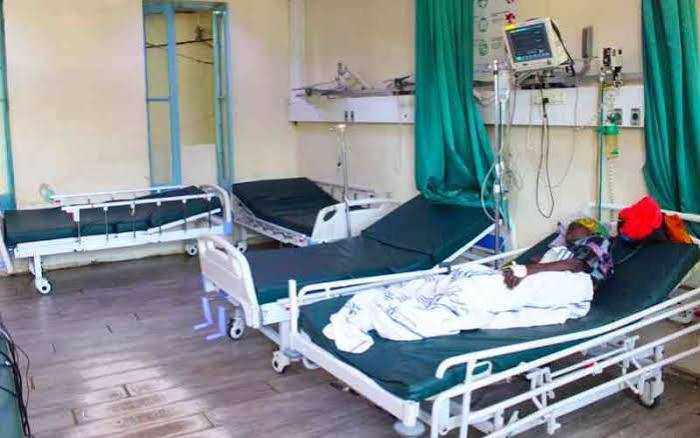
But as a solution to the medical sector collapse remains elusive, Kenyatta National Hospital (KNH) is witnessing low traffic as patients stay away. A spot check inside the wards revealed empty beds even as nurses remained busy taking care of the few who were there.
Military doctors were still taking care of emergency cases but patients seemed to have sought medical services elsewhere.
The scenario was different in neigbouring private hospitals, which are now overstretched by the huge number of patients who have fled KNH.
St Mary’s Mission Hospital in Langata, Nairobi, is one such facility where we encountered Linet Omala nursing her yet-to-be-named son in the maternity ward. She was rushed to the hospital from Kayole after she suffered a retained placenta, which could lead to death because the bleeding does not stop.
Ms Omala had gone to a private hospital to deliver and developed complications before she was rushed to a bigger private hospital in Kayole, which eventually rushed her to St Mary’s.
In the paediatric ward was Alice Mwangangi from Eastleigh who delivered aBaby Samantha on December 23, as Lorene Omondi from Uthiru attended prenatal clinics at Waithaka Health Centre.
Ms Omondi, who delivered Baby James Odera a day after Christmas, said, “I was scheduled to go back for a scan but the clinic was closed so I had to come here.”
Another mother in the ward was Caroline Arum, who had been referred from KNH to Kibera South but could not get any help.
“I took the letter to Kibera South Health Centre but was informed that doctors were on strike so I could not be helped and they advised me to come to St Mary’s,” said Ms Arum.
St Mary’s managers said the situation was overwhelming despite the hospital trying to ensure that high standards of service were maintained.
Director of Clinical Services Frank Endere and his deputy, Wycliff Kimani, explained that patient numbers had increased over the past few weeks and the facility was overstretched.
While the hospital can ordinarily handle 800 outpatient cases, it is now handling 1,500 cases daily basis, and this has strained health workers at the hospital.
“We had an average of 20 deliveries per day but the number has more than doubled to 50 and the cases requiring Caesarean section deliveries has tripled,” said Dr Kimani.
CLINIC OVERWHELMED
The number of pre-term babies has also increased, forcing babies to share the available incubators. Mothers are also using the ‘kangaroo care’ method.
“The paediatric ward could take in 50 patients but is now holding up to 78, forcing us to get more beds,” said Kimani.
The usually spacious wards are now constrained for space and the maternity ward has not been spared, with some beds being placed in the corridors to accommodate more patients.
The antenatal clinic is also overwhelmed, holding up to three times the capacity. All these depend on 14 medical officers, 15 clinical officers and 65 nurses. More nurses are being engaged as locums.
“Even the surgical theatre has been affected because we are getting more patients in the same space. We’ve managed to keep death low in the department but the situation might worsen,” said Dr Endere.
Erick Ngeny, the nursing officer in charge, said the 280-capacity hospital could hold on any longer, especially with bed capacity. He asked the Government to step in and subsidise some services like maternity care, which are free in public hospitals.
“We cannot deny patients services and we have done our best to ensure that we are offering high quality but if the strike continues, we might also face the consequences,” he said.
The striking doctors are demanding a 300 per cent pay increase as well as promotions.
They also want county governments to hire additional personnel to deal with a shortage of doctors. Some have also complained of poor working conditions.








 join
join