
 The Standard Group Plc is a multi-media organization with investments in media
platforms spanning newspaper print
operations, television, radio broadcasting, digital and online services. The
Standard Group is recognized as a
leading multi-media house in Kenya with a key influence in matters of national
and international interest.


Kenya has thousands of trained healthcare professionals without jobs even as hospitals face staffing shortages, exposing gaps in recruitment, workforce planning and distribution.
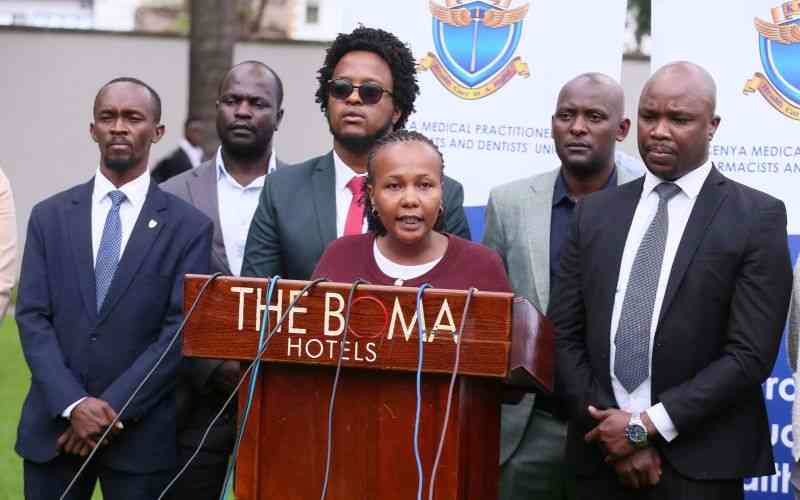
Kenya Medical Practitioners, Pharmacists and Dentists Union (KMPDU) Secretary-General Davji Atellah has challenged the government to increase funding for healthcare recruitment, arguing that qualified professionals should not remain jobless while health facilities struggle with inadequate staffing.
Atellah made the remarks on Saturday, November 28, during Amref International University's alumni dinner, where graduates and other stakeholders gathered to discuss professional development, employment and the future of healthcare.
He questioned why the government had not established a dedicated budget for employing health workers, despite allocating funds to recruit personnel in other sectors.
“Today we have most of you wallowing in desperation, wallowing in stress because you don't have jobs, yet the shortage is quite high,” Atellah observed.
He cited the changing doctor-to-patient ratio, which he said had improved from one doctor for every 30,000 people in 1957, when Amref was established, to one for every 10,000 people in urban areas and 15,000 in rural areas.
However, he maintained that the country still needed to train, recruit and retain more healthcare professionals to meet the population's needs.
The Ministry of Health's 2023 Health Labour Market Analysis for Kenya estimated that 27,243 trained healthcare professionals, representing 14.34 per cent of the active workforce, were unemployed or underemployed in 2021.
- Doctors set 90-day ultimatum for pay talks, warn of strike
- Doctors issue June strike notices to Meru, Isiolo counties
- KMPDU demands security after mob raids Naivasha hospital, steals body
- Doctors threaten nationwide strike over delayed salary adjustments
Keep Reading
The same analysis found that the available health workforce met 76.4 per cent of Kenya's needs, leaving a needs-based shortfall of 59,966 professionals across 31 occupational categories. Without interventions to improve training, recruitment and retention, the gap was projected to rise to 114,352 by 2030.
The mismatch is not simply a question of how many professionals Kenya trains. The analysis found that the country's health workforce was growing at an estimated 3.4 per cent annually, while the need for health services and personnel was increasing at 4.7 per cent.
The report also identified unequal distribution of health professionals across counties and differences between the skills available and those required. Some cadres had more trained professionals than the labour market could absorb, while specialist personnel remained scarce in several counties.
Recruitment delays further compound the problem. The analysis found that filling a funded vacancy took an average of 7.5 months across health facilities, rising to about 11 months in public facilities. It cited lengthy administrative processes, political interference in recruitment and weak human resource planning as factors contributing to the delays.
The report also pointed to limited economic capacity to employ all available professionals at prevailing wages, suggesting that the existence of trained workers does not automatically translate into funded jobs.
These findings show why Kenya can have unemployed professionals and understaffed facilities at the same time: recruitment budgets, workforce planning, deployment and the mix of skills available do not always match the needs of health facilities.
In February 2026, the World Health Organization reported that Kenya would need more than 114,000 additional health professionals across 31 occupational categories to be trained, employed and retained by 2031 to meet population health needs.
Atellah argued that recruitment should be treated as a national priority, questioning why the government could provide for employment in other sectors but had no comparable commitment to healthcare workers.
“An employer has to train you, has to employ you with dignity. Dignity means that they should not pay you wages that leave you like a beggar. They should give you wages that make you able to exist within society,” he argued.
He pointed to the government's recruitment of 100,000 teachers over four years and plans to recruit another 20,000, asking why healthcare professionals could not receive similar attention.
“We have a budget for teachers, there is a budget for military, there is a budget for police, but where is the budget for healthcare workers?” he posed.
Atellah called on healthcare professionals and their unions to engage Parliament and participate in budget-making processes to push for funding that would support recruitment and improve working conditions.
He argued that Universal Health Coverage (UHC) would remain difficult to achieve without enough healthcare workers to deliver services.
National Assembly Majority Whip Silvanus Osoro, who attended the alumni dinner as chief guest, urged graduates to broaden their employment options and prepare for a labour market where traditional career paths were changing.
Osoro challenged alumni to build professional networks, explore entrepreneurship and consider opportunities beyond formal employment, noting that graduates could not rely solely on securing jobs through personal connections.
He also pointed to artificial intelligence as one of the forces changing professional practice, urging healthcare professionals to embrace new technologies and adapt their skills.
Osoro encouraged graduates to consider employment opportunities outside Kenya, noting that other countries also needed trained medical personnel.
Amref International University Alumni Association President Dr Cliffland Mosoti called for stronger partnerships between universities, government, employers and alumni to address graduate unemployment and improve the relevance of university education.
Mosoti argued that universities should assess their performance not only through enrolment figures, academic programmes and graduation numbers but also by tracking whether graduates secure employment, advance in their careers and contribute to society.
“We are the direct beneficiaries and consumers of university education, and therefore an important source of honest feedback on the relevance and quality of training,” Mosoti noted.
He urged universities to involve alumni in curriculum reviews and discussions on the changing demands of the labour market.
“Universities should not only teach us; they should also learn from us,” he observed.
Mosoti said alumni associations could help bridge the gap between education and employment through mentorship, professional networks, internships, career guidance and support for enterprise development.
He also called for institutional support to strengthen alumni associations, improve accountability and build sustainable partnerships that could benefit graduates and current students.
The dinner brought together university alumni, healthcare professionals, government representatives and other stakeholders to discuss employment, professional development and the role of alumni in strengthening healthcare education and the health sector.












 join
