
 The Standard Group Plc is a multi-media organization with investments in media
platforms spanning newspaper print
operations, television, radio broadcasting, digital and online services. The
Standard Group is recognized as a
leading multi-media house in Kenya with a key influence in matters of national
and international interest.
The Standard Group Plc is a multi-media organization with investments in media
platforms spanning newspaper print
operations, television, radio broadcasting, digital and online services. The
Standard Group is recognized as a
leading multi-media house in Kenya with a key influence in matters of national
and international interest.

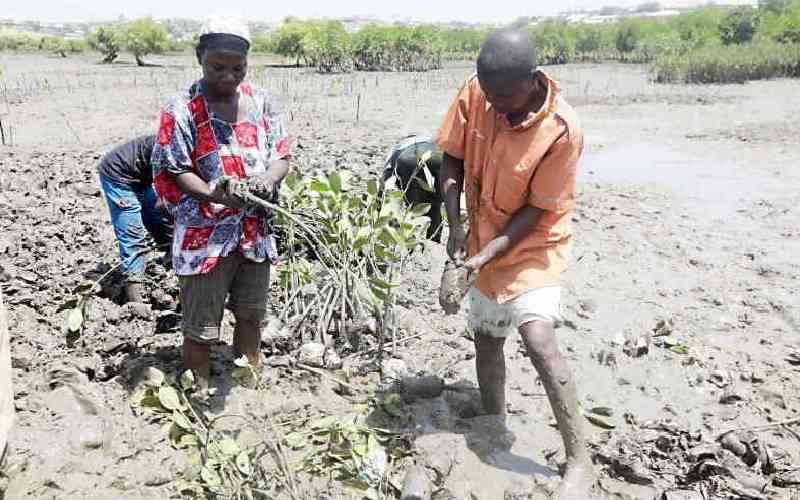
Residents plant mangroves at Tudor Creek in Mombasa. [File, Standard]
Environmental stakeholders and youth groups in Mombasa have intensified efforts to restore mangroves along Tudor Creek.
Through a large-scale tree planting initiative, the stakeholders say the effort would combat coastal degradation and create livelihoods for local communities.
The environmentalists face challenges where tree-growing is threatened by the effects of urbanisation.
Officials of a conservation group, Brain Youth Group, said they grapple with the theft of mangroves for construction and fuel, including firewood used to make chang'aa within the forest.
"The growing urbanisation has posed a challenge to conservation efforts because it has raised demand for mangrove products. Some even steal mangroves to use in brewing chang'aa," said project manager Mary Gona.
She said on Monday, the group, which was formed in 2011, recently introduced beekeeping within the mangrove forest to scare away tree poachers.
- Illegal logging, poverty fuel forest crime in Kenya
Keep Reading
"We have 70 beehives, and we use the bees to protect the forest and also sell the honey to boost our revenues as a group," she said.
She spoke when the community group, the Kenya Forest Service and a church-based organisation, Mother's Garden Project/We Love U Foundation, planted 1,000 mangrove seedlings in a campaign to protect the fragile coastal ecosystem.
Brain Youth Group secretary Eunice Kalewa noted that they have so far planted about 4.5 million mangroves in the area while also engaging in fish farming and beekeeping projects to support livelihoods.
Kalewa said that the restoration efforts have contributed to cleaner air, increased fish populations and employment opportunities for residents living around the creek.
She, however, cited illegal logging and lack of sponsors to purchase seedlings as some of the major challenges affecting the sustainability of the initiative.
“We prepare seedlings, but sometimes they overgrow before getting sponsors to support the planting. Some people also continue cutting mangroves despite our awareness campaigns,” she said.
Kalewa called on the government and partners to support youth groups by purchasing seedlings and creating employment opportunities to curb the destruction of mangrove forests.
International WeLoveU Foundation representative Given Molopiani said the initiative forms part of the organisation's global environmental protection programme dubbed the “Mother’s Garden Project".
Molopiani regretted that Tudor Creek has experienced severe environmental destruction caused by rapid urbanisation and illegal logging, exposing nearby communities to flooding and coastal erosion.
“This initiative is not only about planting trees but also about building a natural barrier to protect residents and creating a blue carbon reservoir that helps reduce climate change,” he said.
He said that the International WeLoveU Foundation, which operates in more than 90 countries, continues to partner with local communities in environmental conservation and humanitarian activities.
Meanwhile, Ms Gona urged young people across the country to embrace environmental conservation and income-generating activities instead of engaging in crime and drug abuse.
She said the group has empowered youth through tree nurseries and beekeeping projects that provide alternative sources of income.
“Youth should use their talents and skills to create opportunities for themselves instead of engaging in activities that destroy their future,” she said.
The stakeholders reaffirmed their commitment to continue restoring mangrove forests and sensitising communities on the importance of environmental conservation along the Kenyan coast.











 join
join