
 The Standard Group Plc is a multi-media organization with investments in media
platforms spanning newspaper print
operations, television, radio broadcasting, digital and online services. The
Standard Group is recognized as a
leading multi-media house in Kenya with a key influence in matters of national
and international interest.
The Standard Group Plc is a multi-media organization with investments in media
platforms spanning newspaper print
operations, television, radio broadcasting, digital and online services. The
Standard Group is recognized as a
leading multi-media house in Kenya with a key influence in matters of national
and international interest.

For an expectant mother facing complications during childbirth, the difference between life and death can sometimes come down to minutes—and whether the nearest health facility has the right equipment and skilled personnel.
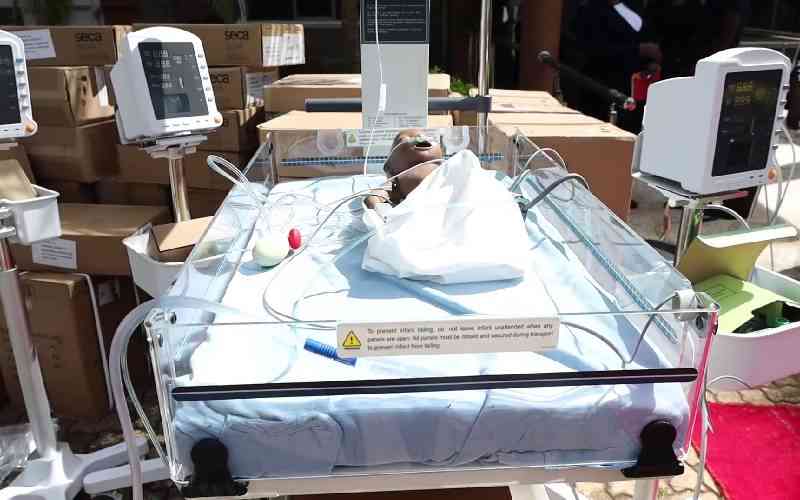
In Vihiga County, efforts to close that gap received a major boost after the county government received life-saving maternal, newborn and child health equipment worth Sh50 million through the Momentum Country and Global Leadership (MCGL) project.
The investment, supported through the partnership between the County Government of Vihiga and Jhpiego, is expected to strengthen reproductive, maternal, newborn and child health services and further reduce maternal, neonatal and under-five deaths.
The latest donation builds on years of collaboration that has focused not only on medical equipment but also on strengthening health workers, referral systems, health information and county structures.
The MCGL–county collaboration has supported newborn services at Vihiga Teaching and Referral Hospital, helped establish the Emuhaya Newborn Unit and trained approximately 1,700 health workers in maternal, newborn and child health.
It has also introduced evidence-based approaches for managing complications, including postpartum haemorrhage.
Governor Wilber Ottichilo said the partnership had helped bring quality maternal and newborn healthcare closer to residents while strengthening the county's ability to respond to emergencies.
- Beyond theatre: How digital tech is reshaping surgery and saving lives
- Death at birth: Makueni's new lifeline for mothers
- Busia unveils plan to cut maternal and newborn deaths
- New maternity unit brings healthcare closer to families in Gikomba
Keep Reading
“Our partnership has helped us bring quality maternal and newborn services closer to the people of Vihiga and strengthen our referral facilities,” the governor said.
He said investment in the health workforce would remain central to sustaining the gains.
“The most important investment is in our health workers. By strengthening their skills, we are strengthening the health system for the long term,” he said.
For the county government, the latest Sh50 million equipment investment is therefore more than a donation of machines and medical supplies.
It represents another layer in a broader system being built around mothers—from the community health worker who identifies a high-risk pregnancy to the nurse, midwife and doctor handling an emergency in a maternity ward.
“Our success has been built on County leadership and ownership,” Ottichilo said, adding that systems strengthened through the partnership must continue beyond the life of the project.
The new equipment comes as Vihiga intensifies efforts to make childbirth safer by taking services closer to communities. County officials say the average distance to the nearest health facility has fallen from three kilometres in 2022 to 2.3 kilometres in 2025, while the number of public health facilities increased from 54 in 2017 to 78 in 2025.
New facilities, including Kisatiru, Epang'a, Givigoi and Evojo, have been operationalised, while several others have been renovated to provide maternal services.
“Reducing the distance mothers travel to access healthcare has had a direct impact on maternal health outcomes because women are now able to seek antenatal services early and deliver under the care of skilled professionals,” Governor Ottichilo said.
The results are beginning to show. The proportion of births attended by skilled health workers rose from 72 per cent to 80 per cent, while more mothers are attending antenatal clinics as services become available closer to their homes.
The county has also invested in modern maternity facilities, expanded laboratory services, strengthened referral systems and increased community health outreach. According to county health officials, specialised newborn units have been established in three Level Four hospitals to care for premature and high-risk babies.
The partnership with MCGL has further strengthened this response through investment in maternal and newborn technologies, including Continuous Positive Airway Pressure (CPAP) machines, radiant warmers, phototherapy machines and oxygen equipment.
About 4,000 V-Drapes were also distributed to support the management of postpartum haemorrhage, while anthropometric equipment was supplied to health facilities.
Dr Allyson Bear, the President and Chief Executive Officer of Johns Hopkins Program for International Education in Gynecology and Obstetrics (Jhpiego), acknowledged the progress made in Vihiga's maternal, newborn and child healthcare programmes.
She described it as a product of the partnership between the county and Jhpiego through their MCGL project.
“We are encouraged by the progress Vihiga County has made in strengthening maternal, newborn and child health services. This is a testament to the strong partnership," said Dr Bear.
Another success story in Vihiga is seen before many expectant mothers reach a maternity ward, when their journey begins with a visit from a Community Health Promoter.
Across Vihiga, CHPs conduct household visits, encourage pregnant women to attend antenatal clinics, identify high-risk pregnancies and facilitate referrals to health facilities.
County officials say this community-level approach, combined with improved facilities and better-equipped health workers, is helping ensure that complications are detected early.
“The role of Community Health Promoters has been critical in ensuring pregnant women seek care early and complete their antenatal visits,” said Vihiga Health Executive Committee Member Dr Nicholas Kitungulu.
Globally, maternal mortality remains a major public health concern, with hundreds of women dying daily from preventable pregnancy and childbirth-related complications, particularly in low- and middle-income countries.
In Kenya, maternal mortality remains a significant challenge, making investments in skilled birth attendance, emergency obstetric care and newborn services critical.
Vihiga, however, has emerged among the counties making progress, having been ranked third among Kenya's 47 counties with the lowest risk of maternal mortality within healthcare facilities in 2025.
The county currently records 75 maternal deaths for every 100,000 live births, according to figures provided by county officials.
Chief Officer for Health Services Mary Anyiendah said the county's approach had gone beyond expanding the number of health facilities to ensuring that quality services were available at every level.
“We have strengthened healthcare systems, improved staffing, enhanced monitoring and expanded community health services to support maternal and newborn health,” said Dr Anyiendah.
She said the partnership had also strengthened the skills of healthcare workers through training and capacity-building programmes while contributing to efforts to reduce teenage pregnancies and maternal and child deaths.
MCGL Country Director Paul Nyachae said the progress recorded through the partnership had encouraged the programme to introduce the Healthy Births Initiative, which aims to further drive down maternal deaths.






 join
join