×

The Standard e-Paper
Stay Informed, Even Offline
 The Standard Group Plc is a
multi-media organization with investments in media platforms spanning newspaper
print operations, television, radio broadcasting, digital and online services. The
Standard Group is recognized as a leading multi-media house in Kenya with a key
influence in matters of national and international interest.

Audio By Vocalize
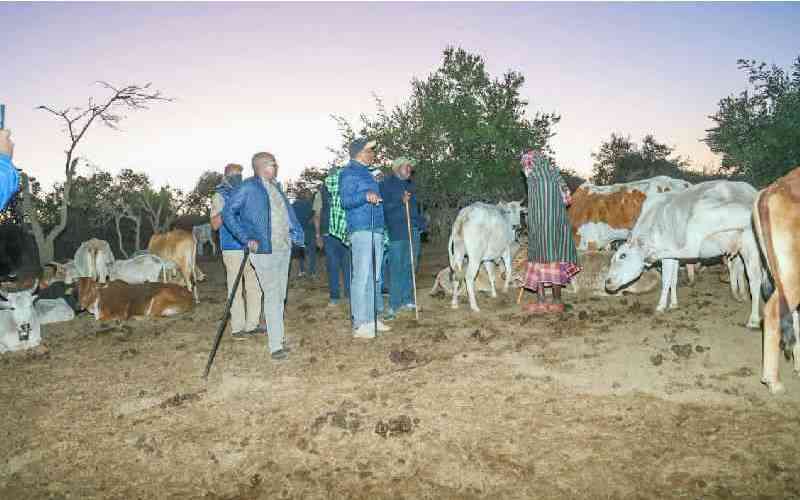
Samburu Governor Lati Lelelit visits families affected by bandit attacks in Lolmolog on October 3, 2026. [Michael Saitoti, Standard]
The National Assembly has moved to investigate persistent banditry and cattle rustling in Isiolo County following petitions seeking tougher security measures, livestock tracking and action against organised criminal networks.
The petitions have been committed to the Departmental Committee on Administration and Internal Security, which is expected to examine the security situation and consider a series of proposals aimed at tackling the problem.
Among the demands are the establishment of a permanent and adequately resourced rapid-response framework in affected areas, a comprehensive assessment of lives, livestock, homes and businesses lost through banditry, and the creation of a national system for livestock identification and traceability.
The petitioners are also seeking amendments to the Prevention of Terrorism Act, 2012, to classify organised armed banditry and commercialised cattle rustling as acts of terrorism.
They want Parliament to enact legislation establishing a Livestock Loss, Traceability, Compensation and Recovery Framework, including mechanisms for verifying losses, financing compensation, resolving inter-county disputes and supporting pastoralist communities affected by livestock theft.
The petitions further call for independent investigations and prosecution of public officers suspected of financing, facilitating or concealing banditry.
The parliamentary action follows growing pressure over insecurity in Isiolo and the wider northern region, including a demonstration and subsequent efforts to have the matter formally placed before Parliament.
Abdikadir Suleiman, who was involved in the mobilisation, said the October 7 demonstration was aimed at drawing national attention to the worsening security situation since locals were losing their livestock and families were affected by Insecurity.
“People were losing their livestock, families were being affected and insecurity was undermining livelihoods. The demonstration was meant to bring that reality into the national conversation and have Parliament take up the matter,” said Abdikadir.
Abdikadir said the mobilisation was followed by efforts to formalise the grievances through a petition to the National Assembly.
“We wanted the concerns raised by the communities to enter the parliamentary process, so that security, cattle rustling, recovery of stolen livestock and compensation for losses could be formally considered,” Suleiman said.
The petitions accuse existing security interventions of failing to adequately address the problem and argue that cattle rustling has evolved into an organised criminal enterprise with consequences extending beyond the theft of livestock.
Conveying the petitions to the House, Speaker Moses Wetang’ula said Isiolo had experienced recurrent armed attacks and livestock raids resulting in deaths and injuries, destruction of homes and infrastructure, displacement of families and closure of schools and health facilities.
Stay informed. Subscribe to our newsletter
“The economy of the county is predominantly anchored on pastoralism and consequently the theft of livestock has severely undermined the livelihoods and food security of the affected communities,” said Wetang’ula.
He said the petitioners had also raised concerns over the lack of a functional national livestock identification and traceability system, arguing that stolen animals could be moved to other counties and sold.
Wetang’ula said the nature of cattle rustling had changed considerably, with the petitioners describing it as “a commercialised and heavily armed criminal enterprise” that was causing livestock losses on a large scale across the Northern Frontier and North Rift regions.
The petitioners further argue that treating organised cattle rustling as ordinary stock theft or robbery allows financiers and organisers of criminal syndicates to evade the tougher measures available under the counter-terrorism legal framework.
They are therefore seeking changes to the law to classify organised armed banditry and commercialised cattle rustling as terrorism-related offences.
The Speaker also highlighted the petitioners' concern over compensation for families affected by attacks.
“They observe that there is presently no legal framework for the compensation of families who lose their next of kin to such attacks nor a structured programme for compensation,” said Wetang’ula.
The petitioners have invoked constitutional provisions on the right to petition Parliament, cooperation between the national and county governments and the principles of national security.
Wetang’ula said the petitioners had raised the matter with local administration and security agencies but that the interventions undertaken had not sufficiently resolved their concerns.
“The petitioners state that despite raising the matter with the local administration and security agencies, the interventions undertaken have not sufficiently resolved their concerns,” he said.
The petition seeks, among other measures, stronger security operations and a permanent rapid-response framework capable of responding to attacks in affected areas.
It also calls for an assessment of losses arising from banditry and the establishment of a national mechanism through which affected pastoralist communities could have livestock losses verified and addressed.
The demand for livestock traceability is particularly consequential for the pastoral economy, where animals can be moved across administrative boundaries after raids.
The petitioners argue that without an effective national identification system, recovering stolen livestock becomes difficult once the animals leave the area where they were taken.
They are also seeking a national financing mechanism and a pastoralist restocking and economic recovery fund, arguing that livestock losses have consequences beyond individual households and directly affect food security and the wider local economy.
The petition further seeks independent investigations into allegations that public officials may be financing, facilitating or concealing banditry; a demand that, if pursued, would extend the parliamentary inquiry beyond security operations to questions of accountability within the public sector.
Having determined that the issues raised fell within the authority of Parliament and were not pending before a court or another constitutional or legal body, Wetang’ula committed the petition to the Departmental Committee on Administration and Internal Security.
“I hereby commit the petition to the Departmental Committee on Administration and Internal Security for consideration,” said Wetang’ula.
The committee is required to consider the petition and report its findings to the House and the petitioners.
The parliamentary action places the security crisis in Isiolo within a formal legislative process, with the committee now expected to examine the concerns raised, assess the situation and make recommendations to the House.
The issues raised in the petitions also extend beyond Isiolo, touching on the wider security and pastoral economy of Kenya's northern frontier and North Rift, where livestock theft, armed raids and the movement of stolen animals across administrative boundaries have complicated efforts to contain insecurity.
For the affected communities, the next question is whether the parliamentary process will produce concrete measures on security, livestock identification, recovery of stolen animals, compensation and accountability; areas that have remained at the centre of complaints over insecurity in the region.
Subscribe to our newsletter and stay updated on the latest developments and special offers!


 Prefer the Standard on Google