×

The Standard e-Paper
Home To Bold Columnists
 The Standard Group Plc is a
multi-media organization with investments in media platforms spanning newspaper
print operations, television, radio broadcasting, digital and online services. The
Standard Group is recognized as a leading multi-media house in Kenya with a key
influence in matters of national and international interest.

Audio By Vocalize

Opposition leaders on Thursday walked out of a consultative meeting with the Independent Electoral and Boundaries Commission (IEBC), accusing the electoral body of failing to address fundamental concerns threatening the credibility of the August 2027 General Election.
Former Deputy President Rigathi Gachagua, Wiper Party leader Kalonzo Musyoka and Nairobi Senator Edwin Sifuna led the walkout after rejecting the agenda presented by IEBC Chairperson Erastus Ethekon, arguing that it failed to capture electoral reforms proposed by the opposition and concerns raised by Kenyans.
The leaders said they had attended the meeting in good faith but were disappointed that the commission had not incorporated issues they consider critical to ensuring free, fair and credible elections.
Speaking before the walkout, Gachagua accused the commission of ignoring repeated attempts by the opposition to secure formal engagement on electoral reforms.
“The People of Kenya have instructed us that there should be no decision, no discussion that should go on without their involvement. IEBC must know that election is about the people,” Gachagua said.
He cited a letter dated May 10, 2026, reminding Ethekon of an earlier agreement to establish a technical team that would engage the commission on the proposed reforms.
He also referenced another letter dated June 24, 2026, written by former Attorney General Justin Muturi on behalf of the United Opposition, which he said had similarly gone unanswered.
“We have on several occasions requested for engagement and clarification of issues that the people of Kenya wanted addressed ahead of 10th August 2027 polls, but IEBC has remained non-commital and unresponsive. This is mockery of democracy and freedoms that the people of Kenya have fought for,” he added.
He argued that proceeding with discussions without addressing the outstanding concerns would make the consultation meaningless.
"We feel that any discussion that does not include those issues given to us by the people of Kenya would not be meaningful and will not be useful to the country. Being treated to spin and public trickery by a commission that draws taxpayers money shall be resisted and it is unwarranted," he said.
Gachagua proposed that IEBC engage a technical team led by former Chief Justice David Maraga, appointed under the People’s Coalition on Electoral Reforms, to develop a comprehensive agenda before another high-level meeting is convened.
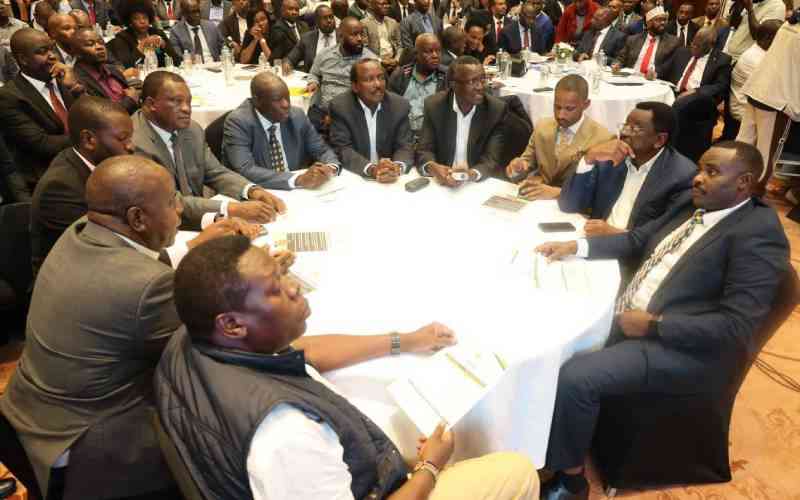
He maintained that the opposition was not opposed to dialogue but wanted meaningful consultations that would address the credibility of the electoral process.
"We are willing to work together because this is our country and we want an election that is believable and people believe in, and they must believe in the process," he said.
The walkout followed a strategy meeting by opposition leaders under the People’s Coalition on Electoral Reforms, where they agreed on four major demands they want IEBC to address before the next General Election.
Stay informed. Subscribe to our newsletter
Kalonzo said the opposition had expected the commission to demonstrate the same goodwill it had shown in attending the meeting.
"We came to the IEBC today in good faith, and we expected the same in return. Good faith is shown in deeds: an independent, impartial and prepared Commission. Today, we did not find it," he said.
He warned that the opposition would not participate in consultations that could legitimise what he termed a "bundled election".
The coalition is demanding a comprehensive cleanup of the voter register to eliminate duplicate entries, deceased voters and ineligible persons while ensuring all qualified Kenyans are registered.
It also wants the abolition of the national presidential tallying centre at Bomas of Kenya, proposing that presidential results declared at constituency tallying centres be final, with the national centre restricted to receiving, aggregating and announcing the results.
On diaspora voting, the opposition is pushing for electronic voting to enable Kenyans living abroad to participate more easily in elections.
It is also demanding livestreaming of voting, counting and announcement of results at polling stations and tallying centres to enhance transparency.
Gachagua has raised concerns over the expiry of the Smartmatic election technology contract on November 24, 2026, warning that the absence of a clear transition plan could disrupt continuous voter registration.
He argues that procuring and certifying a replacement system could take up to six months. The opposition has also demanded access to election servers and biometric systems before and after the polls, alongside enforcement of existing legal provisions on transmission and publication of polling station results.
The leaders have further called for engagement with the Registrar of Persons over alleged selective issuance of national identity cards, warning that delays could lock out eligible Kenyans from registering as voters.
Kalonzo insisted that the opposition wanted an electoral process in which every vote is counted at the polling station, verified openly and declared as cast, without manipulation or the inclusion of ineligible voters.
"Kenyans deserve their voices to be heard and every vote counted at the polling station, verified in the open and declared as cast. Not manufactured. Not padded with the names of people who are not on the voter roll," he said.
Subscribe to our newsletter and stay updated on the latest developments and special offers!


 Prefer the Standard on Google