
 The Standard Group Plc is a multi-media organization with investments in media
platforms spanning newspaper print
operations, television, radio broadcasting, digital and online services. The
Standard Group is recognized as a
leading multi-media house in Kenya with a key influence in matters of national
and international interest.
The Standard Group Plc is a multi-media organization with investments in media
platforms spanning newspaper print
operations, television, radio broadcasting, digital and online services. The
Standard Group is recognized as a
leading multi-media house in Kenya with a key influence in matters of national
and international interest.

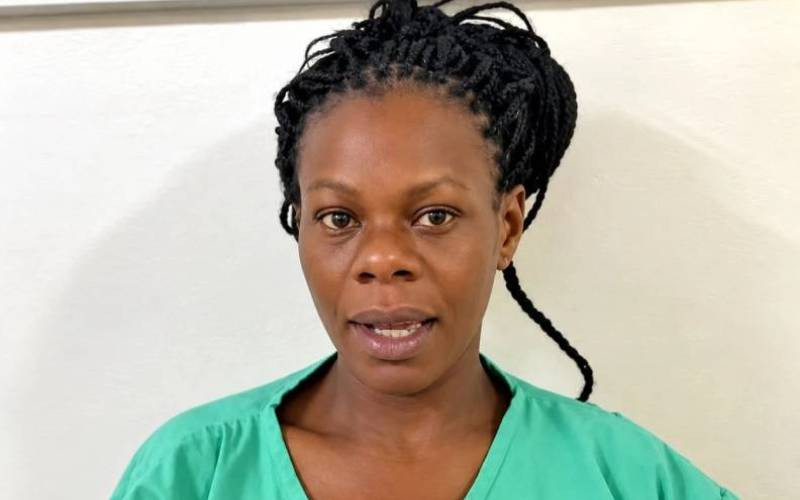
Mercy Kanini, 28 years old, from Juja, Kiambu County, gave birth to 5 children at Thika Level Five Hospital. [Gitau Wanyoike, Standard]
A family in Juja, Kiambu County, is mourning the deaths of four of five babies born prematurely in a rare quintuplet delivery after the newborns developed complications associated with extreme prematurity and very low birth weight.
The babies, born at Thika Level Five Hospital, were transferred to Kenyatta National Hospital (KNH), where they were admitted to the neonatal intensive care unit (NICU) for specialised care.
Four of the newborns have since died while receiving treatment at KNH, leaving one baby under care.
The deaths have highlighted the difficult fight for survival faced by babies born extremely prematurely, particularly those weighing less than one kilogramme.
The five babies, four girls and a boy, were born between 26 and 27 weeks of pregnancy and weighed 630, 715, 720, 800 and 660 grammes.
Neonatologist Dr Christine Manyasi said babies born at such an early stage of pregnancy face three major challenges: breathing, feeding and maintaining body temperature, with infections posing an additional serious threat.
- Why the referral system is choking major hospitals as patients suffer
- KNH perform haemorrhoids surgery
- KNH unveils new technology in treatment of haemorrhoids
- Why SHA wants hospitals not dispensing drugs punished
Keep Reading
“The three killers of preterm babies are breathing, feeding and infections,” Manyasi told The Standard.
At 26 or 27 weeks, the lungs of premature babies are not fully developed, making breathing one of their biggest challenges.
Some require surfactant, a medication administered into the lungs to help keep the air sacs open.
Relatively stable babies may be placed on continuous positive airway pressure (CPAP), which provides breathing support while allowing them to breathe on their own.
If a baby fails to respond to CPAP, mechanical ventilation may be necessary.
Manyasi said access to surfactant and mechanical ventilation remains limited outside specialised neonatal units, making referral necessary in some cases.
“At least two or three out of the five were looking for NICU because they needed ventilation and surfactant,” she said.
She noted, however, that not all five babies necessarily required the same level of respiratory support, with some potentially stable enough to remain on CPAP.
Feeding is another challenge for extremely premature babies because their digestive systems are not sufficiently developed.
Some may initially require nutrients delivered intravenously before they can gradually be introduced to breast milk through a feeding tube.
The babies must also be kept warm and protected from infections, which can rapidly become life-threatening in extremely premature newborns.
Manyasi said some of these interventions can be provided in county hospitals, but access to specialised equipment and medicines remains a challenge.
She said the babies' gestational age and weight are critical in determining their prospects.
“The smaller the baby, the lower the survival. The bigger ones have a better chance,” she said.
According to Manyasi, babies weighing 600 grammes or less have significantly lower survival prospects, with survival in some settings estimated at 25 per cent.
Those weighing between 700g and 800g generally have better prospects, while babies weighing around 1.2kg may have survival rates of between 70 and 80 per cent where appropriate neonatal care is available.
Gestational age is equally important, with babies born later in pregnancy generally having better chances of survival.
For extremely small newborns, even routine medical procedures can become difficult.
A baby weighing only a few hundred grammes may have a very small airway, making procedures such as administering surfactant challenging.
Inserting intravenous lines and managing breathing-support machines can also be difficult.
She said Kenya still faces challenges in providing the level of neonatal care available in countries with more advanced systems.
In the United Kingdom, for example, some babies weighing about 200 grammes have survived with intensive neonatal support.
In Kenya, the challenge remains significant even for babies weighing about one kilogramme.
“If a baby is very sick and very small, they are unlikely to survive,” Manyasi said.
However, she stressed that extremely low birth weight does not automatically mean a baby is critically ill.
“You can get a 500 grams baby who is stable, even breathing is okay, and even they do not get bleeding in the brain. It is rare, but you can get,” she said.
The specialist said the smaller the baby, the greater the likelihood of complications and the more difficult it becomes to perform life-saving interventions.
Manyasi said KNH has recorded cases of very small babies making it through intensive neonatal care, including a recent case involving a baby weighing 700 grammes who was eventually discharged.
“Yes, we have had babies surviving even at KNH. But not all of them survive. A fraction of them survive, despite all the care,” she said.
The tragedy came shortly after the family had celebrated what had initially appeared to be an unexpected blessing.
Mercy Kanini, 28, and her husband, Evans Mganga, had prepared to welcome four babies after scans during the pregnancy showed that Kanini was carrying quadruplets.
Instead, she delivered five babies through normal delivery at Thika Level Five Hospital.
“We had prepared ourselves for four babies because that is what the scans had shown us. Getting five was a big surprise,” Kanini said before the deaths.
Kanini said she first discovered she was carrying multiple babies during antenatal care at a private health facility. An ultrasound showed four babies.
She later developed complications and underwent another scan, which again indicated that she was carrying four babies.
Because of the high-risk pregnancy, Kanini was referred to KNH, where she attended two appointments. She was due for another review on October 9, but labour started earlier than expected.
She was initially taken to Mary Help of the Sick Mission Hospital in Thika, where she was assessed before being referred to Thika Level Five Hospital for specialised care and access to a larger newborn unit.
The couple arrived at the hospital at about 6 pm, with labour already advanced.
Doctors began preparing Kanini for a Caesarean section, but before the procedure could be performed, the first baby was delivered normally. The other four followed, also through normal delivery.
The couple already have two children, a first-born daughter and a son.
The family is now left to mourn four children while hoping for the recovery of the surviving baby.
The case has also renewed attention to the specialised care required by extremely premature babies and the limitations faced by facilities outside highly equipped neonatal referral units.







 join
join