
 The Standard Group Plc is a multi-media organization with investments in media
platforms spanning newspaper print
operations, television, radio broadcasting, digital and online services. The
Standard Group is recognized as a
leading multi-media house in Kenya with a key influence in matters of national
and international interest.
The Standard Group Plc is a multi-media organization with investments in media
platforms spanning newspaper print
operations, television, radio broadcasting, digital and online services. The
Standard Group is recognized as a
leading multi-media house in Kenya with a key influence in matters of national
and international interest.

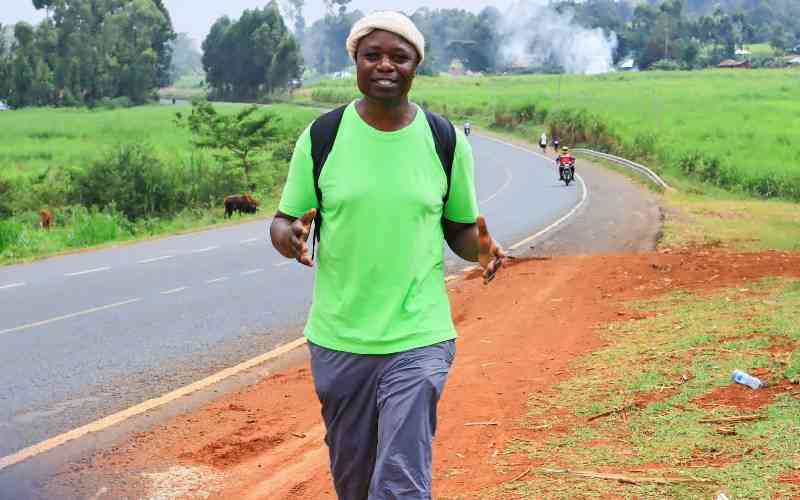
University lecturer Frederick Gori began an 18-day walk from Migori to Nairobi to raise awareness about mental health on August 18, 2026. [Rodgers Otiso, Standard]
For years, Frederick Gori lived with a pain he could not name. From as early as five years old, the communication specialist says he struggled with serious mental health challenges. Yet, for much of his childhood and adult life, he did not know that what he was experiencing had anything to do with mental health.
He simply thought there was something wrong with him. It was only about five years ago that Gori began to understand what he had been going through and accepted that he needed help. That realisation marked the beginning of a journey that has now taken him beyond his personal experience and into a national campaign to get Kenyans talking about mental health.
This week, Gori, a lecturer at Rongo University, began a long walk from Migori County to Nairobi, covering hundreds of kilometres across several counties to deliver petitions to county governments and push mental health higher on the public agenda.
But behind the walk is a deeply personal story. “I have personally dealt with mental health challenges for a long time, since I was about five years old. Even younger, I struggled with these challenges,” Gori says.
“For a long time, I didn't even know that I was struggling with mental health. I just thought something else was wrong with me.”
His first major experience manifested through sleep paralysis, a condition that became so frequent that going to bed itself became frightening.
- Break free from anxiety's grip: Face your fears and train your brain to feel calmer
- She fled trauma, now fights to save children living it
- One in four Kenyans likely to suffer mental health condition
- Experts call for more funding to tackle mental health crisis
Keep Reading
Sleep paralysis, which occurs when a person temporarily cannot move or speak while falling asleep or waking up, can be experienced occasionally by many people. But for Gori, it became a recurring nightmare.
“When sleep paralysis becomes a daily experience, then it becomes a nightmare to a point that you are even afraid of going to bed because you say, ‘Wow, that thing is going to happen to me again,’” he says.
The sleep problems were only part of his struggle and he later began experiencing anxiety attacks and depression.Depression, he says, is unlike the temporary sadness that may follow a difficult experience such as losing a loved one, losing a job or going through a personal crisis.
“When you're suffering from clinical depression, it's another thing altogether. Your world becomes grey, your world is dark. You lose interest in everything that most normal people enjoy. You feel pain,” he says.
A person living with depression may want companionship but at the same time struggle to interact with others. Relationships begin to suffer, careers can be disrupted and family members may not understand why their loved one has changed.
“You become a loner. No one wants to hang around a person with depression. So you find yourself alone. You want to be with people. You want to enjoy company, but at the same time, you can't find the company,” Gori says.
“It affects relationships. If you're a married person, your marriage might suffer. Your relationships with family members might suffer. It will affect your performance at work.”
Some people eventually leave jobs because they can no longer cope, while others are forced out by employers who may not understand what they are going through. “It affects careers. It affects relationships. It affects your overall health. It affects your entire life,” he says.
It is this reality that Gori now wants Kenyans to confront. His walk from Migori to Nairobi is not simply an endurance challenge. He wants it to become a national conversation about mental health, particularly the gaps that continue to leave many people without support.
Gori says the problem is even more complicated in rural areas, where mental health awareness remains low and traditional explanations can sometimes overshadow medical understanding.
“If, for instance, you are in a rural area and you have a mental health challenge, you may not even know that you have a mental health challenge. You might just imagine something else is wrong with you. Maybe demons are attacking me,” he says.
“If I go to church, I will be told to pray. I will be told to be filled with the Holy Spirit so that this bad feeling can go.”
He says this does not necessarily mean religious institutions or communities are deliberately ignoring mental health. Rather, the lack of awareness means many people may not recognise mental illness when they encounter it. “The community isn't aware. No one is aware. So if you have a mental health challenge, you are in a very big problem,” he says.
Then comes stigma and some mental health conditions attract such strong stigma that families would rather keep affected relatives away from public view than seek help for them.
Even when someone eventually decides to seek medical attention, Gori says, the health system can present another challenge.
A person seeking help at a county hospital may not find a psychiatrist, counselling psychologist or clinical psychologist. Instead, they may encounter a general practitioner who might refer them to a higher-level facility.
For someone living in a rural area and struggling financially, travelling to a specialised facility such as Mathari National Teaching and Referral Hospital in Nairobi may not be realistic. “And when I get there, where will I sleep? Where will I stay?” he asks.
The result, he says, is that many people continue dealing with their problems at home until the condition deteriorates to a point where it harms them or those around them. “I think we need to get the country talking. We need to get the nation talking about mental health, because silence is killing us,” he says.
He points to suicide as one of the most worrying consequences of untreated mental health challenges.
Among young people aged 15 to 29, suicide is among the leading causes of death globally, while in Kenya men account for a disproportionately large share of suicide deaths.
According to data from the World Health Organization and Kenya's Ministry of Health, about one in four people seeking healthcare in Kenya presents with a mental health condition. The country's mental disorder prevalence is estimated at 4.4 per cent, with depression, anxiety, post-traumatic stress disorder and substance use among the major conditions.
National data also shows that men account for nearly 80 per cent of suicide deaths in Kenya, with men significantly more likely than women to die by suicide.
The Kenya Red Cross has reported that 40 per cent of Kenyan men have never spoken to anyone about their mental health, highlighting the silence surrounding mental illness, particularly among men.
Gori wants to challenge that silence and he has chosen his home county, Migori, as the starting point of his journey. “I said, let me do a walk from Migori, which is my home county. I've made this place my home. I bought property here, and I said, okay, this now becomes my home,” he says.
From Migori, the journey will take him through Homa Bay, Kisii, Nyamira, Bomet and Narok before he reaches Nairobi. He will also pass through parts of Kajiado along the route, although he may not reach Kajiado town itself to present a petition.
At each county headquarters, Gori plans to present a petition to county leaders and his demands are based on the fact that health services are largely devolved, placing county governments at the centre of healthcare delivery.
One of his key proposals is the training of community health promoters in mental health first aid. Community health promoters are often the first point of contact for people seeking healthcare within their communities. Gori believes they can play a similar role in identifying mental health challenges early and guiding people towards appropriate care.
“I would like the counties to train these people on mental health challenges so that they can do what we call mental health first aid at the community level,” he says. "They can offer therapy and, where a case needs advanced care, they can advise them where to go and seek help.”
For Gori, mental health should be addressed within communities before problems become severe enough to require specialised institutional care. His second demand is for counties to employ at least one counselling psychologist or clinical psychologist in every Level Four hospital.
Such a move, he argues, would not only expand access to mental health services but also create employment opportunities for young professionals trained in psychology and counselling.
More importantly, patients presenting with mental health symptoms would have someone to turn to. “If a patient walks into a hospital presenting with what looks like mental health challenges, they have somebody who understands who they can go to, and they can be reviewed and advised on what to do next,” he says.
Gori also wants technology to be incorporated into mental healthcare. One of his proposals is for counties to establish toll-free mental health helplines where people experiencing anxiety, depression, burnout or emotional distress can speak to someone and receive guidance.
“If I am feeling a particular way and I can tell maybe I'm suffering burnout, maybe I'm depressed, maybe I've got anxiety, there's a number that I can call. There will be a person on the other side who will pick it and talk to me and advise me what to do next,” he says.
“That alone can save a lot of people from suicide because some people normally commit suicide because there's no one to talk to.”
The fourth proposal is the creation of mental health corners in Level Four hospitals. These would be quiet and safe spaces where people could sit, access information, relax and speak to someone about what they are experiencing.
He hopes to meet governors and county executive committee members responsible for health and personally present the petitions.
At Migori County Government, has met the director of public health after the county executive for health, who had initially agreed to meet him, became unavailable and he hopes that as he moves from one county to another, the conversation will rise beyond the local level.
“By the time I get to Nairobi, I hope that not just these seven county governments that I will pass through, but that the entire country will begin to think about mental health. Mental health will begin to have a conversation,” he says.
He wants Kenyans to understand that psychological suffering deserves the same seriousness as physical injury.
“Just as a person who has been injured on the football pitch is rushed to hospital, a person who is injured on the inside because of a mental health challenge also deserves to be treated the same way. Both are injuries,” he says.
Gori plans to begin each day's journey early, initially targeting about 20 kilometres a day before deciding to increase the distance in an effort to complete the walk within about two weeks. On the first day, he plans to cover about 40 kilometres from Migori towards Rongo but he insists that the journey will not be about pushing his body beyond its limits.
“If I am too exhausted, then the following day we can do 20 kilometres. Or if I am still feeling better, we can still do 40,” he says.
He has, however, spent about six months preparing for the challenge, walking roughly 20 kilometres regularly since February. “So the body is prepared for this. And I can't wait to start,” he says.
But beyond the kilometres, petitions and county headquarters, Gori wants ordinary Kenyans to become part of the campaign.











 join
join