×

The Standard e-Paper
Kenya’s Boldest Voice
 The Standard Group Plc is a
multi-media organization with investments in media platforms spanning newspaper
print operations, television, radio broadcasting, digital and online services. The
Standard Group is recognized as a leading multi-media house in Kenya with a key
influence in matters of national and international interest.

Audio By Vocalize
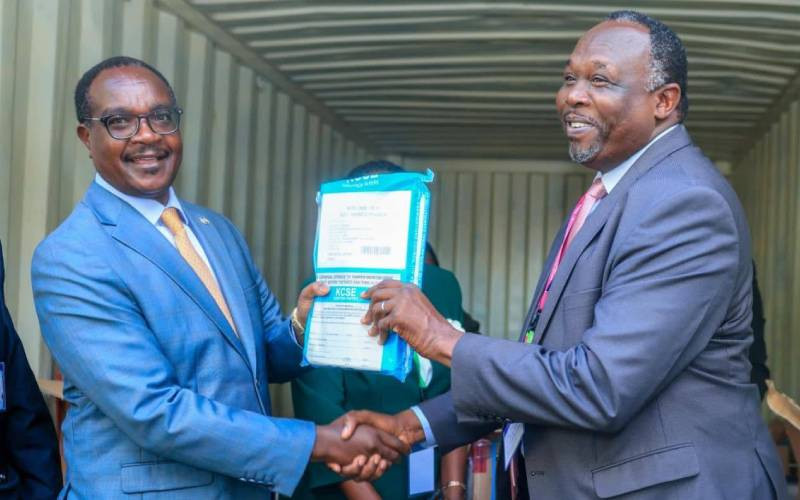
Education CS Julius Ogamba issue 2026 KCSE examination papers to school principal at Belgut Sub-County Deputy County Commissioner’s office in Kericho County on November 20, 2026. [MoE]
The Kenya National Examinations Council (KNEC) is heading into a financially turbulent year, with mounting pending bills, shrinking government allocations and an expanding candidate population.
This threatens to complicate the administration of national examinations in 2027, a year that will also see Kenya hold its General Election in August.
The council required Sh14.72 billion to administer this year's examinations and assessments but received an allocation of Sh9.9 billion, leaving a funding gap of Sh4.82 billion. With outstanding bills of Sh2.38 billion from the previous financial year, the council's financial shortfall rises to about Sh7.2 billion.
For 2027, Budget estimates presented to Parliament indicate that KNEC requires Sh14.6 billion to administer the KCSE, KPSEA, KJSEA and school-based assessments against an allocation of Sh9.9 billion, leaving a shortfall of approximately Sh4.7 billion.
Emuhaya MP Omboko Milemba warned that the financial constraints could undermine the council's ability to manage the country's examination calendar, particularly when it comes to paying examiners and other personnel involved in the exercise.
“The experience of examiners who participated in the previous examination cycle offers a glimpse of what could lie ahead. Some had to wait until August this year to receive their allowances, as an indication of the difficulties facing the council,” he said.
The delayed payments, he said, raise questions about whether KNEC will have sufficient resources to compensate examination personnel promptly in the coming cycle.
National Parents Association chairman Silas Obuhatsa warned that the situation could become particularly difficult as candidate numbers increase and the country approaches the election period.
"Starting the year with a deficit of Sh7.2 billion will make things messy, considering that last year examiners had to wait until August this year to be paid. With the number of candidates expected to swell next year, KNEC will have it rough administering the examinations," said Obuhatsa.
KNEC also faces an expanding workload arising from growing candidature and the implementation of Competency-Based Education (CBE), which requires assessments at different stages of learning.
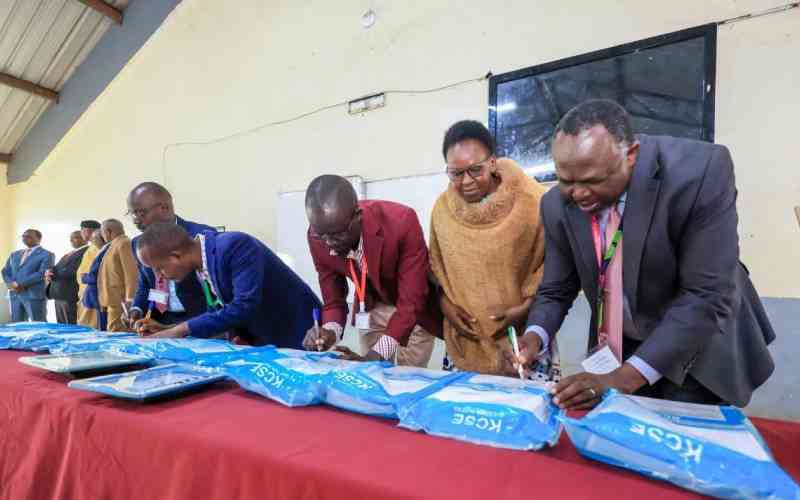
School principals sign for last 2026 KCSE Examination papers at Belgut Sub-County office on November 20, 2026. [MoE]
This year's KCSE attracted 1,048,355 candidates across more than 10,000 examination centres, representing a 5.27 per cent increase from the 995,860 candidates registered in 2025.
Education Cabinet Secretary Julius Ogamba described the milestone as historic, noting that the growing candidature reflected the increasing responsibility facing the education sector.
"This year's examination is historic. For the first time in the history of KCSE, more than one million candidates have been registered," said Ogamba.
Stay informed. Subscribe to our newsletter
The 2027 KCSE will also mark the final examination under the outgoing 8-4-4 education system, introduced in 1989.
KNEC Chief Executive Officer Dr David Njengere has urged former students who wish to complete secondary education or improve their grades to take advantage of the remaining examination opportunities.
"This is a critical moment. If you have unfinished business with KCSE, whether you started in 1989 or dropped out recently, you have next year to re-sit. After 2027, it will be extremely difficult," Njengere said.
Already KNEC has administered the KCSE Qualifying Test (QT) to 2,000 candidates specifically for prospective 2027 candidates who lack a KCPE certificate or hold foreign primary qualification.
“Candidates who dropped out of school, never completed secondary education or wish to improve their performance are being encouraged to take advantage of the remaining examination opportunities,” said Dr Njengere.
Behind the milestone, however, logistical challenges, including insecurity, difficult terrain and adverse weather, continue to increase the cost of administering examinations, despite investments in technology, decentralised storage facilities and examination security systems.
Stakeholders argue that the recurring funding crisis points to a deeper problem in the government's approach to financing national examinations.
Kenya Secondary Schools Heads Association chairman Willy Kuria called on the government to settle KNEC's outstanding obligations and increase allocations before the next examination cycle.
"The government should clear the debts owed to the council this year. Additionally, the funds allocated to KNEC to administer next year's examinations are inadequate. It will be messy," he warned.
Gitutu Masaba MP, Clive Gesairo said financial uncertainty could undermine an important national opportunity for thousands of candidates seeking to complete their education.
"National examinations are a predictable annual government responsibility and should not be subjected to recurrent budgetary uncertainty," he said.
Mugo Waiganjo, an economist, noted that the August 2027 General Election could introduce another layer of uncertainty into government financing, with competing demands on the National Treasury potentially affecting the release of funds to the examinations council.
“A possible presidential run-off would further increase the financial demands on the Treasury making it difficult for KNEC,” Waiganjo said.
He fears that these competing priorities could leave examination financing vulnerable, particularly if outstanding obligations are not settled before the next financial year.
“With the elections set for August, pending bills could spill into the next financial year beginning July 2027. In case the elections go into a second round, IEBC will knock on the doors of the Treasury for more funds, making it difficult for the council to be funded as a priority," he said.
Subscribe to our newsletter and stay updated on the latest developments and special offers!

 Prefer the Standard on Google