Please enable JavaScript to view advertisements.
×
App Icon
The Standard e-Paper
Stay Informed, Even Offline
★★★★ - on Play Store
Download App

How a basic anti-shock cloth saved mother on brink of death in Baringo

Vocalize Pre-Player Loader

Audio By Vocalize

Nurse Fredrick Kipsang sits with Mercy Chemenjo, months after helping save her life during a near-fatal childbirth complication. [Kipsang Joseph, Standard]

By mid-morning, Atiar Dispensary in Bartabwa Ward, Baringo North, is already stretched beyond capacity.

The maternity wing hums with activity. Women sit shoulder to shoulder on wooden benches, some cradling newborns wrapped in faded lesos, others shifting as labour builds steadily into pain. A child cries in one corner, while another sleeps despite the heat pressing in from outside.

Beyond the facility, more women continue to arrive on foot or on motorbikes from villages scattered across the vast landscape. For many, the journey is undertaken while already in labour.

Nurse Fredrick Kipsang sits with Mercy Chemenjo, months after helping save her life during a near-fatal childbirth complication. [Kipsang Joseph, Standard]

Inside, movement never stops. A nurse moves quickly around, checking, listening and making decisions. “You do not have the luxury of time here. You act. The numbers are slightly high today,” says Fredrick Kipsang, the nurse in charge.

He has worked here since 2020. In places like this, one nurse often carries the weight of an entire health system.

Overstretched facility

Officially, Atiar is a dispensary, but it functions beyond its designation. It is sometimes a maternity refuge, a stabilisation point, and even the only barrier between life and death for mothers arriving from kilometres away.

Among the women seated under a tree is Mercy Chemenjo, a survivor of a near-fatal childbirth experience that unfolded here almost a year ago.

Her memory of that day remains vivid.

On April 21, she left her home in Kapkurungwo village before dawn, already in labour. She walked through the darkness towards the facility and by mid-morning had delivered safely — a healthy baby boy, her fifth child. “I did not have any problem during pregnancy. Even that day, I came early and delivered very well,” she recalls.

For a brief moment, there was relief. Mother and child were safe. Then everything changed; she began bleeding.

“At first, the nurse told me there was a problem. He attended to me, but the bleeding continued,” she says.

Inside the maternity room, the atmosphere shifted instantly. Voices lowered, movement sharpened, and routine turned into urgency. “When you are in such a facility, it is important to always be prepared because complications can occur after delivery and they can be fatal,” says Kipsang.

Mercy had developed postpartum haemorrhage, one of the leading causes of maternal deaths when not treated quickly. Her condition deteriorated rapidly. “I started feeling weak, like my strength was leaving me,” she says.

Kipsang moved quickly, administering medication, monitoring her condition and calling for an ambulance.

In rural Baringo North, help does not arrive instantly. Distances stretch time, poor roads delay response, and network failures disrupt communication.

As her condition worsened, the facility turned into an emergency unit operating under pressure.

Then came a simple but critical intervention: a non-pneumatic anti-shock garment (NASG), wrapped tightly around her lower body to slow blood loss. “Most mothers who develop this condition lose a lot of blood if not managed quickly. Many do not survive. I used the NASG to prevent severe blood loss,” says Kipsang.

Life saved

Later, Mercy would only remember it as that tight cloth. “They tightened it around my body. It was very tight. I even told them not to press near my chest because I felt like my heart was being squeezed,” she says.

It was not about comfort; it was survival. The facility has no theatre, no blood bank and no specialised obstetric team, only a nurse.

The ambulance eventually arrived nearly an hour later. “That wait is normal here,” Kipsang says quietly.

Mercy was transferred to Kabarnet County Hospital via Kipsaraman Health Centre. Along the way, she lost consciousness. “I do not remember what happened. I woke up the next day,” she says.

By the time she reached Kabarnet, she had lost a significant amount of blood and was rushed into theatre. Her survival was uncertain. “They told me I had lost a lot of blood. Even the doctors said I was lucky,” she says.

When she regained consciousness, her baby was not beside her. “They had separated me from the baby so they could attend to me,” she says. Later, mother and child were reunited, and she could not hide her joy.

“I was very happy to see my baby again. If it were not for Kipsang, I would not be alive today,” she says.

Kipsang has seen this pattern repeatedly. In 2022, he received emergency maternal and neonatal care training through Dandelion Africa. The training introduced structured response techniques and a key lifesaving tool: the non-pneumatic anti-shock garment (NASG), used to stabilise women experiencing severe blood loss. “The training helped me a lot. Before, managing such cases was very difficult,” he says.

But training alone is not enough. On average, Atiar manages 25-45 deliveries per month, yet it remains critically under-equipped. “We are not upgraded. We cannot manage complicated cases fully,” says Kipsang.

At times, multiple emergencies occur simultaneously, forcing difficult decisions.

“Many mothers have low blood levels. Some come with haemoglobin as low as 8,” he explains.

Across Baringo County, survival is uneven.

According to the Kenya Health Information System (KHIS 2025), skilled birth attendance stands at 60 per cent, but this masks stark disparities.

In Koibatek (82.73 per cent) and Baringo Central (85.94 per cent), most women deliver under skilled care due to better infrastructure and proximity to higher-level facilities.

But in Baringo North (33.37 per cent) and Tiaty West (33.52 per cent), most deliveries occur outside skilled supervision. In these areas, risk is not occasional — it is structural.

Tiaty East records only 37.1 per cent skilled birth attendance.

Even within the same county, geography determines survival.

Maternal mortality still rises in some areas, reaching as high as 132.71 per 100,000 live births in Marigat, showing that access alone does not guarantee safety.

The challenge begins long before delivery. Only 49 per cent of women in Baringo complete the recommended four antenatal care visits, according to the KDHS 2022. This means many pregnancies are not fully monitored, and complications can emerge unexpectedly during labour.

“When a mother is already weak, even normal bleeding becomes dangerous,” says Kipsang.

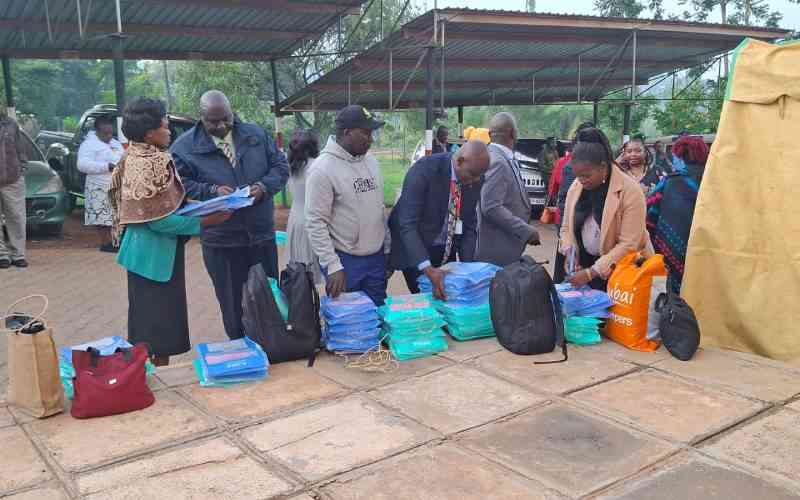
Efforts are underway to strengthen response capacity. More than 280 healthcare workers in Baringo have been trained in emergency obstetric care by Dandelion Africa. Facilities have also received NASG kits to stabilise patients before referral.

“These tools help bridge critical gaps, but distance, staffing and infrastructure still determine outcomes,” says Harun Karanja of Dandelion Africa. “In the last quarter of 2025, Baringo recorded fewer maternal deaths.”

Eased pressure

Recently, through the Social Health Authority (SHA) reimbursement funds, Atiar has added a nurse and a watchman, easing pressure on the overstretched facility.

But it remains classified as a dispensary and does not receive full maternal health reimbursements. “We do deliveries, but as a dispensary, we are not fully covered for maternity under SHA. That gap affects how we run services,” says Anderson Kebut, the facility chairman.

Cultural shifts are also beginning to emerge. Cosmas Kimalit sits beside his wife, Joan. “I decided to accompany her. At first, it was not easy. Culturally, men are not supposed to accompany their wives during delivery. Even carrying her handbag is not acceptable. But the world is changing, and we must change too,” he says.

He began accompanying her from five months into the pregnancy, encouraged by Kipsang. He even stood inside the delivery room. “In fact, I held the baby before the nurse,” says Kimalit.

Joan says it changed everything. “I felt supported and loved. He helps me even at home,” she says.

Kipsang encourages this shift. “When men understand what women go through, they support them better,” he says.

Mercy now returns to the facility for routine child health visits. She sits quietly holding her baby in the same room that once carried panic, now calm. “I will not have another baby now due to my condition. If I had delivered at home, I would not be here,” she says.

Her story reflects a wider truth across rural Baringo: survival is often determined not by certainty, but by speed, distance and fragile interventions.

Atiar Dispensary remains a critical lifeline. Many mothers leave smiling. Others come dangerously close to not leaving at all. Kipsang remains always on the move, steady and alert.

Support Independent Journalism

Stand With Bold Journalism.
Stand With The Standard.

Journalism can't be free because the truth demands investment. At The Standard, we invest time, courage and skills to bring you accurate, factual and impactful stories. Subscribe today and stand with us in the pursuit of credible journalism.

Pay via
M - PESA
VISA
Airtel Money
Secure Payment Kenya's most trusted newsroom since 1902

Follow The Standard on Google News