The Standard Group Plc is a multi-media organization with investments in media
platforms spanning newspaper print
operations, television, radio broadcasting, digital and online services. The
Standard Group is recognized as a
leading multi-media house in Kenya with a key influence in matters of national and
international interest.

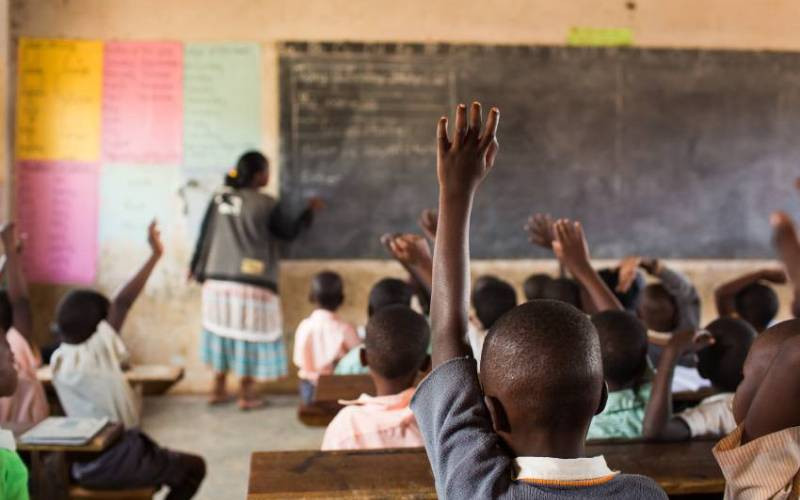
Refugee teachers face low pay, overcrowded classrooms and insecure contracts despite their dedication to learners. [Courtesy]
More than eight in every 10 teachers working in Kenya’s refugee camp schools earn Sh9,000 or less a month, despite shouldering the responsibility of educating children whose lives have been shaped by displacement, violence and interrupted schooling, while their counterparts in public schools serving host communities are more likely to enjoy permanent employment, higher pay and clearer career paths.
Yet the most striking finding in a new study is that teachers remain deeply committed to their work despite conditions threatening their well-being and potentially pushing them out of the profession.
The African Population and Health Research Centre (APHRC) found that more than 90 per cent of teachers in refugee camps and host communities reported strong professional motivation, engagement and a sense of purpose.
However, the overall Teacher Well-being Index stood at 59.2 out of 100, exposing a gap between teachers’ commitment and the conditions under which they work.
“Motivation does not equal well-being. These are two different things,” said Lydia Namatende-Sakwa, an APHRC researcher involved in the study, warning against assuming that teachers who continue teaching are necessarily coping well.
The research, based on a survey of 927 teachers and qualitative interviews and discussions with 105 participants in Garissa and Turkana counties, documents disparities in pay, employment security, professional recognition and working conditions.
Sakwa said teachers could remain in the profession because of their commitment to learners while still considering leaving if better opportunities arose.
“If I find something else, I’ll just go. I’ll just stay for the sake of it,” she recalled teachers saying during the research.
For Patricia Kita, an APHRC research scientist working in the organisation’s Adolescent and Child Development unit, supporting teachers is essential to improving children’s educational and psychosocial outcomes.
“It’s very important for teachers to be in a good state of mental well-being because they are the ones who support our young children,” she said.
The demands in refugee camp schools are immense. The study found that 51.6 per cent of classrooms in refugee camps had more than 80 learners, compared with 13.8 per cent in public host-community schools. Researchers also heard accounts of classrooms holding as many as 200 learners.
Teachers must manage children of different ages, languages and educational levels, some of whom have experienced conflict, displacement and family separation. Namatende-Sakwa said researchers encountered classrooms where teachers were expected to work with learners speaking as many as 18 different languages.
Kita said teachers also struggled with inadequate learning materials, poor sanitation and heavy workloads. In some schools, teachers share toilet facilities with pupils, while female educators lack dedicated spaces to change or attend to personal needs.
Dorcas Tindi Ayo, a refugee teacher in Kakuma, confirmed that overcrowding undermines lesson preparation and delivery.
“In a refugee set-up, you are having more than 200 learners in one class,” she said, describing classrooms where there may not be enough space for desks.
Teachers also face insecurity on their journeys to school. While some Teachers Service Commission (TSC)-registered teachers receive transport assistance, refugee teachers may have to walk through areas where they risk attacks and gender-based violence.
Ayo said women face additional pressures from inadequate maternity protection, short contracts and family responsibilities. Insecure employment can leave them uncertain about their income when they become pregnant or need time away from work.
The disparity is reflected in salaries. The APHRC study found that 86.7 per cent of teachers in refugee camp schools earned Sh9,000 or less monthly, compared with 71.4 per cent of public host-community teachers who earned at least Sh30,000. Only 5.1 per cent of camp-school teachers earned Sh30,000 or more.
Only 5.6 per cent of refugee camp-school teachers said their salaries were sufficient to meet basic needs. Even among teachers in public host-community schools, the proportion was just 15.3 per cent. Across both groups, 80.4 per cent were dissatisfied or very dissatisfied with their pay.
Employment security is another fault line. While 87.6 per cent of teachers in public host-community schools had permanent contracts, 92.3 per cent of those in refugee camp schools were employed on one-year contracts. Nearly all camp-school teachers, 98.8 per cent, worked for non-governmental organisations, while 93.8 per cent of teachers in host-community public schools were employed by the government.
Joseph Mutua, a senior programme officer at the Lutheran World Federation (LWF), which implements refugee education programmes, said camp schools depended heavily on humanitarian and development partners for staffing, learning materials and other essential services.
“The majority of education is funded through donors. It’s not funded through the Government of Kenya,” he said.
Mutua estimated that close to 140,000 learners were enrolled in about 62 schools across Dadaab and Kakuma. He said donor funding reductions had put additional pressure on programmes already struggling to meet demand. Since learners do not pay school fees, education provision relies heavily on continued support from humanitarian and development partners.
Professional recognition remains another obstacle. The APHRC study found that only 31.6 per cent of teachers in refugee camp schools had teaching qualifications, compared with 91 per cent in public host-community schools. None of the refugee teachers included in the study was registered with the TSC, compared with more than 95 per cent of Kenyan citizen teachers.
Sakwa said refugee status and documentation requirements prevent many teachers from accessing the same professional pathways as their counterparts. Without TSC registration, teachers can miss out on professional development, better pay, longer contracts and social protections.
Mutua noted that some refugee teachers had studied in Kenya or taught for years but still faced barriers related to identity documents and recognition of qualifications acquired in their countries of origin. He called for pathways to assess prior training, bridge gaps where necessary and recognise qualifications.
Abas Abdullahi Abdi, a refugee teacher born in Dadaab who has taught for about 15 years, is pursuing a Diploma in Teacher Education at Garissa Teacher Training College. He earns Sh13,000 monthly as a trainee, which he said is insufficient to support his family and assist his parents.
Abdi welcomed the training initiative, saying recognised qualifications could improve teachers’ prospects and allow them to work alongside other teachers under more equitable terms. He said some classes had about 100 learners with only one teacher, while language differences and the effects of conflict presented further challenges.
The government says it is addressing some of these barriers through the Shirika Plan, which seeks to integrate refugees into Kenya’s national systems.
Dr Gishuhe Degwa, the Director of Education and head of the Directorate of Policy, Partnerships and Institutional Community Affairs, said the government was working with education stakeholders to improve conditions and integrate refugee teachers.
He said education bills before Parliament could provide a legal framework for inclusion, while plans to enable refugee teachers to obtain TSC registration numbers were at an advanced stage.
Degwa said refugee teachers were already enrolled in in-service training at Garissa Teacher Training College and Bishop Mahon Teacher Training College to acquire the skills and certification required for professional recognition.
“Once the education bill in the House is passed, we’ll also address that,” he said.
Mutua said education partners were also working with government agencies on school registration, teacher training and teacher deployment. He cited the deployment of 10 TSC teachers to schools in Dadaab and an assessment in Dadaab and Kakuma to facilitate registration of additional schools.
However, teachers say challenges extend beyond pay and qualifications. Evelyn Nyechama, a Kenyan teacher at Garissa Primary School, said overcrowded classrooms make it difficult to deliver lessons under the Competency-Based Education curriculum, which requires greater learner participation and appropriate learning resources.
She also raised concerns about unreliable school feeding programmes, saying hunger contributed to absenteeism and dropouts. Flooding during heavy rains further disrupted access to schools for teachers and learners.
The APHRC report recommends stronger professional development, more secure employment, improved school environments and better access to mental health support. It also calls for refugee-serving schools to be better integrated into national education structures, with clear pathways for teacher qualification and recognition.
The study’s fieldwork was conducted in September and October 2025. While government officials and education partners point to ongoing training and integration initiatives, the pace of reforms and the extent to which they will address salary disparities, insecure contracts and inadequate social protection remain key questions.
Kenya’s refugee education response depends on more than ensuring teachers report to class. It requires a system that allows them to earn a living, work safely, access professional development and support vulnerable children without sacrificing their own well-being.
The teachers’ motivation is already there. The question is whether government and education partners will match that commitment with the resources, recognition and protections needed to sustain it.