×

The Standard e-Paper
Fearless, Trusted News
 The Standard Group Plc is a
multi-media organization with investments in media platforms spanning newspaper
print operations, television, radio broadcasting, digital and online services. The
Standard Group is recognized as a leading multi-media house in Kenya with a key
influence in matters of national and international interest.
The Standard Group Plc is a
multi-media organization with investments in media platforms spanning newspaper
print operations, television, radio broadcasting, digital and online services. The
Standard Group is recognized as a leading multi-media house in Kenya with a key
influence in matters of national and international interest.

Audio By Vocalize
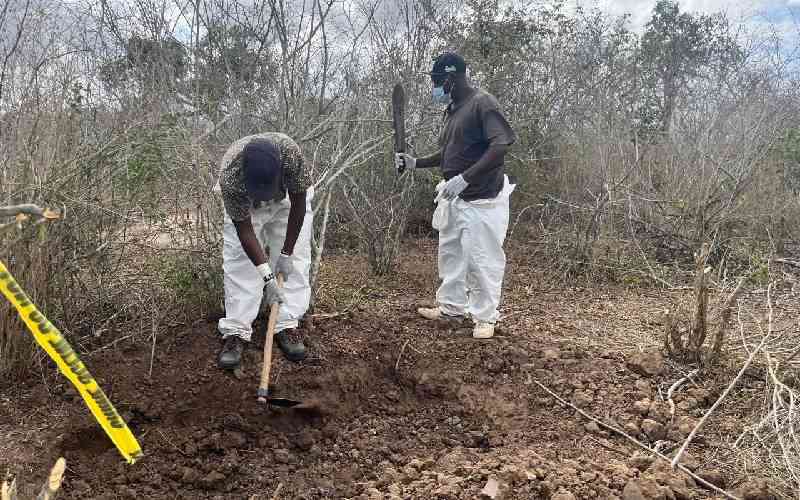
A witness has told Mombasa Senior Principal Magistrate Eric Wambo that victims of the Kwa Binzaro massacre were buried in a manner that sharply departed from the long-established burial traditions of Kilifi residents.
Chakama Location Chief Raymond Charo said that although the burials bore some similarities to those of the local community, mainly the Giriama sub-group of the Mijikenda, they differed significantly from the community’s customs.
The chief said he witnessed the exhumation exercise and observed that several bodies had been buried naked, without coffins, in shallow graves, a practice he described as completely inconsistent with Giriama traditions.
Charo further told the court that, according to Giriama customs, burials are conducted during the day, accompanied by prayers, with rites varying according to the deceased’s gender. The dead are also buried in coffins. “The graves were less than six feet deep. Although the locals are predominantly Giriama, the burials I witnessed did not conform to any burial practices recognised within the community,” Charo told the court.
He added that he was aware police had recovered additional human remains and body parts from the area before carrying out extensive exhumations.
The chief further told the court that the burials at Kwa Binzaro closely resembled those uncovered during investigations into the Shakahola massacre. Kwa Binzaro is about 30 kilometres from Shakahola.
Controversial pastor Paul Makenzi, Shallyne Temba, Kahindi Garama, Tom Mkonwe, Julius Luwali and Johnson Richard are facing 29 counts of manslaughter over the deaths of 29 people at Kwa Binzaro.
They have denied the charges. The prosecution alleges that Makenzi, who is also the principal suspect in the Shakahola massacre, orchestrated the Kwa Binzaro deaths. More than 450 people died in the Shakahola tragedy after allegedly starving themselves to death.
Police Constable Isaiah Barasa of Langobaya Police Station told the court that officers responded swiftly after receiving reports that followers at Temba’s homestead had been radicalised into starving themselves.
Meanwhile, another witness recounted how his father forced him to leave his job because of his religious beliefs.
Appearing virtually, Japheth Lennox told the court that his family first encountered Makenzi’s teachings through Times TV while living in Migori County.
He said the sermons warned followers against receiving the “mark of the beast”, discouraged them from seeking medical treatment by teaching that illnesses should only be healed through prayer, and portrayed formal education as part of a corrupt worldly system. “In 2021, my father, Seth, a prison officer, resigned from the Kenya Prisons Service after embracing the teachings, believing that he could not serve both the beast and the Lord. My father later invited me to relocate to Shakahola with the family, but I declined because I felt I was too young,” Lennox told the court.
He further testified that in March 2025, while he was in Homa Bay, his parents informed him they were relocating to Kisii.
Stay informed. Subscribe to our newsletter
However, when he tried to contact his father the following month, the phone was switched off.
Lennox said that in June 2025, he received an anonymous phone call from a person with a coastal accent, who informed him that his parents and siblings had died.
He told the court that he has neither seen nor heard from his family since then.
Subscribe to our newsletter and stay updated on the latest developments and special offers!


 Prefer the Standard on Google




 join
join