×

The Standard e-Paper
Join Thousands Daily
 The Standard Group Plc is a
multi-media organization with investments in media platforms spanning newspaper
print operations, television, radio broadcasting, digital and online services. The
Standard Group is recognized as a leading multi-media house in Kenya with a key
influence in matters of national and international interest.
The Standard Group Plc is a
multi-media organization with investments in media platforms spanning newspaper
print operations, television, radio broadcasting, digital and online services. The
Standard Group is recognized as a leading multi-media house in Kenya with a key
influence in matters of national and international interest.

Audio By Vocalize
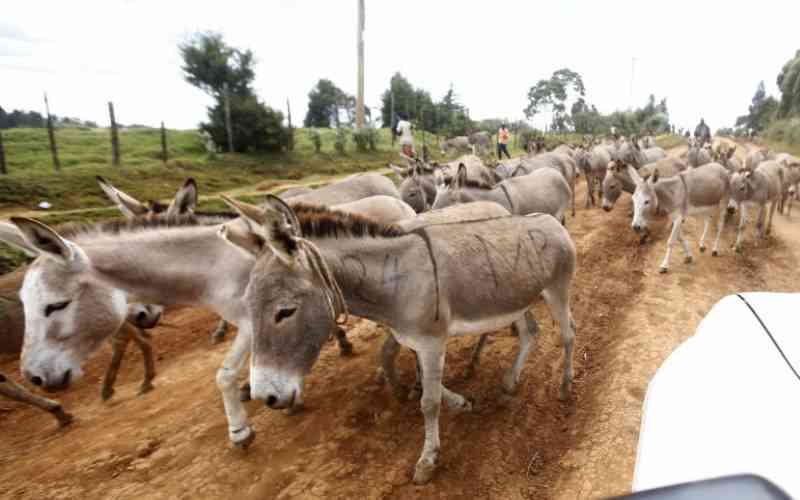
Thirty donkeys have been rescued from a godown in Juja, Kiambu County, where authorities suspect the animals were being slaughtered and their meat supplied to unsuspecting consumers.
The animals, including two young donkeys, were found at the premises along Juja Farm Road during an operation led by Kiambu County Executive Committee Member for Environment David Kuria in collaboration with police officers from Juja.
The discovery followed complaints by residents over the dumping of donkey and pig carcasses in residential areas of Juja, raising concerns that the remains could be linked to an organised slaughter operation.
A week ago, residents of Tola Estate blocked the Ndarugu-Mang'u road with rotting animal carcasses in protest, saying they had endured a foul smell and feared the remains posed a serious public health risk.
The residents said the carcasses had been dumped in an area that was not designated as a dumpsite and accused authorities of failing to act despite repeated complaints.
During Wednesday's operation, officers gained access to the godown and found 30 live donkeys, two young ones, as well as knives, animal hooves, intestines and skins, which authorities said pointed to an active slaughter operation.
Juja Deputy County Commissioner Daniel Ndege said preliminary investigations indicated that the slaughtering was allegedly carried out at night, with the operators taking advantage of the premises being closed during the day.
“Some officers from the county government discovered and gained access to the godown and found what you have seen: 30 donkeys, including two young ones,” Ndege said.
He said the discovery could explain the source of some of the carcasses that had been dumped along roads and in residential areas in Juja.
“We had cases of carcasses being dumped along the roads in Juja without knowing where they came from. We now suspect this could be one of the places where the animals were slaughtered,” he said.
The DCC said investigators suspected the donkey meat was being transported to Nairobi, with Palma Market among the possible destinations, although this had yet to be established conclusively.
He said investigations would begin with the owner of the premises and other people linked to the operation.
“We will start with the owner of the premises. That is the start of our investigations. Once the investigations are complete, we will inform members of the public,” he said.
The authorities also suspect the godown could be part of a wider network, with the DCC saying investigations would seek to establish where the animals were sourced and whether other similar slaughter points existed in the area.
Stay informed. Subscribe to our newsletter
CEC Kuria described the operation as a breakthrough, saying the nature of the premises and the number of animals involved pointed to an organised operation rather than an isolated incident.
“If you look at this godown, this is not something done by a local person. It is a very organised crime,” Kuria said.
He appealed to traders and members of the public dealing in meat to exercise caution and establish the source of meat before buying or selling it.
Kuria said some of the donkeys found at the premises appeared to be sick, raising concerns over the potential health risks posed by meat from diseased animals.
“You can see about four or five donkeys that are sick. We do not know what will happen if you consume meat from an animal which is sick,” he said.
The CEC said authorities were also investigating where the animals originated, noting that some appeared to have been transported from outside the region.
Residents had earlier raised similar concerns, with Stanley Mwangi saying they were shocked that animal remains were being dumped in a residential area.
He said the carcasses had attracted hyenas, stray dogs and crows, worsening the health and sanitation concerns.
“We do not know where the donkeys are brought from, but we suspect some could be coming from the Mwea area in Kirinyaga County, where there have been concerns over theft of donkeys,” Mwangi said.
Lilian Wanjiru said children were particularly vulnerable to health risks posed by the decomposing remains, warning that the situation could worsen during the rainy season. She said the rotting sludge could be washed into homes and a nearby river.
Another resident, Simon Chege, said the dumping had persisted for more than two months despite repeated reports to authorities.
The county government and police have now launched investigations to establish the owners of the premises, the source of the animals and the suspected market for the meat.
Authorities said those found involved in the illegal slaughter and distribution of the meat would face the law.
Subscribe to our newsletter and stay updated on the latest developments and special offers!


 Prefer the Standard on Google








 join
join