×

The Standard e-Paper
Smart Minds Choose Us
 The Standard Group Plc is a
multi-media organization with investments in media platforms spanning newspaper
print operations, television, radio broadcasting, digital and online services. The
Standard Group is recognized as a leading multi-media house in Kenya with a key
influence in matters of national and international interest.
The Standard Group Plc is a
multi-media organization with investments in media platforms spanning newspaper
print operations, television, radio broadcasting, digital and online services. The
Standard Group is recognized as a leading multi-media house in Kenya with a key
influence in matters of national and international interest.

Audio By Vocalize
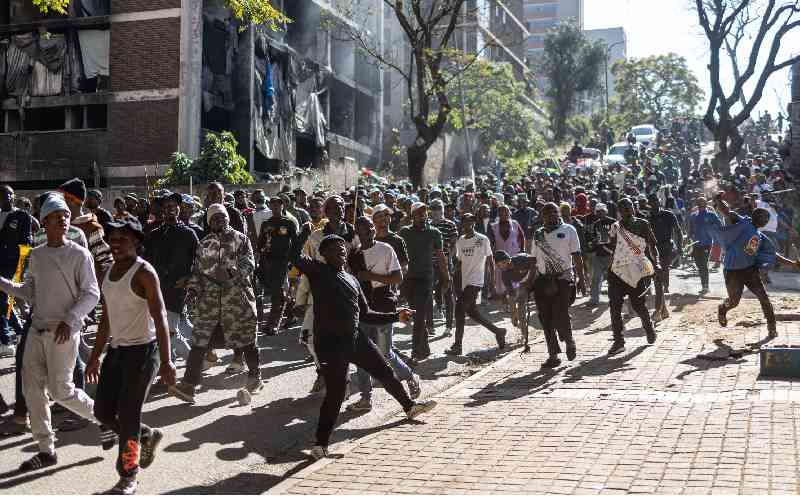
Protesters march during a demonstration by the "March and March" and Operation Dudula movements marking an unofficial deadline for undocumented foreign nationals to leave South Africa, in Johannesburg, on June 30, 2026. [AFP]
The chant carries a rhythm you could almost dance to, if you didn't understand what it meant. Abahambe... abahambe... bazo hamba. They must go. They will go. I heard it outside a police station in Hillbrow on the last Tuesday of June, sung by a crowd wrapped in MK Party colours, Jacob Zuma's face printed on their chests, private security men with rifles slung across their shoulders standing thicker on the ground than the police themselves. Somewhere in that crowd was the answer to a question every African migrant in this country now asks before leaving the house each morning: am I safe today, or am I the reason someone else feels unsafe?
By then, South Africa was already in its deadliest wave of xenophobic violence since 2008. Two movements—March and March, founded by Jecinter Ngobese-Zuma, and Operation Dudula—had spent months building toward June 30, the deadline they set for every undocumented foreigner to leave, or, as one Malawian gardener was warned, "leave in a coffin." He was not exaggerating: researchers now count at least 148 migrants killed since 2022, making 2026 the deadliest year on record. This is not spontaneous mob fury. It has organisers, deadlines, and a name for every target: makwerekwere—an onomatopoeic insult mimicking the sound of African languages that the hearer refuses to understand as human speech, reducing an entire continent into unintelligible noise.
This has happened before, and it will happen again unless the machinery driving it is dismantled. In May 2008, sixty-two people were killed and more than a hundred thousand displaced, a tragedy epitomized by Ernesto Alfabeto Nhamuave, the thirty-five-year-old Mozambican migrant burned alive before the world's eyes. Echoing apartheid's brutal pencil test, the mobs did not check passports; they weaponized the local tongue, turning indololwane—the Zulu word for elbow—into a lethal linguistic trap that consumed foreign nationals and local Tsonga or Venda citizens alike. They checked skin, accent, the shape of a vowel. In March 2015, Zulu King Goodwill Zwelithini told a cheering crowd in Pongola that the government must "deal with our own lice" and "take out the ants." Within days, seven people were dead. When challenged, Zwelithini denied saying it and blamed a hidden "third force"—until a recording proved otherwise. The South African Human Rights Commission found the comments "hurtful and harmful," warning they could "fuel a climate which leads to violence against migrants."
The government's response, Operation Fiela, deported more than 15,000 people between April and July that year against only 558 convictions ever secured; the Johannesburg High Court eventually halted the deportations, but only after the damage was done. Then in July 2021, the jailing of Zuma for contempt of court triggered riots that killed more than 350 people—a purely internal ANC crisis that had nothing to do with migration, yet foreign-owned shops became the softest, nearest target once the looting began. The message each time is the same: when South Africa burns, the foreigner burns first.
What is different in 2026 is structure—this is organised, branded, and entangled with formal politics in a way earlier waves were not. It is Ngobese-Zuma herself who let slip the grievance sitting underneath it: "It's difficult to fight white people currently," she said, "because they are basically rendering us out of our own country using migrants." Strip away the euphemism and what is left is a confession—the target may be the migrant, but the grievance is the unfinished business of apartheid's economy, still concentrated largely in the same hands three decades after liberation. Thabo Mbeki has made the same point more bluntly, telling audiences in Cape Town that six million jobs were created between 1994 and 2009 and that the subsequent decline owes nothing to migration and everything to policy failure at home—insisting that those actually responsible "are laughing in a corner" while public anger is pointed "somewhere else."
Frantz Fanon described this reflex more than sixty years ago: violence that should travel upward, toward the structure that caused the deprivation, instead turns sideways, onto the neighbour who looks almost—but not quite—like family. This is not merely individual anger; it is a contagion. What philosopher René Girard called "mimetic desire" explains how a community unconsciously mimics a leader's targeted hostility until the rhetoric hardens into collective action. A politician's speech becomes a hashtag; the hashtag becomes a common-sense belief; and the belief is then cited back by the next politician as proof the fear was justified all along. Each cycle makes the next one easier to ignite. Nowhere is this contagion more visible than in the confusion of traditional authority.
President Cyril Ramaphosa is fighting on three fronts at once: inside the ANC against Zuma's old patronage network, inside his own coalition against a Democratic Alliance jostling for leverage, and outside government entirely, where Zuma's MK Party has openly courted the anti-migrant movements ahead of local elections. Zuma's own conduct shows how far this has drifted from ordinary politics—in June he travelled to India to meet Ajay Gupta, the fugitive at the centre of the state capture scandal, calling him a "brother," while International Relations Minister Ronald Lamola accused him of running "a parallel foreign policy." Inside the country, DA veteran Helen Zille met privately with Ngobese-Zuma at the movement's request, reportedly without her own party's mandate, and was told DA ministers had "an obligation" to act on undocumented migrants. Government's own paper trail is damning: South Africa's White Paper on migration admits the country made "a serious mistake" on refugee law, a later memorandum calls it "a fatal mistake," and officials admit they have "no idea" how many undocumented migrants live in the country. In November 2025, the High Court found Operation Dudula's vigilante hospital checks unlawful and ordered government to implement its long-shelved National Action Plan to Combat Racism and Xenophobia. Eight months on, it still hasn't.
Traditional authority has not spoken with one voice, and its confusion has cost lives. Beyond Zwelithini's fatal 2015 remarks, his son, King Misuzulu kaZwelithini, addressed a crowd at Isandlwana in February this year using the same kwerekwere slur, telling foreign nationals to pack their bags regardless of South African family ties. By June, with the country burning, he executed a breathtaking about-face, appealing for restraint: "Whatever you do, there should be no violence... they are here because they are poor." He was publicly rebuked by the very movements he tried to calm. A king who demands expulsion in February and pleads for peace in June is not a simple story of a peace-making monarch—it is a throne pulled in two directions by the same crowd it depends on for legitimacy. This is the contagion in action: a leader's words, even when reversed, have already done their work. The crowd has already learned to mimic the hostility. When moral authorities waffle, they leave the decision to the street—and the street has decided with fire.
For Kenya, this is no longer distant. High Commissioner Elizabeth Choge issued a safe-passage notice in late June; by July 2, 240 Kenyans had registered for emergency assistance, over 100 sheltering at the Pretoria mission. The first flight home landed on June 30 with 26 evacuees; dozens more followed. Kenya's community in South Africa numbers 27,000 to 40,000. Ruth Mwaura ran a beauty salon in KwaZulu-Natal for thirteen years before fleeing with her children and a few salvaged bags. Simon Cheyi, twenty-two years in the country, described house-to-house evictions "with no reason," and said even his South African-born children remain unsafe "because they are called under my surname."
Kenyans are concentrated in banking, hospitality and logistics—visible, customer-facing sectors easy to target when tempers flare. Some 7,026 foreign academics work in South African public universities; a single contested appointment—Kenyan professor Muthoni Masinde's 2025 deanship at the Central University of Technology—has been repeated endlessly as "proof" that foreigners take citizens' jobs. Healthcare carries similar exposure, with 2,625 foreign nationals in a public health system 85 percent of South Africans depend on. Only 33 business visas were approved in the 2025/26 financial year, closing off legal migration almost entirely.
The way forward needs a clock, not a wish list. Within the month, Nairobi should stand up a dedicated consular crisis unit and raise South Africa's failure to implement its own court order at the African Union's Peace and Security Council, alongside Malawi, Zimbabwe and Nigeria. Within the quarter, it should negotiate a bilateral protection agreement for documented Kenyans and a reintegration fund for those who came home with nothing. For South Africa, the obligations are older and simpler: implement the court's judgment, hold police accountable, and begin the harder work of confronting the economic architecture apartheid built and thirty-two years of democracy has not dismantled. Until that reckoning happens, the anger will keep finding the nearest, softest target: the shopkeeper from Blantyre, the nurse from Harare, the professor from Nairobi, the gardener with nowhere left to run.
The mask has slipped. What is underneath is not new—it is the same old failure, wearing a new slogan. Abahambe is not a solution. It is a symptom. The question is whether we have the courage to treat the disease.
Subscribe to our newsletter and stay updated on the latest developments and special offers!


 Prefer the Standard on Google







 join
join