×

The Standard e-Paper
Join Thousands Daily
 The Standard Group Plc is a
multi-media organization with investments in media platforms spanning newspaper
print operations, television, radio broadcasting, digital and online services. The
Standard Group is recognized as a leading multi-media house in Kenya with a key
influence in matters of national and international interest.
The Standard Group Plc is a
multi-media organization with investments in media platforms spanning newspaper
print operations, television, radio broadcasting, digital and online services. The
Standard Group is recognized as a leading multi-media house in Kenya with a key
influence in matters of national and international interest.

Audio By Vocalize

A government directive urging prisons to expand farming and livestock production to boost revenue could face significant challenges following revelations that vast tracts of prison land have been illegally acquired across the country.
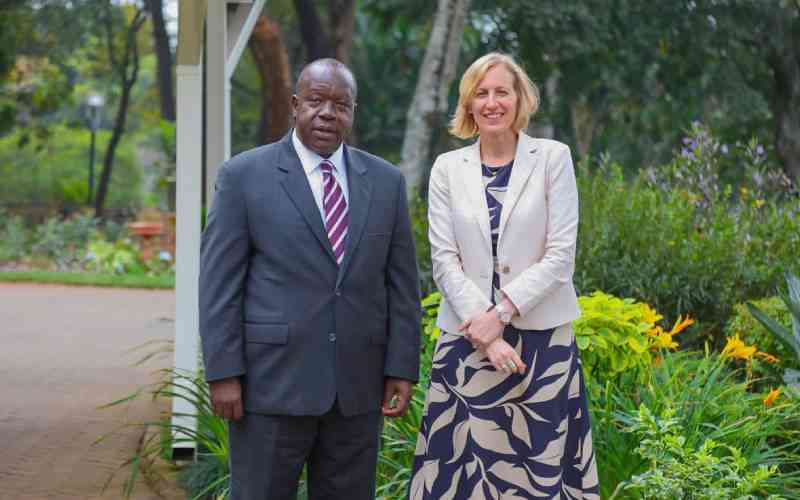
Commissioner-General of Prisons Patrick Aranduh has directed correctional facilities to maximise the use of available land by diversifying agricultural and livestock production to enhance revenue generation.
Speaking during a tour of four prison facilities in Trans Nzoia County, Aranduh emphasised the need for proper land utilisation to increase productivity and support government revenue collection.
Accompanied by North Rift Regional Commander Joseph Saitoti, Aranduh visited Kitale Main Prison, Kitale Women Prison, Kitale Annex Prison and Kitale Medium Prison.
He urged the officers in charge, Moses Chepkoy (Kitale Main Prison), William Tanui (Kitale Medium Prison), Caleb Mukangai (Kitale Annex Prison) and Asha Siomi (Kitale Women Prison), to diversify agricultural and livestock activities.
“I encourage you to diversify agricultural and livestock production activities to enable the government to increase revenue,” said Aranduh.
He noted that increased farm productivity would not only boost government revenue but also provide valuable vocational training opportunities for inmates.
“The innovations will support the rehabilitation of inmates and facilitate their reintegration into society,” he added.
The Commissioner-General, accompanied by Director of Rehabilitation and Welfare Priscila Majere and Director of Farms Patrick Kariti, also toured a six-acre parcel of land at Kitale Medium Prison that was recently reclaimed from land grabbers.
However, even as prison authorities push for greater land utilisation, a recent audit by the Auditor-General paints a worrying picture of widespread encroachment and illegal acquisition of prison land across the country.
According to the Auditor-General’s 2023/24 report, several parcels of land owned by correctional facilities have been occupied by unauthorised individuals, reducing the acreage available for productive use.
The findings raise concerns about the ability of prisons to implement government directives aimed at expanding agricultural production and increasing self-sufficiency, as land disputes and encroachment continue to erode critical correctional assets.
At Kitale Prison, ownership of 2,321.09 acres remains the subject of litigation. Despite a directive by the National Assembly's Public Accounts Committee ordering the immediate eviction of encroachers and the fencing of the land, no action has been taken.
The report further revealed that 141.24 acres belonging to Shimo La Tewa Prison were allocated to 77 private individuals without the land first being de-gazetted as prison property.
In Nakuru, prison land originally measuring 628 acres and gazetted in 1961 was reportedly irregularly subdivided and allocated to private developers, churches and government institutions.
Stay informed. Subscribe to our newsletter
Narok Prison has also lost portions of its 64.8-acre property to private developers who have constructed permanent residential and commercial structures. The report noted that a prison borehole was vandalised after the land on which it stands was allocated to a private developer, effectively cutting off the facility's water supply.
At Shikusa Prison, 764.7 acres have been encroached upon amid a long-standing ownership dispute involving the prison, the Kenya Forest Service (KFS) and the local community. KFS and community members claim the prison encroached on forest land and have called for its relocation.
Kapsabet Prison's 40.995-acre property has also been affected. The audit report states that in 2005, the then Chief Conservator of Forests, acting on recommendations of the Ndung’u Commission Report, directed the prison to cease farming on forest land and surrender it to KFS.
Upon vacating the land, prison authorities discovered that the land they previously owned had been subdivided and allocated to private individuals and other entities. The prison is yet to secure a title deed for the remaining land.
Kisumu Prison has similarly experienced encroachment on its 376-acre property. Although the land has been surveyed, the prison has not obtained title deeds. The absence of fencing has allowed members of the public to trespass, resulting in losses and frequent conflicts with prison authorities.
Some residents claim the land was their ancestral property and was allocated to the prison during the colonial era.
The report further revealed that part of the Kisumu Prison land has been occupied by private developers.
Additionally, the prison was allocated 1.646 hectares through Gazette Notice No. 721 of 1971. The land has since been subdivided into three parcels and allocated to a church organisation, a court and private developers.
According to the Auditor-General, the Ethics and Anti-Corruption Commission (EACC) is investigating how the land was subdivided and reallocated to the current owners.
Subscribe to our newsletter and stay updated on the latest developments and special offers!


 Prefer the Standard on Google








 join
join