×

The Standard e-Paper
Home To Bold Columnists
 The Standard Group Plc is a
multi-media organization with investments in media platforms spanning newspaper
print operations, television, radio broadcasting, digital and online services. The
Standard Group is recognized as a leading multi-media house in Kenya with a key
influence in matters of national and international interest.
The Standard Group Plc is a
multi-media organization with investments in media platforms spanning newspaper
print operations, television, radio broadcasting, digital and online services. The
Standard Group is recognized as a leading multi-media house in Kenya with a key
influence in matters of national and international interest.

Audio By Vocalize
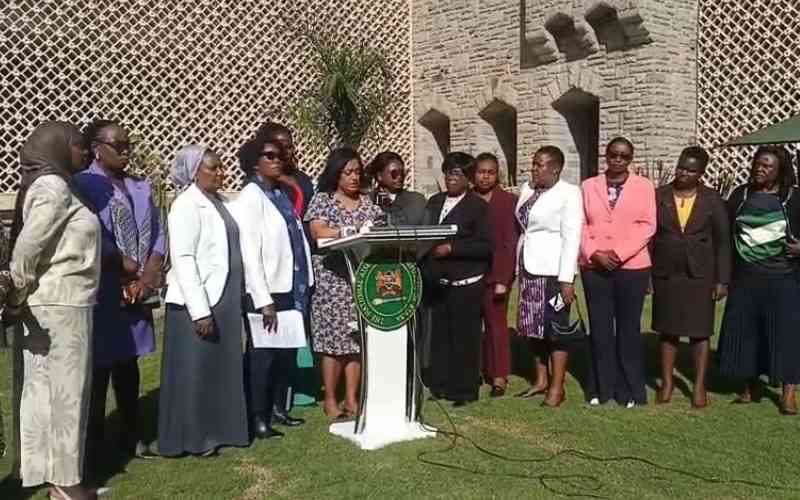
Women Members of Parliament have condemned former Deputy President Rigathi Gachagua over what they described as a sequence of gender-based political violence, intimidation and attacks targeting women leaders and women associated with political opponents.
The 15 Members of Parliament who addressed Journalists at Parliament buildings said that political disagreements should not be allowed to degenerate into personal attacks, humiliation or the targeting of women because of their gender, marital status or political affiliations.
Nairobi County MP Esther Passaris said that legislators were particularly concerned about remarks and conduct they attributed to Gachagua, stating that women leaders should be judged on their policies, decisions and performance rather than their gender or personal circumstances.
“We are concerned over the conduct of the former Deputy President Rigathi Gachagua, where he has on several occasions singled out innocent women leaders and women spouses, drawing them into unnecessary political confrontations,” said Passaris
Dagoretti North MP Beatrice Elachi said that there are several incidents in which Gachagua illustrated a pattern of abuses which includes an alleged verbal attack against Nyandarua County MP Faith Gitau, who has accused the former DP of referring to her as a witch.
Elachi said that such kind of language from a leader of Gachagua’s calibre amounted to gender-based humiliation rather than legitimate political criticism, stating that Women leaders should be challenged on their policies, performance, ideas and not their morality, sexuality or womanhood.
Migori County MP Fatuma Mohammed pointed to an incident in April involving Mwea MP Mary Maingi during a burial ceremony in Mwea where Gachagua, while addressing mourners by phone, reportedly described Ms Maingi as a “traitor of the community.
“Maingi had a constitutional right to make independent political choices and that disagreements over her political position should be addressed through policy debate and facts rather than personal humiliation,” said Mohammed.
Marsabit County MP Naomi Waqo criticised the alleged involvement of the family of Interior Cabinet Secretary Kipchumba Murkomen in political exchanges, citing remarks by CS Murkomen on August 23 in which he complained that Gachagua had repeatedly dragged his wife into politics.
Waqo questioned why the wife of a political opponent should become part of a political contest, arguing that women should not be exposed to political controversy merely because of whom they are married to.
“A woman is not a political weapon simply because she is married to a politician; most of us did not even know where Murkomen’s wife comes from. Let Gachagua respect families since women can be married anywhere,” said Waqo.
Teso South MP Mary Emaase raised concerns over Gachagua’s visit to the family of the late former Emurua Dikirr MP Johana Ng’eno, particularly regarding the dignity and autonomy of the widow and immediate family.
Emaase said that while they acknowledged that condolences and support to a bereaved family were commendable, political leaders should exercise sensitivity when engaging bereaved families and they should have their privacy, wishes, dignity and consent respected.
“Let it be known that a widow's grief is not weakness, her home is not political property and her consent must never be treated as optional; it was very wrong that Gachagua visited Ng’eno’s home without bothering to inform his widow,” said Emaase.
Stay informed. Subscribe to our newsletter
Vihiga County Woman Representative Beatrice Adagala cited political exchanges involving Kirinyaga Governor Anne Waiguru, Embu Governor Cecily Mbarire and Nakuru Governor Susan Kihika with Gachagua making disrespectful remarks against them.
Adagala stated that elected women leaders should be free to make independent political decisions without being labelled disloyal or being subjected to gender-based intimidation, arguing that Political independence is not betrayal, and disagreement is not disloyalty.
“These incidents, when considered together, pointed to a wider political culture in which women were increasingly being subjected to personal attacks and their families being drawn into political disputes,” said Adagala.
Kisii County MP Doris Aburi pointed out that while they acknowledge that women leaders should not be exempt from scrutiny, they were insisting that criticism must focus on their record, policies, decisions and performance.
Aburi said that the matter went beyond Gachagua and raised broader questions about the kind of political culture Kenya was creating ahead of future elections and that this could discourage young women who might be contemplating joining elective politics in future
“Young women entering politics could be discouraged if they believed that seeking elective office exposed them and their families to personal attacks and humiliation. Women have a right to lead without being punished for being women,” said Aburi.
Siaya County MP Christine Ombaka said that they were demanding that Gachagua publicly acknowledge and apologise for remarks and conduct they considered to be demeaning to women leaders or that dragged women spouses and families into political disputes.
Ombaka said that they were calling for an immediate end to what they considered to be sexist, abusive, demeaning and gendered political language against women who had equal rights just like their male counterparts to participate in elective politics.
“We are demanding that politicians keep wives, children and other family members out of political battles and that bereaved women and families be accorded privacy, dignity, autonomy and consent,” said Ombaka.
Subscribe to our newsletter and stay updated on the latest developments and special offers!


 Prefer the Standard on Google