×

The Standard e-Paper
Home To Bold Columnists
 The Standard Group Plc is a
multi-media organization with investments in media platforms spanning newspaper
print operations, television, radio broadcasting, digital and online services. The
Standard Group is recognized as a leading multi-media house in Kenya with a key
influence in matters of national and international interest.
The Standard Group Plc is a
multi-media organization with investments in media platforms spanning newspaper
print operations, television, radio broadcasting, digital and online services. The
Standard Group is recognized as a leading multi-media house in Kenya with a key
influence in matters of national and international interest.

Audio By Vocalize
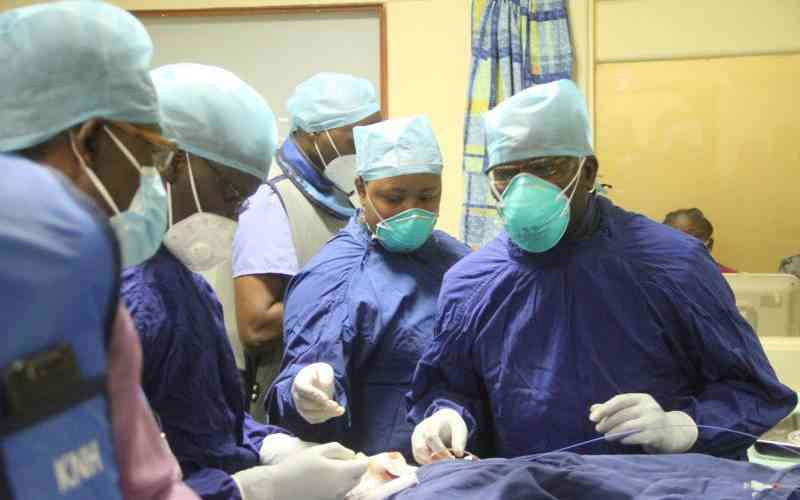
The promulgation of the Constitution in 2010 marked a defining moment in our nation's history. It introduced devolution to address decades of regional inequality by transferring power and resources from the national government to 47 county governments.
Among the functions devolved was healthcare, with the aim of bringing services closer to citizens and allowing counties to respond to local health needs.
More than a decade later, devolution has undeniably expanded access to healthcare. Counties have built health facilities, improved maternal and child health services, invested in medical equipment, and brought healthcare closer to communities that had long been neglected. These achievements deserve recognition.
However, one aspect of health devolution requires urgent national reflection: The management of healthcare workers. Before devolution, Kenya's healthcare system was highly centralised. Decisions concerning infrastructure, staffing, procurement, and budgeting were largely made in Nairobi. Counties in Northern Kenya, the Coast, and parts of Western Kenya often experienced chronic neglect and inadequate investment.
Devolution sought to correct these historical injustices by empowering county governments to plan and deliver healthcare services based on local priorities. To a considerable extent, this objective has been achieved. Counties have expanded health facilities, invested in maternal-child healthcare, strengthened emergency response systems, and enhanced access to primary healthcare services. Residents in many rural communities no longer travel hundreds of kilometres to access basic medical care. These achievements deserve recognition. The greatest challenge, however, lies not in infrastructure but in workforce management. Today, Kenya effectively operates 47 separate public health workforce systems. Each county independently recruits, transfers, and manages its healthcare personnel. The result has been significant disparities in salaries, allowances, career progression, and working conditions.
Healthcare professionals performing identical duties often receive different compensation depending on the county employing them. Predictably, doctors, nurses, and specialists increasingly migrate from financially weaker counties to those offering better terms of service. Marginalised counties are left struggling to attract and retain skilled personnel despite having functional hospitals and modern equipment.
This undermines one of the Constitution's core aspirations: Equitable access to healthcare for all Kenyans regardless of where they live. One often-overlooked consequence of the current arrangement is the gradual erosion of a truly national public health workforce. Before devolution, healthcare professionals employed by the national government were routinely posted across the country.
Doctors from Kisii served in Wajir, nurses from Bungoma worked in Mombasa, while clinical officers from Garissa could spend years serving in Nakuru or Nyeri. Such deployments promoted national integration, professional exchange, and staffing based on need rather than local affiliation.
Today, recruitment is largely undertaken by individual counties, many of which understandably prioritise local residents. While local employment has advantages, it has significantly reduced workforce mobility and made it more difficult to redistribute healthcare workers to areas experiencing critical shortages.
The localised employment model has also created potential conflicts of interest. In some counties, healthcare professionals employed by public facilities simultaneously operate or have interests in nearby private clinics. While many maintain the highest ethical standards, such arrangements can create divided loyalties, contribute to absenteeism, and encourage referrals from public facilities to private practice. National deployment would not eliminate private practice, but it would strengthen professional accountability and reduce conflicts arising from close local, social and political relationships.
The weaknesses of the current system are most visible in Kenya's marginalised counties, including Wajir, Mandera, Marsabit, Turkana, and Garissa. These counties have consistently struggled to attract and retain specialists. Hospitals often possess operating theatres, diagnostic equipment, and modern facilities but lack the skilled personnel required to utilise them effectively.
This reality demonstrates a simple truth: Healthcare is ultimately delivered by people, not buildings. Effective workforce planning requires coordination beyond county boundaries. Many countries with decentralised health systems have recognised this. In South Africa, provincial governments manage healthcare delivery, but recruitment frameworks, remuneration, labour relations, and professional standards remain nationally coordinated.
Australia and Canada similarly combine decentralised service delivery with strong national workforce planning and labour mobility.
These examples show that devolution and national coordination are not mutually exclusive. County governments can continue managing hospitals, budgets, and local health services while healthcare professionals operate under a nationally harmonised employment framework.
Kenya should therefore seriously consider establishing a Health Service Commission. Similar to the Teachers Service Commission, it could oversee the recruitment, deployment, remuneration, career progression, inter-county transfers, and continuous professional development, workforce planning, and labour relations of healthcare workers.
Stay informed. Subscribe to our newsletter
County governments would retain responsibility for healthcare infrastructure, budgeting, local administration, and service delivery. Healthcare professionals, however, would serve under one national employer operating within uniform standards. Such a system would promote fairness, improve staff mobility, strengthen workforce planning, and reduce inequalities between counties. It would also protect healthcare workers from excessive local political interference while reinforcing professionalism.
Critics argue that centralising health personnel would undermine devolution. This concern deserves consideration. The gains made through devolution should not be reversed. The real question, however, is not whether healthcare should remain devolved, but whether every component of healthcare, particularly human resource management, must be devolved.
Education offers a useful comparison. Schools are locally managed, yet teachers are employed through the Teachers Service Commission under nationally harmonised terms and conditions. While not perfect, this model has promoted consistency in remuneration, labour mobility, and professional standards across the country.
Some also argue that counties simply need more financial resources and institutional capacity. There is truth in this. However, after more than a decade of implementation, the persistent challenges suggest that the problem is not purely financial but structural. Managing a highly specialised and mobile workforce through 47 independent employers has inevitably produced fragmentation.
The Constitution remains one of our greatest democratic achievements, but no, the Constitution is beyond reflection or improvement. The strength of any constitutional democracy lies in its willingness to evaluate institutions honestly and reform them where necessary.
The management of Kenya's healthcare workforce deserves such a national conversation. We must ask whether the current system has strengthened healthcare delivery, enhanced equity, and improved labour relations, or whether it has unintentionally fragmented one of our most essential public services into 47 unequal systems.
Kenya's healthcare workforce should be treated as a national strategic resource. Just as teachers serve under a nationally coordinated system while education remains substantially decentralised, healthcare professionals should be managed through a framework that promotes equity, professionalism, mobility, and national cohesion. Every Kenyan deserves access to qualified healthcare workers, regardless of county of residence, and every healthcare professional deserves a fair, harmonised system that allows them to serve anywhere in the Republic with equal opportunity and equal protection.
Subscribe to our newsletter and stay updated on the latest developments and special offers!

 Prefer the Standard on Google









 join
join