×

The Standard e-Paper
Fearless, Trusted News
 The Standard Group Plc is a
multi-media organization with investments in media platforms spanning newspaper
print operations, television, radio broadcasting, digital and online services. The
Standard Group is recognized as a leading multi-media house in Kenya with a key
influence in matters of national and international interest.
The Standard Group Plc is a
multi-media organization with investments in media platforms spanning newspaper
print operations, television, radio broadcasting, digital and online services. The
Standard Group is recognized as a leading multi-media house in Kenya with a key
influence in matters of national and international interest.

Audio By Vocalize
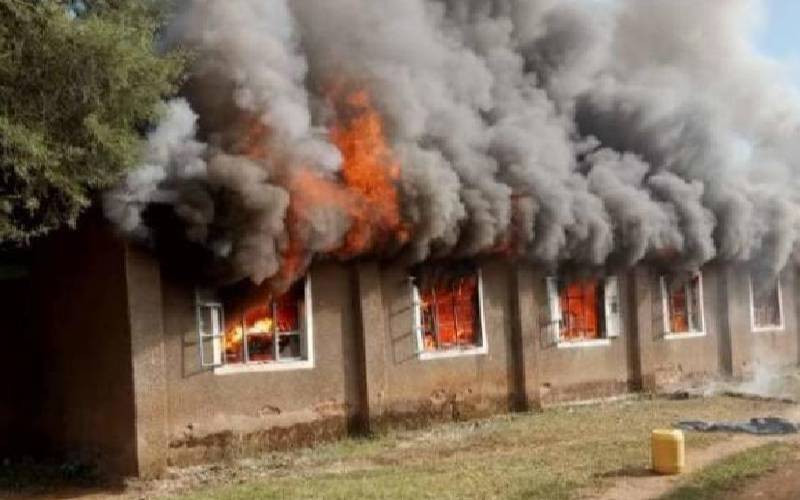
There are few sounds more terrifying to a parent than a midnight phone call from a boarding school. In Kenya today, that call has become a national nightmare.
The recent wave of school fires has transformed ordinary parents into reluctant prophets, security experts, and emergency responders. A parent sees an unfamiliar number and immediately imagines smoke, ambulances, police tape, and television cameras. Before answering, they have already buried their child three times in their imagination and resurrected them twice through prayer. Such is the cruelty of uncertainty.
For nearly a decade, every second term seems to arrive carrying the smell of panic. The weather changes, examinations draw closer, pressure builds, and suddenly, school fires return to national conversation as faithfully as Parliament returns to allowances.
Coincidence? Perhaps. But one wonders whether somewhere within our education system, young minds are quietly reaching breaking points.
Consider the modern Kenyan student. The child wakes at 4 am while even witches are still concluding night-shift reports. He studies until 10 pm under the watchful eyes of teachers, parents, principals, ministry officials, and neighbours who all seem convinced that one examination determines the meaning of life itself. By Form Four, some students have accumulated more pressure than a steam boiler.
Everybody wants grades. Nobody asks whether the child is still enjoying childhood.
Some of us survived the famous 8-4-4 system, carrying knowledge that remains gloriously unemployed. We mastered X and Y, memorised logarithms, periodic tables, and mitochondria with military precision, only to discover adulthood requires more interaction with M-Pesa...
Today, many cannot remember the formulas, the dates, or even the grades that nearly destroyed their peace. Yet the pressure remains.
Perhaps it is time to ask uncomfortable questions. Must a child spend 18 hours preparing for a three-hour examination? Must learning resemble punishment? Must schools become pressure cookers before national examinations? Reducing learning hours is not reducing standards. Sometimes it is preserving sanity.
A boarding school is built on trust. Parents hand over children, believing they will return educated, disciplined, and alive. Alive first. Everything else second.
The debate must therefore move beyond assigning blame after every tragedy. We must ask whether students are being heard before frustration becomes disaster.
Because children are not examination machines, schools are not warehouses, and safety is not an optional budget item.
For when the school bell becomes a siren, an entire nation discovers how flammable its hopes truly are.
Subscribe to our newsletter and stay updated on the latest developments and special offers!

 Prefer the Standard on Google









 join
join