×

The Standard e-Paper
Kenya’s Boldest Voice
 The Standard Group Plc is a
multi-media organization with investments in media platforms spanning newspaper
print operations, television, radio broadcasting, digital and online services. The
Standard Group is recognized as a leading multi-media house in Kenya with a key
influence in matters of national and international interest.
The Standard Group Plc is a
multi-media organization with investments in media platforms spanning newspaper
print operations, television, radio broadcasting, digital and online services. The
Standard Group is recognized as a leading multi-media house in Kenya with a key
influence in matters of national and international interest.

Audio By Vocalize
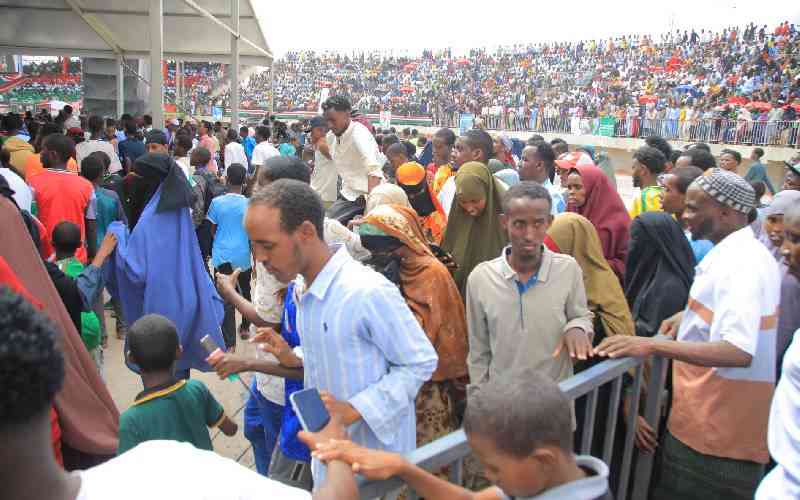
Residents arrive at Wajir Stadium during the 63rd Madaraka Day Celebrations on June 1, 2026. [Elvis Ogina, Standard]
Sixty-three years ago, as Kenyans raised the national flag for the first time, the people of Wajir, Garissa, and Mandera were not celebrating the dawn of opportunity. They were handed a different document titled African Socialism and Its Application to Planning in Kenya, codified what colonial cartography had begun - a policy of deliberate, structural segregation in development.
The architects of independence argued for a pragmatic allocation of resources, prioritising regions with “high potential” for agriculture and industry. In practice, this meant the fertile highlands of Central, Rift Valley, and Nyanza would receive hospitals, tarmac roads, and schools, while the arid Northern Frontier District (NFD), now the counties of Wajir, Mandera, Marsabit, and Isiolo - were left to the mercy of camels and dust.
Development was not merely uneven; it was ethnically and geographically engineered. The North was not underdeveloped by accident. It was marginalised by design with intent. As Wajir County host the 63rd Madaraka Day celebrations - a symbolic honour for a region long treated as a security liability rather than an economic frontier - we must ask the haunting question: What would Wajir, Garissa, and the entire North look like today if, in 1963, the government had invested in agriculture, roads, schools, and hospitals with the same vigour it showed for the highlands?
Imagine a 1963 where irrigation schemes along the Daua and Tana Rivers were launched not as pilot projects, but as massive agricultural engines. Today, Wajir would not be synonymous with food aid. It could be Kenya’s basket for drought-resistant sorghum, millet, and livestock value addition. Farmers would export camels’ milk powder to the Middle East. The region’s perennial hunger pangs would be a historical footnote.
Imagine if, 63 years ago, we built a network of tarmacked roads connecting Wajir to Isiolo and the Lamu port—not seasonal murram tracks that wash away every El Niño. Today, a child born in Wajir would not need three days to reach a referral hospital in Nairobi. The cost of transporting a sack of maize from the highlands would not quadruple by the time it reaches the border. Trade with Ethiopia and Somalia would have turned Wajir into a logistical hub, not a smuggling route.
Imagine if, in 1963, the government planted a university campus and technical schools in the North, not just primary school shelters that doubled as relief food distribution points. Today, a Wajiri youth would be a software engineer or a hydrologist managing the region’s vast groundwater reserves, not a desperate migrant to Mombasa or a recruit by extremists promising a paycheck.
Most painfully, imagine if the same number of hospitals per capita built in Kiambu, Eldoret, Kisumu in the 1960s had been built in Wajir. Today, maternal mortality rates-still among the highest in Kenya-would be normal. A child with a snakebite would not die before reaching the dispensary.
The indelible mark Sessional Paper No. 10 left is not just potholes and malnutrition. It is a psychological scar, a sense that Kenya’s northern half was always meant to be a catchment zone for security threats, not a frontier of prosperity. The 63rd Madaraka Day in Wajir is a bittersweet mirror. Yes, it signals national recognition. But it also reminds us that the North is celebrating from the backseat of a bus that left the station 63 years ago without its passengers. To heal this wound, we do not need apologies. We need reparative development-an economic Marshall Plan for the arid counties. The question is no longer whether Wajir deserves investment. The question is whether Kenya can afford to keep ignoring the very region that hosts our national celebration. We must not allow the blueprint that broke the camel’s back again.
-The writer is a journalist and comments on public policy. [email protected]
Subscribe to our newsletter and stay updated on the latest developments and special offers!


 Prefer the Standard on Google








 join
join