×

The Standard e-Paper
Smart Minds Choose Us
 The Standard Group Plc is a
multi-media organization with investments in media platforms spanning newspaper
print operations, television, radio broadcasting, digital and online services. The
Standard Group is recognized as a leading multi-media house in Kenya with a key
influence in matters of national and international interest.
The Standard Group Plc is a
multi-media organization with investments in media platforms spanning newspaper
print operations, television, radio broadcasting, digital and online services. The
Standard Group is recognized as a leading multi-media house in Kenya with a key
influence in matters of national and international interest.

Audio By Vocalize

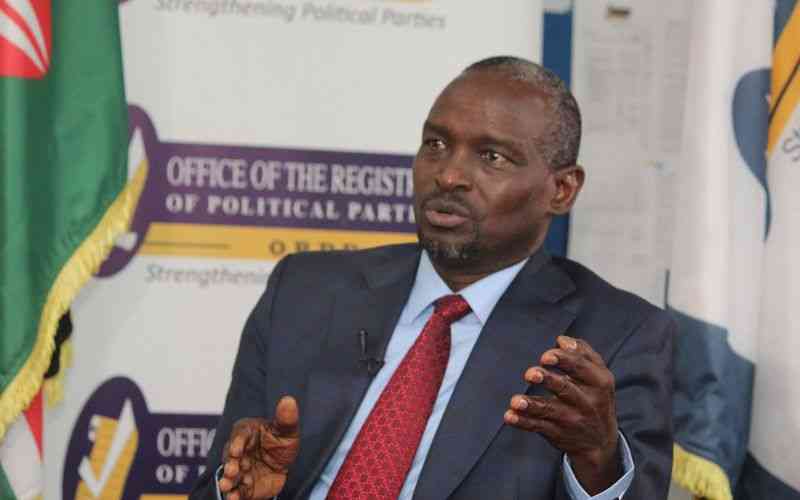
National Deputy Secretary General of the Kenya Medical Practitioners, Pharmacists and Dentists Union (KMPDU) Dennis Miskellah and Odhiambo Otieno, Political and communications consultant. [Screengrab]
Health stakeholders have faulted county governments over what they describe as the continued deterioration of healthcare services, saying devolution has failed to deliver quality, accessible and affordable healthcare to millions of Kenyans.
According to them, the country's health sector is grappling with deep-rooted leadership and governance challenges, leaving ordinary Kenyans to bear the burden of a failing system.
Among the key challenges they cited are the struggles surrounding the implementation of the Social Health Authority (SHA), shortages of medicines, counterfeit and substandard drugs and poor infrastructure.
Others include inadequate numbers of healthcare workers, supply chain failures, corruption, financial mismanagement, and inequalities in service delivery across counties.
For many Kenyans, these problems have translated into rising treatment costs, long hospital queues, poor quality of care and increased out-of-pocket medical expenses despite contributing to SHA.
"The tragedy of our country is that the choice between living and dying depends on how much money you have or where you happen to be when you fall sick," said Dennis Miskellah, National Deputy Secretary General of the Kenya Medical Practitioners, Pharmacists and Dentists Union (KMPDU).
Speaking during an interview on Spice FM, Miskellah argued that healthcare should never have been fully devolved to county governments.
"I believe healthcare should never have been devolved in the first place. We live in a country where politics takes precedence over everything," he said.
According to him, if healthcare had to be devolved, it should have been done gradually and systematically to ensure counties were adequately prepared to manage the function without compromising the quality of services.
"Another mistake was devolving healthcare all at once instead of progressively. It was devolved without first putting in place the necessary systems," he said.
He argued that the result has been 47 counties running healthcare differently, with no uniform standards or clear national leadership.
"In deciding to devolve healthcare, we accepted running it 47 different ways. Every governor is doing their own thing. There is no one taking charge of healthcare nationally, and every change in leadership affects service delivery. That is madness," he said.
Miskellah blamed poor infrastructure, corruption, mismanagement of resources and political interference for the current crisis, saying the biggest victims have been ordinary Kenyans.
Stay informed. Subscribe to our newsletter
He also faulted the government for misplaced priorities, saying counties continue constructing hospitals while failing to employ enough healthcare workers, while also politicising recruitment.
"You say you do not have enough money to pay doctors, but you have enough money to build big hospitals. Who is supposed to work in those hospitals?" he posed.
"These politicians know where the problem is. You are told to apply for a job only in the county where you come from. There are ghost workers on payrolls. Someone will tell you there are 50 consultants, yet only 10 or 20 actually exist," he added.
Political and communications consultant Odhiambo Otieno: Kenya's doctor-to-patient ratio remains far below the World Health Organisation recommendation of one doctor for every 1,000 people, with the country currently averaging about one doctor for every 17,000 people.
They added that doctors continue to face delayed salaries, stalled promotions, lack of comprehensive medical cover and non-remittance of statutory deductions, challenges that have repeatedly triggered strikes since the introduction of devolution.
According to Otieno said affordability remains one of the biggest barriers to healthcare despite the rollout of SHA.
"It is in this country where the affordability of healthcare has become a real issue, yet health is a constitutional right," he said.
He argued that while some healthcare functions can effectively be managed by county governments, others should remain under the national government.
He proposed the establishment of a National Health Commission to oversee healthcare standards, workforce welfare and policy implementation across the country.
According to him, preventive healthcare should remain a county function, while treatment services, specialised care, health infrastructure and human resource management should be a national function.
"If we focus on preventive healthcare, we can reduce treatment costs by more than half. That is where counties should put more emphasis," he said.
He, however, warned that political patronage continues to undermine healthcare leadership.
"There are aspects that counties can manage and others they cannot because of political goodwill and patronage. Once healthcare leadership is left to politics, standards automatically go down," he said.
Otieno also pointed to glaring disparities in health services across counties, noting that some still lack critical facilities decades after devolution.
“Although some counties are doing well, some are messy. In Siaya, for example, there is no renal unit or ICU the whole of the county”
The stakeholders maintained that universal health coverage can only be achieved through stronger leadership, proper financing, adequate staffing and a governance system that places the welfare of patients above politics.
"Healthcare should not depend on where you live or how much money you have. Every Kenyan deserves the highest attainable standard of health," they said.
Subscribe to our newsletter and stay updated on the latest developments and special offers!


 Prefer the Standard on Google






 join
join