The Standard Group Plc is a multi-media organization with investments in media
platforms spanning newspaper print
operations, television, radio broadcasting, digital and online services. The
Standard Group is recognized as a
leading multi-media house in Kenya with a key influence in matters of national and
international interest.

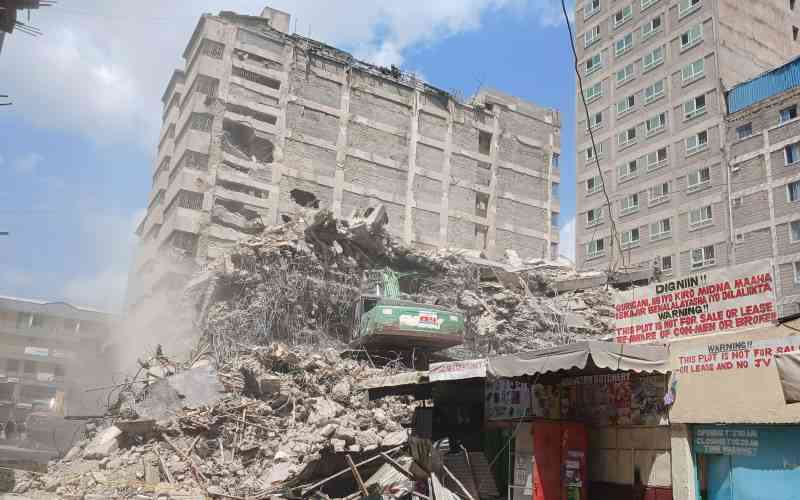
Police hunt developer and contractor as Sakaja admits building had no occupation certificate. But the record shows warnings, enforcement notices and stop orders have never stopped the next collapse.
The rubble on 9th Street had not yet cooled when Johnson Sakaja began explaining.
Standing near the wreckage of what was supposed to be a fifteen-storey building, the Nairobi Governor confirmed what many in Eastleigh already suspected: the application to build had never been approved. A change-of-use had been granted in October 2024, permitting the property to shift from residential to commercial-residential. But the architectural plans submitted weeks later were never signed off. Construction proceeded anyway. The building rose. Then it fell.
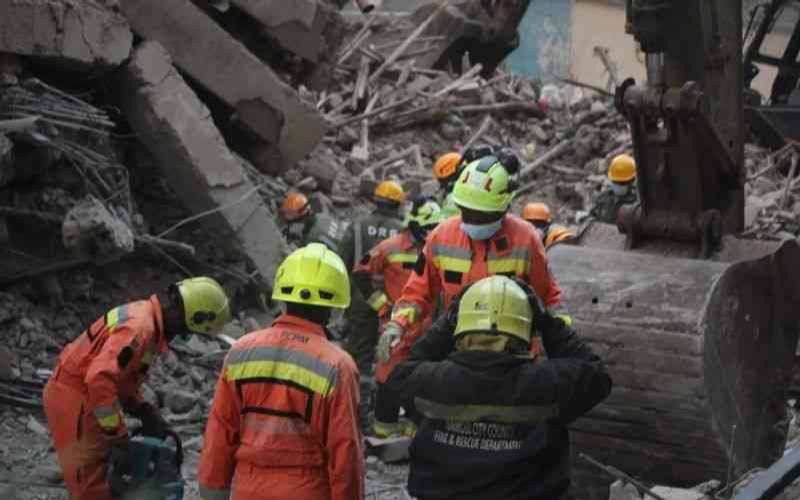
By Saturday, rescue teams had pulled two people alive from the debris, a man and a woman, both rushed to hospital. Sixty-six of the sixty-seven construction workers on site had been accounted for. But five people remained missing, according to police. Those unaccounted for were believed to have been in shops at the base of the building when it came down.
What was not moving was the political ground beneath the Governor.
Sakaja has been careful. He has not denied that something went catastrophically wrong. He has instead built a case that points outward at the developer, at the professionals, at the prosecution system, at the national government.
The developer, he said, was John Mutia Musyoke, operating on land belonging to the estate of the late Wilson Mutia Musyoke. The application for a fifteen-storey building with a basement was submitted but never granted. The Urban Planning Committee raised concerns in November 2024 about a proposal for basement and ground-floor shops. An enforcement order was issued earlier this year. Construction continued.
The building had no occupation certificate. Eleven shops had already opened on the bottom floors, operating illegally. "Before anybody gets an occupation certificate, you're not allowed to get into that property," Sakaja said. "At all. Even temporarily, that is not allowed".
Then the broader indictment over 200 files relating to construction violations is stuck at the Director of Public Prosecutions. Fines for violations can be as low as Sh5,000. Developers pay, shrug, and keep building. "That does not deter anyone from continuing with an illegality," Sakaja said.
His solution is more power for counties: return prosecutorial authority to City Hall, toughen penalties, let the county act without waiting for the DPP.
It is a coherent argument from a man who can do better. It is also an argument that has been available to Sakaja for every collapse of his tenure. The question is why, if the tools were inadequate, the building still rose.
The Eastleigh collapse is not an anomaly. It is the latest entry in a ledger that has been accumulating for years.
In South C, on January 2, 2026. A high-rise under construction collapsed. The Architectural Association of Kenya later confirmed that the project had been registered with the National Construction Authority and had secured county and environmental approvals. But public records from Nairobi City County showed enforcement actions were taken at the site in May, July, and December 2025, after officers identified infractions. Construction continued until the day of collapse. The developer pressed on despite stop orders issued by both the NCA and the Nairobi County Government. The legal design was for twelve storeys, but the building reached sixteen. The additional floors were approved without any recorded structural review or documented inspections.
In Karen, January 2026, barely a week after South C, two workers died and seven others were injured when a building under construction collapsed.
In Westlands, March 18, 2026. Two separate construction incidents on the same day left at least two people dead and several others injured.
The pattern is not complicated. Enforcement notices are issued and they are not followed up. Fines are levied and they are paid or ignored. Construction continues and people die. A Governor visits the site. A promise is made. The file moves to the DPP. Nothing happens. The next building goes up.
Between 2009 and 2019, Kenya recorded 86 building collapses and roughly 200 deaths, according to the Kenya Institute for Public Policy Research and Analysis. Nairobi was the epicentre.
Nairobi MCAs were not persuaded by Sakaja's framing.
Members of the County Assembly's Planning Committee urged the Governor to review the county's planning department and the process of issuing construction approvals. Nairobi South MCA and Deputy Minority Leader Waithera Chege said the governor should investigate cases where approvals may be issued by officers who are not mandated to do so.
"The law dictates that the CEC in charge of planning is the one to issue approvals. Communication should be done by the Director, Planning," Chege said. She said the county administration should ensure that the responsibilities of officials involved in planning and approval processes are clearly defined and followed.
Baba Dogo MCA Geoffrey Majiwa raised concerns about the department's supervisory structure, saying there were instances where junior officers supervised senior officers. He urged the county administration to look into the matter.
The MCAs' intervention matters because it reframes the question. Sakaja's defence is that the developer broke the rules and the system could not stop him. The MCAs' counter is that the system was not merely weak; it was being exercised in ways that served developers, not residents. The planning department's approval process, they suggested, had been inverted.
Sakaja has not directly responded to the specific allegation that approvals may have been issued by unauthorised officers. The discrepancy between a Governor saying no construction approval existed and MCAs saying the approval process itself needs investigation is now central to the unfolding accountability fight.
The explanations offered by professionals who study these collapses are consistent, and they do not point to any single villain.
A joint statement issued by built environment associations after the South C collapse identified the drivers: poor governance, political interference, bypassed procedures, corruption, credential renting, lack of geotechnical investigations, poor construction sequencing, substandard materials, weak quality control. The statement called for accountability across the entire development chain: developers, professionals, county officials, and regulators.
The Ombudsman's investigation into a February 2026 Eastleigh approvals case, separate from Friday's collapse, found that Nairobi City County officials were culpable for "dereliction of duty, irregular approvals, disregard of technical objections, misrepresentation of a sewer wayleave, and failure to enforce regulatory measures." The Commission on Administrative Justice recommended prosecution of five senior Nairobi City County officials. The investigation described the approval process as "irregular, non-transparent, and contrary to legal and planning frameworks".
The report also identified systemic weaknesses: "unregulated officer discretion, inactive enforcement modules, poor inter-departmental coordination, and widespread non-compliance among surrounding developments".
Sakaja's proposed remedy of more prosecutorial power for the county does not address this. "A county government that cannot or will not use its existing enforcement powers to stop a building under construction will not suddenly use new powers to prosecute the people it has been protecting," says lawyer Peter Wena.
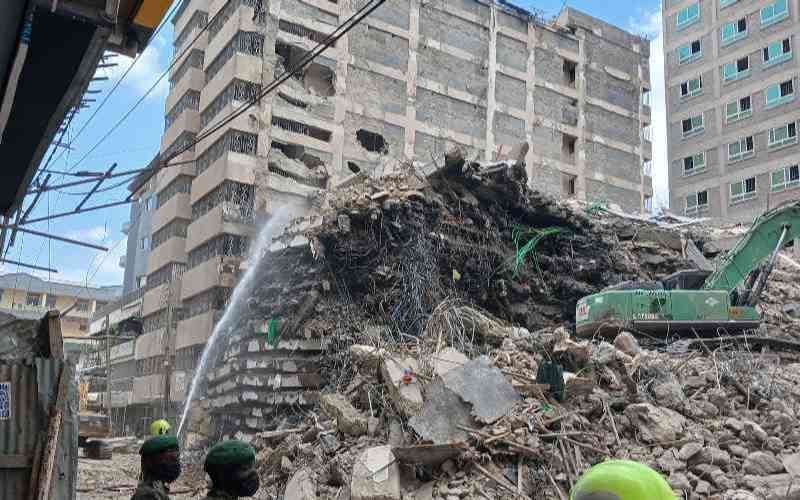
Rescue operations continued into yesterday. The Kenya Defence Forces joined. Sniffer dogs were deployed. Excavators and breakers worked to clear the debris. Sakaja said some people inside had been communicating with rescuers, and that teams were opening spaces to let oxygen in.
The missing are still missing. The dead, if there are any, have not been named.
The political fight has already begun. The MCAs want Sakaja to review the planning department. Sakaja wants the DPP and the professional bodies to take responsibility. Police have launched a manhunt for the building's owner and the contractor. The National Construction Authority said it had identified the company behind the development, as well as the architect and structural engineer, but did not say whether the site had been inspected before Friday.
In the middle of it all is a simple, unanswered question: if the building had no construction approval, how did it get to fifteen floors?
"The answer will not be found in a single file or a single statement. It will be found in the routine, documented, repeated failure of a system that has been warned, audited, investigated, and warned again. The Eastleigh collapse is not a story about one rogue developer. It is a story about a city that has learned to live with the knowledge that its buildings may fall, and a political class that has learned to visit the rubble, promise accountability, and move on." Adds Wena.
The rescue teams are still digging. The families are still waiting. And somewhere in Nairobi, another building without approval is going up.