 The Standard Group Plc is a multi-media organization with investments in media
platforms spanning newspaper print
operations, television, radio broadcasting, digital and online services. The
Standard Group is recognized as a
leading multi-media house in Kenya with a key influence in matters of national and
international interest.
The Standard Group Plc is a multi-media organization with investments in media
platforms spanning newspaper print
operations, television, radio broadcasting, digital and online services. The
Standard Group is recognized as a
leading multi-media house in Kenya with a key influence in matters of national and
international interest.

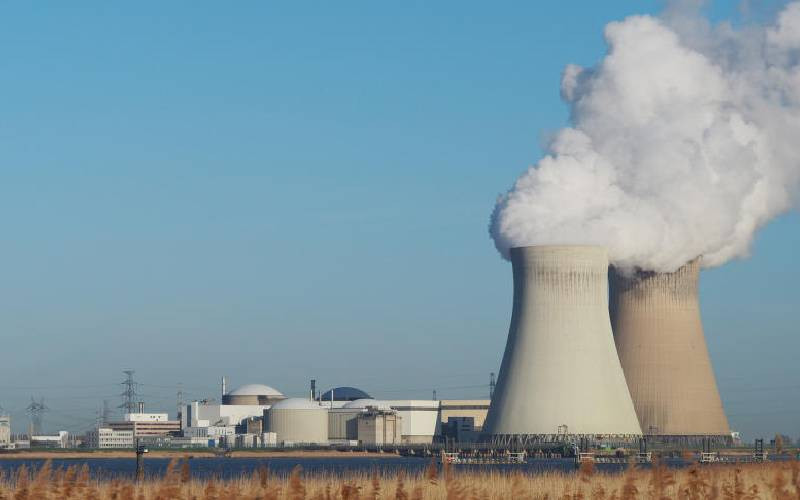
The science behind nuclear power is the stuff of Sci-Fi movies. Imagine this: 100 grammes — an amount so miniscule a newborn baby could comfortably hold in one hand — of enriched uranium carries energy equivalent of 1,000 kilogrammes of oil.
At face value, its return on investment is simply mind-blowing.
Nuclear power or nuclear energy is generated from chain reactions inside a nuclear reactor, where uranium atoms (also known as uranium-235), split due to radioactivity, releasing huge amounts of heat energy in the process.
“The heat is used to superheat steam in a generator, which is then used to turn turbines, which then generates electricity,” says Eric Ohaga, the director of Nuclear Energy and Structural Development at Nuclear Power and Energy Agency (NuPEA).
He says Kenya is in great need of energy as the current demand is not being met.
“The current peak demand stands at about 2,439 megawatts. As our population grows so does the demand. In fact, projections by our Least Cost Power Development Plan indicates that our peak demand will be around 8,800 megawatts by 2043.”
According to the Ohaga, Kenya really has no option but to embrace and adopt nuclear power.
“Nuclear energy is coming to sort out issues of reliability and issues of climate change because it does not emit any greenhouse gases,” Ohaga says.
‘‘Nuclear energy has zero carbon footprint. It is therefore an alluring option for a world that is keen on charting a path to zero (or near zero) greenhouse gas emission.’’
France, a leader in climate change crusade (and the birth place of the Paris Agreement that calls for limiting global warming to below two degrees Celsius) has the highest reliance on nuclear energy: generating at least 65 per cent of its electricity from nuclear power.
Kenya currently gets majority of its energy — approximately 85 per cent — from renewable sources such as hydropower, geothermal, wind, and solar.
“Tapping nuclear energy will get us to 100 per cent clean energy; we will decommission all the diesel generators in the country,” Ohaga says.
On the other hand, we have all seen in the news Kilifi residents, in their thousands, come out to voice their opposition to nuclear power. And they are not alone.
Why would many people be opposed when the technology promises totally clean energy that would solve all of our energy as a country?
To answer that question lets offer the wider context.
Today, only 31 countries — out of 195 — in the world generate electricity from nuclear power according to June 2025 data from International Atomic Energy Agency (IAEA). This is barely 16 per cent of the entire planet.
In Africa, only South Africa is in that league. Egypt, according to Ohaga, is very close to becoming the second.
This gives the image of an energy source that many are extremely careful to tap into.
Fredrick Njau is the programme coordinator for the sustainable development project run by Heinrich Boll Stiftung in Kenya.
He says: “Nuclear power is capital intensive: it is extremely expensive to actualise. Then it has long lead time; for instance, in Kenya we have been pursuing it for 13 or so years and we are barely there. Egypt has been pursuing it for decades and it is just getting close to the finish line now.
“But the major reason people, for example in Kilifi, are opposed is the handling of nuclear waste. The life span of a nuclear power plant is anything between 60 and 80 years. After that the plant is de-commissioned. In the time when the plant is operational, it will host the waste. The real challenge for all nuclear power producing countries is: where do you put that waste permanently in a manner that guarantees human safety from radiation after decommissioning of the plant?”
Kenya’s capacity to properly handle nuclear waste is in doubt among those opposing the idea of nuclear reactors in Kenya.
Ohaga seeks to allay those fears. He says: “Nuclear safety, security, and safeguard, as well as management of nuclear waste, are critical infrastructure elements that any country that wants to develop nuclear power must take into consideration.
“Kenya is following the process as set up by IAEA; which reviews every country’s plan. They greenlight to move from phase one to phase two to phase three. We have undergone a lot of review. .”
What Ohaga failed to tell us is how the waste in Kenya would be handled permanently. According to IAEA, high-level nuclear waste — consisting of spent fuel (actual uranium-235) — makes up a small proportion of overall nuclear waste from a nuclear power plant. However, it remains radioactive for long, and would need to be safely kept away from human and biological systems for at least one million years. Life expectancy in Kenya is 64 years today. Before a million years end at least 15,000 generations of Kenyans would have lived and died.
In the whole world, so far, only Finland has designed and excavated final nuclear waste storage: built 437 metres below the ground. The other nuclear countries are either holding their waste inside the cooling pool or in some temporary caves or in dry casks — canisters shaped like drums, made of thick silver and copper, and which block any remnant radiation from the nuclear waste.
In the past, nuclear waste was dumped in the open ocean. In 1972 the world came together at the London Dumping Convention and banned dumping of radioactive and industrial waste in the seas.
Much closer home, the Bamako Convention of 1991 — an Africa specific treaty — prohibited importation of all hazardous and radioactive waste into Africa.
While Kenya is moving towards nuclear power, Germany has moved in the opposite direction. Germany’s last nuclear reactor wound operations in 2023.
Speaking to American news channel CNBC, a spokesperson for the Federal Ministry for the Environment, Nature Conservation, Nuclear Safety and Consumer Protection in Germany said: “The nuclear phase-out makes Germany safer and avoids additional high-level radioactive waste. The risks of nuclear power are ultimately unmanageable. No insurance in the world covers the potentially catastrophic extent of damage from a nuclear accident.”
Two of the world’s biggest nuclear accidents — the Fukushima nuclear disaster (2011) and the Chernobyl disaster (1986) — led to radioactive material escaping into the environment.
Of 600 workers on site at Chernobyl, 134 received high doses of radiation and suffered from radiation sickness. Twenty-eight died in the first three months.
In Fukushima, there were no direct and immediate deaths related to radiation exposure. However, one worker later died of radiation-induced lung cancer.
“The thing about nuclear waste in the environment is that we can never be sure to what extent, and for how long, it will affect human health and other forms of life,” Njau says.
Ohaga calls Germany’s decision a “political and emotional decision.”
He adds: “Germany today imports electricity from France. What is the source of that electricity? It is nuclear power produced in France. So, it why did they decide against nuclear power?”
We could not independently verify if indeed Germany imports electricity generated by nuclear power plants in France.
Ohaga is responsible for the deployment of the Kenya Nuclear Power Programme.
He says NuPEA has identified three sites where — if all goes according to plan — the agency will put up three nuclear reactors. They are: Siaya, Kilifi and Kwale.
All three venues have large water bodies as nuclear power requires an unending supply of water to cool down the reactors and prevent ‘melting’, which would release significant radiation and radioactive material into the environment.
Njau’s opinion is that the risks of nuclear power outweigh its advantages.
According to him, Kenya should instead invest in renewable energy like geothermal, hydro, and wind, “which we have in abundance.”




