×

The Standard e-Paper
Smart Minds Choose Us
 The Standard Group Plc is a
multi-media organization with investments in media platforms spanning newspaper
print operations, television, radio broadcasting, digital and online services. The
Standard Group is recognized as a leading multi-media house in Kenya with a key
influence in matters of national and international interest.
The Standard Group Plc is a
multi-media organization with investments in media platforms spanning newspaper
print operations, television, radio broadcasting, digital and online services. The
Standard Group is recognized as a leading multi-media house in Kenya with a key
influence in matters of national and international interest.

Audio By Vocalize
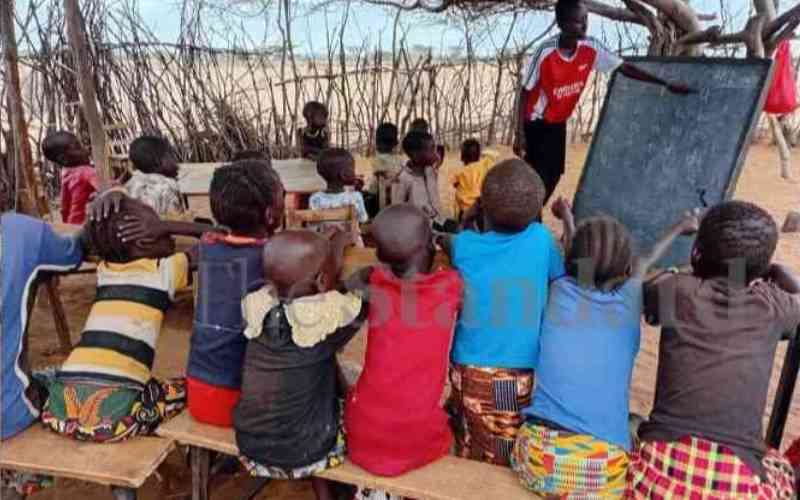
For many years, Nariamawoi Primary School in Kalapata, Turkana South, was a place associated more with neglect than opportunity. The school operated with inadequate infrastructure, sanitation was poor and there was no reliable access to clean water. At one point, the school was unofficially regarded as a disciplinary posting for teachers within the sub-county, reinforcing the perception that it was a difficult and undesirable place to work. Yet beneath these challenges was a community that had not given up on its children.
The story of Nariamawoi's transformation is therefore not simply a story about classrooms, water tanks and latrines. It is a story about changing mindsets, unlocking community agency and transforming how a community sees education and its responsibility towards children.
It started with changing the way the community saw the school. Through the ‘Let Children Learn’ (LCL) project by the Girl Child Network (GCN), with support from Aidlink, the school's Board of Management (BoM) was trained in school development planning, resource mobilisation, governance, roles and responsibilities, and inclusive, gender-and disability-responsive school development. The training changed the way members of the BoM and the wider community looked at Nariamawoi. LCL is an ongoing project that started in July 2024 and is currently in its third year. It is primarily being implemented in Kajiado and Turkana counties.
The training helped the community understand that improving education was not solely the responsibility of government or external organisations. They could identify problems, mobilise resources and take action themselves. For the women of Nariamawoi, this realisation was particularly significant. They began looking inward at the resources available within their own community rather than waiting for outside assistance. Akiru, a parent and community member, explained the change in these words: “After the BoM’s training on inclusive gender and disabilities, we really started seeing our school, Nariamawoi, through new eyes. It wasn't just about sending our kids there; it was about making sure the environment truly helped them learn.”
One BoM member reflected, “The training opened our eyes to the importance of a school-friendly environment... We looked at our school and thought, ‘We can do better for our kids.’”
The change in mindset quickly translated into action. Faced with an acute shortage of classrooms, the community — particularly women — mobilised locally available materials and constructed makeshift learning shelters for children. What began as a simple response to an infrastructure gap became a powerful demonstration of community ownership.
The women were not instructed by GCN to build the shelters; they acted because they had come to understand the relationship between a conducive learning environment and children's ability to learn. Their contribution went beyond the makeshift classrooms. The community also mobilised resources and constructed an office/staffroom, staff quarters and latrines, demonstrating an increasingly strong sense of responsibility for the school.
For Akiru, the initiative represented much more than constructing a shelter: “When we took this on, we weren’t just building a classroom; we were taking ownership of our children’s future.”
The makeshift classrooms provided immediate relief for learners who had previously been exposed to harsh weather while learning outdoors or under trees. More importantly, they sent a powerful message: the community valued education enough to invest its own time, labour and resources in it.
The initiative also elevated the role of women in decisions concerning education and community development. Their actions demonstrated that women were not simply beneficiaries of development interventions; they were capable of identifying problems, mobilising resources and leading solutions.
The community's initiative created momentum. The makeshift facilities demonstrated both the urgency of the school's needs and the community's commitment to addressing them. Their efforts helped persuade GCN's partners to invest further in Nariamawoi. This subsequently contributed to the construction of permanent classrooms and WASH facilities, transforming the physical learning environment.
Today, the school has permanent classrooms, improved water and sanitation infrastructure and a more stable environment for teaching and learning. The temporary shelters that began as a community-led response have therefore become part of a much bigger transformation.
The Headteacher, Mr Hosea Gogong, described the change as significant. The school that was once viewed as a punishment posting for teachers is increasingly regarded as a beacon of hope and progress, particularly for girls, in Turkana South.
Perhaps the most significant transformation at Nariamawoi is less visible than the new buildings. The school sits within a predominantly pastoralist community where traditional ways of life and mobility have historically shaped attitudes towards education. For some families, the immediate demands of pastoralism competed with the long-term benefits of schooling. The case study also highlights the persistence of practices such as early marriage, with one observation documenting young girls already caring for babies.
GCN's emphasis on inclusive, gender- and disability-responsive school development has also encouraged community members to think differently about whose needs matter. Rather than seeing education simply as getting children into school, the community is increasingly considering whether the school environment is safe, inclusive and responsive to the needs of different learners.
Stay informed. Subscribe to our newsletter
In this sense, the intervention has begun to challenge attitudes and social norms that can limit children's opportunities—particularly those of girls—and replace them with a stronger understanding of children's right to learn, develop and participate in decisions affecting their future.
Nariamawoi's journey is remarkable because the transformation cannot be attributed to infrastructure alone. A school once associated with isolation and neglect is now emerging as a model school in the region. Its improved infrastructure has created a better environment for learning, while stronger community engagement has contributed to increased enrolment and renewed pride in the school.
The transformation also carries a powerful message for other pastoralist communities: change does not always begin with a large external investment. It can begin when communities are supported to recognise their own capacity to act. This is precisely what makes Nariamawoi's story a story of transformative change.
GCN did more than construct classrooms. It helped strengthen the people responsible for the school, equipped them with knowledge about planning and resource mobilisation, and created space for them to take ownership of their children's education. The community then used what it had to address immediate needs, demonstrating commitment that helped unlock further investment. Today, the physical transformation of Nariamawoi stands alongside a deeper social transformation: parents are increasingly valuing education, women are taking a stronger role in school development, communities are thinking more critically about the needs and rights of children, and girls are increasingly seen as deserving of the opportunity to remain in school and shape their own futures.
The author is the Deputy Director, Girl Child Network
dennis.mutiso@girlchildnetwork.org
Subscribe to our newsletter and stay updated on the latest developments and special offers!


 Prefer the Standard on Google







 join
join