Audio By Vocalize
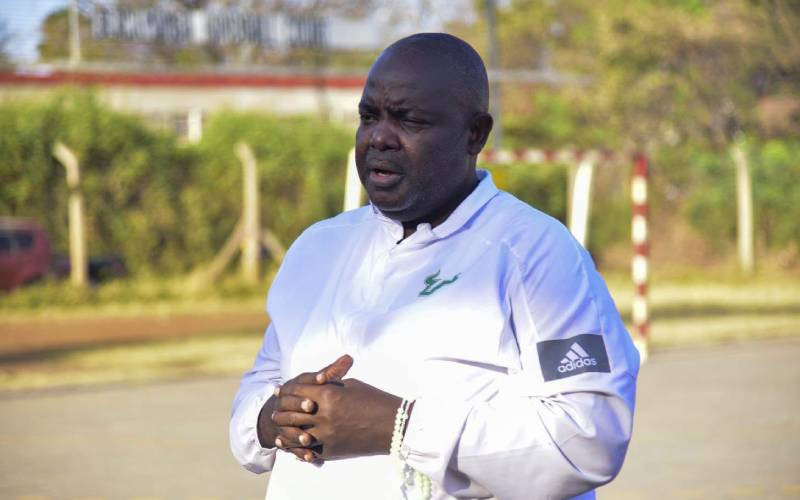
Atheist Society of Kenya chairman Harrison Mumia before the Milimani Law Courts. [Nancy Gitonga, Standard]
The Atheist Society of Kenya chairman will be among Kenyans who will benefit from the Court of Appeal’s judgement outlawing sections of cybercrime Act that gave police sweeping powers to hunt and arrest anyone they deemed to have committed criminal defamation.
Harrison Nyende Mumia was charged with allegedly depicting President William Ruto as dead. The Prosecution claimed that he knew the posts on Facebook and Instagram were false.
However, Court of Appeal judges Patrick Kiage, Aggrey Muchelule and Welson Korir yesterday handed him, alongside others, a lifeline after finding that Sections 22 and 23 of the Computer Misuse and Cybercrimes Act, 2018 were unconstitutional.
MPs sneaked in the two sections alongside others during the debate.
Section 22 criminalises the intentional publication of falsehoods, while depicting it as the truth. Section 23, on the other hand, makes it an offence to falsely print, broadcast, or transmit data over a computer system that is calculated or results in panic, chaos, or violence, or which is likely to discredit the reputation of any person.
The bench headed by Justice observed that although the two sections are differently worded, they speak to one and the same thing, lying or defamation.
They said that lawmakers gave an unguided missile to law enforcers to hunt Kenyans, even those who are innocent.
The trio said that MPs were simply illegally policing social media, but never minded that there are persons who either forward or even quite the falsehood.
The bench headed by Justice Kiage observed that it is better to have lies than a chilling effect of the two sections.
“ Our assessment of sections 22 and 23 of the Act is that they are so broad, wide, untargeted, akin to unguided missiles, and likely to net innocent citizens. They are aimed at patrolling the social media space and are likely to net the originators of what is sought to be criminalised, as well as innocent forwarders who may not even be aware that the information they are publishing is false.”
“These provisions are a danger to the social media warriors who are on sentinel duty day and night, forwarding information without even reading what they are forwarding. In a world without universal truths or falsities, the offences may be difficult to prove. Indeed, false information is better than no information at all,” the trio ruled.
According to the Judges, truth and lies are relative and can change based on circumstances. They were of the view that history was replete with men and women who spoke the truth to the king, who was naked, but were hanged after being accused of lying, only for him to look in the mirror and see his dry chest and pot belly. They observed that Galileo Galilei paid for saying the earth was round, which was then deemed by the Romans to be a lie.
At the same time, Justices Kiage found that MPs were criminalising satire, opinions and journalists' inaccuracies. They held that this was an afront to free speech and democracy as they are an overlap of the law on national cohesion and integration.
Stay informed. Subscribe to our newsletter
“Then we are of the view that the impugned provisions, as drafted, have not succeeded in achieving that purpose. Indeed, it was submitted by the appellant, without much resistance by those opposed to the appeal, that the National Cohesion and Integration Act, 2008, has already criminalised what was sought to be criminalised by the two provisions,” they said.
However, judges upheld laws criminalising cyberbullying and child pornography.
Kenya Union of Journalists, Bloggers Association of Kenya (Bake), Article 19 and the Law Society of Kenya moved to the Court of Appeal after a former High Court Judge ruled that all 26 sections of the Act were constitutional.
The lobbies had moved to court arguing that they threatened the freedom of opinion, freedom of expression, freedom of the media, freedom and security of the person, right to privacy, right to property and the right to a fair hearing.
In the petition filed in the year 2018, the Attorney General, the Speaker of the National Assembly, the Inspector General of Police and the DPP were the key respondents in the case.
The Cybercrimes Law was signed into law by retired President Uhuru Kenyatta on May 16, 2018.