×

The Standard e-Paper
Kenya’s Boldest Voice
 The Standard Group Plc is a
multi-media organization with investments in media platforms spanning newspaper
print operations, television, radio broadcasting, digital and online services. The
Standard Group is recognized as a leading multi-media house in Kenya with a key
influence in matters of national and international interest.
The Standard Group Plc is a
multi-media organization with investments in media platforms spanning newspaper
print operations, television, radio broadcasting, digital and online services. The
Standard Group is recognized as a leading multi-media house in Kenya with a key
influence in matters of national and international interest.

Audio By Vocalize
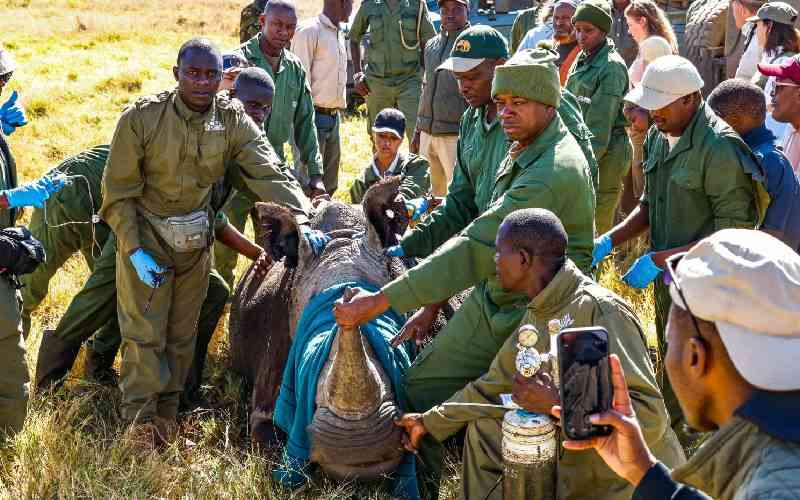
KWS and Lewa Conservancy multidisciplinary team completes an eight-day rhino notching at the Lewa-Borana landscape. [Phares Mutembei, Standard]
The Kenya Wildlife Service (KWS) has partnered with Lewa Wildlife Conservancy in rhino notching at the Lewa-Borana landscape.
A multidisciplinary team comprising veterinary officers, pilots, wardens, rangers and others oversaw the eight-day exercise, which conservationists said is meant to enhance the monitoring, security and conservation of the animals and their habitat.
Kenya's total rhino population stands at an estimated 2,282- two Northern white rhinos, 1,147 black rhinos and 1,133 Southern white rhinos.
Dr Dominic Maringa noted that Lewa has about 200 rhinos, both black and white kinds.
"In total we have 145 black rhinos and 154 white rhinos within Lewa and Borana (conservancies). This is a good population in one part of the entire country and we are proud we have been able to keep up the pace with the growth of the population," he said, during a brief break as teams both airborne and on the ground searched the animals for notching.
Lewa Conservancy hosts more than 10 per cent of Kenya's rhino population, and Maringa said their monitoring and protection were key, hence the notching among other key conservation measures.
He emphasized that black rhinos are a critically endangered species, threatened by poaching for horns, hunting, notching them for close monitoring was crucial.
"We have been called upon to ensure that the population thrives, for Kenya's population and generations to come."
"We are managing quite a big number of rhino population between Lewa and Borana conservancies. We have been hosting nearly 12 per cent of Kenya's black rhino and 7.5 per cent of Kenya's white rhino population," Maringa revealed, adding that they had in the past translocated some to newly established conservancies.
He said the Lewa -Borana landscape had experienced a modest growth rate of the rhinos, but above the 'national threshold.'
"Some years we get 6.5 per cent above the national threshold of five percent, and this is a very good indicator of robust management of the population here. We partner with KWS and other stakeholders in the country who contribute in wildlife conservation efforts," Maringa added.
He said a total of 35 rhinos were notched, 20 of them white.
"In the past we have been doing this exercise once in two years, but owing to the growth of rhinos between Lewa and Borana for the last two years it has now indicated we must notch rhinos every year,” he said.
Stay informed. Subscribe to our newsletter
In a similar exercise last year a total of 46 rhinos were notched while 2024 saw 40 undergo notching.
"It indicates the growth is robust here and we must keep pace with it, otherwise we will end up with a big population of unidentifiable rhinos and that will pose a big challenge for monitoring," Maringa said.
The rangers in the field are charged with identifying and accounting for individual rhinos.
"It enables rhino monitoring and accounting per individual every night and every morning. Therefore, we must do it every year."
Dr Maringa said that giving rhinos to other new conservancies and parks spread across the country enables them to ease the pressure in the ecosystem.
"It is another action that enables us to release the pressure of the rhino population, translocations that occur within here (Lewa) to Borana and other conservancies. It really is another way of easing the population and ensuring that the transfer of genes to other new habitats is met. We have various management actions that enable us to balance the habitat and rhino population."
Last year Lewa translocated six white rhinos to Loisaba Conservancy, a newly established sanctuary in Laikipia.
In 2024, Lewa gave nine black rhinos to Segera Conservancy in Laikipia to open it up for conservation of rhinos.
KWS Senior Assistant Director and Head of Capture Services Dr Isaack Lekolool and Lewa Conservancy Head of Conservation and Wildlife Dr Dominic Maringa led the notching, across the vast landscape that features plains, forests and grasslands.
"This is, basically, putting an identification mark on rhinos. We want to know each animal by an individual ID. Each rhino in Kenya has e name and it is also assigned an identification number," Dr Lekolool said.
The official said it will enable them to account for each animal.
Subscribe to our newsletter and stay updated on the latest developments and special offers!


 Prefer the Standard on Google




 join
join