×

The Standard e-Paper
Home To Bold Columnists
 The Standard Group Plc is a
multi-media organization with investments in media platforms spanning newspaper
print operations, television, radio broadcasting, digital and online services. The
Standard Group is recognized as a leading multi-media house in Kenya with a key
influence in matters of national and international interest.
The Standard Group Plc is a
multi-media organization with investments in media platforms spanning newspaper
print operations, television, radio broadcasting, digital and online services. The
Standard Group is recognized as a leading multi-media house in Kenya with a key
influence in matters of national and international interest.

Audio By Vocalize
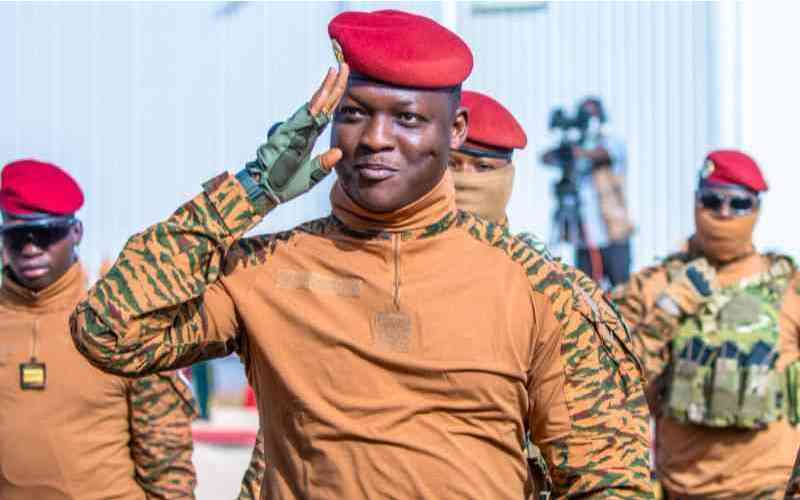
Captain Ibrahim Traore of Burkina Faso. [File Courtesy]
Captain Ibrahim Traore will on Wednesday have led Burkina Faso for four years, the same as Thomas Sankara, the charismatic hero of African rebellion whose legacy he wants to carry forward -- but through harsher measures.
"We'll keep the torch of Burkina's renaissance burning," Traore likes to say, paying tribute to anti-colonial icon Sankara, who he calls the "nation's hero" and "compass".
Both men seized power as red beret-wearing young captains and promoted Pan-Africanism and national, economic and cultural autonomy while silencing dissent.
A Marxist-Leninist firebrand, Sankara seized power aged 33 in an August 1983 coup and embarked on a "democratic and popular revolution" focused on anti-imperialism, self-reliance and national sovereignty.
Nicknamed Africa's Che Guevara, after the iconic figure in Cuba's communist revolution, Sankara blasted the West for neo-colonialism and hypocrisy and carried out radical reforms.
Sankara sought to reduce the cost of running the state, open up and connect rural areas, pursued education for all, women's empowerment and priority for local products
But the "revolution" did not run its full course -- Sankara was gunned down in another putsch in October 1987.
Nearly four decades on, 38-year-old Traore now spearheads his own "progressive and popular" revolution.
It has seen the nationalisation of gold mines and a strategy to revitalise Burkina's industrial output, from cotton to tomatoes and textiles.
He has also launched a major public infrastructure and urban development initiative called Faso Mebo (Build the Country), which relies on enlisting citizens to build roads using local materials.
"Sankara governed under conditions of austerity and with limited resources, relying on rigour and frugal management," teacher and researcher Moussa Kone said.
"Captain Traore, by contrast, governs on a war footing, benefiting from gold revenues and taxes on consumer goods," he added.
Traore's economic policy is heavily promoted in online government propaganda and has played a role in his growing popularity across Africa.
Its success is difficult to independently gauge but Kone confirmed that "numerous projects and worksites" had been launched.
Stay informed. Subscribe to our newsletter
He said that some achievements "sometimes take time to arrive", pointing to the building of a motorway between the west African country's two biggest cities Ouagadougou and Bobo Dioulasso, which is "still in the embryonic stage".
"Sankara had achieved quick results with revolutionary housing estates, the first big housing project launched to ensure dignified access to housing," Kone said.
Traore has also revived the wearing of Faso Dan Fani, a traditional local cotton fabric, by civil servants and in schools, which was originally mandated by Sankara.
But the big difference between the two eras is on security.
Burkina Faso is entrenched in battling jihadist groups, who control a large part of the country and carry out attacks, especially in the north where some towns are even under blockade, despite the mass mobilisation of a civilian volunteer force that supports the military.
Kone said that combat forces were now "better equipped, sometimes with locally manufactured gear, such as light armoured vehicles".
But the north's isolation is particularly symbolic, he stressed, given that Sankara had prioritised opening up the region via a railway line.
Both men dissolved political parties and spoke of "enemies" of the people at home and abroad.
Sankara championed a "democratic and popular" revolution, whereas Traore openly asserts that the country is not a democracy.
While the Sankara years were also marked by repression through purges in the army and special courts that could summarily try counter-revolutionaries, Traore exercises power even more harshly.
Journalists, magistrates and civil society members are regularly abducted and at times sent off to the front lines to boost the ranks of the anti-jihadist forces.
"You can't carry out a revolution in chaos, it's impossible. We are going to enforce order and discipline so that we can move forward," Traore declared last year.
Political analyst Yaya Toure said the "coercive aspect is more oppressive" under the country's current leadership.
"The best revolution is the one that carries the people's aspirations, not the one that oppresses and denies certain fundamental rights," he said.
When it comes to diplomatic ties, the two Burkinabe leaders find common ground in their quest for sovereignty.
Sankara opted for non-alignment during the Cold War, joining countries that chose not to side with either the democratic United States or the communist Soviet Union.
And he championed South-South solidarity, or the mutual backing among countries and people of the Global South.
Traore meanwhile has co-founded a confederation with neighbouring Mali and Niger, broken off ties with former colonial power France and sought new partnerships instead, principally with Russia.
Subscribe to our newsletter and stay updated on the latest developments and special offers!


 Prefer the Standard on Google





 join
join