×

The Standard e-Paper
Kenya's Bold Newspaper
 The Standard Group Plc is a multi-media organization with investments in media
platforms spanning newspaper print operations, television, radio broadcasting,
digital and online services. The Standard Group is recognized as a leading
multi-media house in Kenya with a key influence in matters of national and
international interest.

Audio By Vocalize
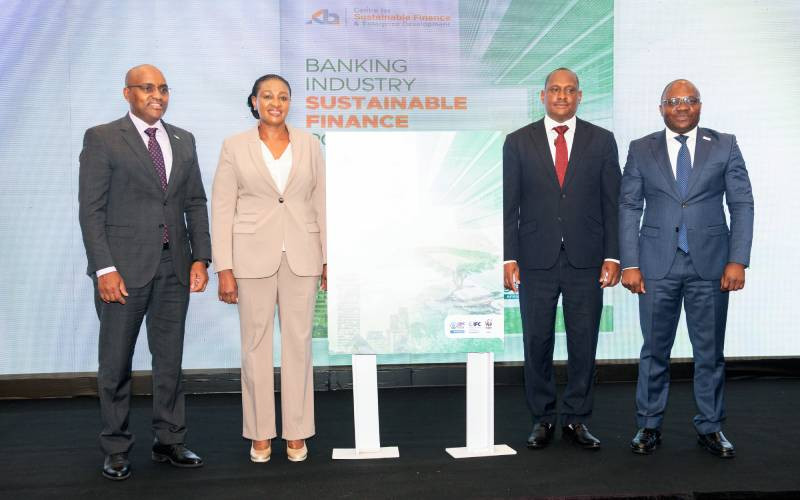
(L) Paul Russo, KCB Group CEO; Betty Korir, Credit Bank CEO; Samson Toniok, NETFUND CEO; and Raimond Molenje, KBA CEO, during the KBA Sustainable Finance Summit. [Wilberforce Okwiri, Standard]
Kenya’s banking sector is targeting $56 billion (Sh7.28 trillion) in sustainable financing under a new five-year roadmap covering 2031 to 2035.
The Banking Industry Sustainable Finance Roadmap is designed to guide financial institutions in expanding sustainable lending, strengthening the management of climate and nature-related risks, improving sustainability disclosures and directing capital towards investments that promote inclusive and sustainable economic growth.
Developed by the Kenya Bankers Association (KBA), through its Centre for Sustainable Finance and Enterprise Development (CSFED), in partnership with the International Finance Corporation (IFC) and WWF-Kenya, the framework provides an industry-wide blueprint for integrating sustainability into banks’ governance structures, risk management, lending decisions, reporting and capital allocation.
The move comes ahead of the implementation of the Central Bank of Kenya’s Climate Risk Disclosure Framework (CRDF).
Across major national frameworks, financing needs are estimated to range from approximately $29 billion (Sh3.8 trillion) to $170 billion (Sh22 trillion) over different periods and policy horizons.
Kenya’s second Nationally Determined Contribution (NDC 3.0), submitted in 2025 for the period 2031–2035, estimates a requirement of about $56 billion at $11.2 billion per year, comprising $22.5 billion for mitigation, $17.7 billion for adaptation and loss and damage and $15.8 billion for actions that deliver both.
Kenya expects to mobilise about 19 per cent of this domestically, leaving 81 per cent dependent on international support and carbon markets.
Principal Secretary, State Department for Environment & Climate Change Eng Festus Ngeno said the framework represents an important step in strengthening the financial sector’s contribution to Kenya’s sustainable development and climate ambitions.
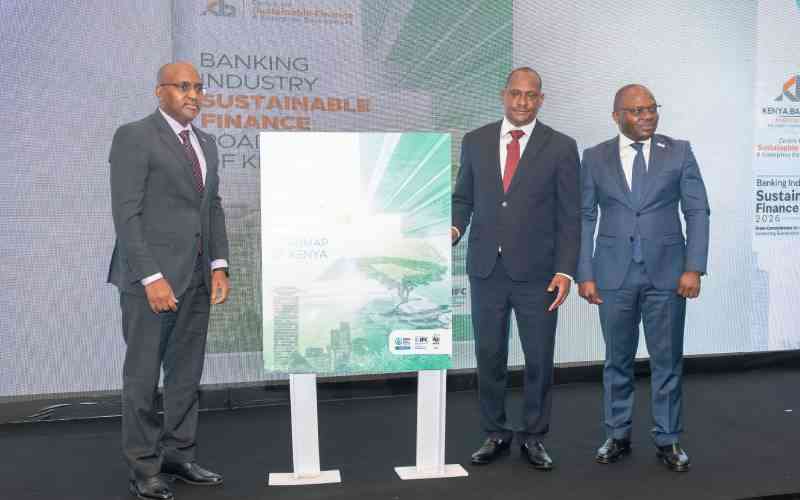
(L) Paul Russo, KCB Group CEO; Samson Toniok, NETFUND CEO; and Raimond Malonje, KBA CEO, during the KBA Sustainable Finance Summit. [Wilberforce Okwiri, Standard]
He said environmental protection must be treated as a core economic priority and that stronger collaboration between government, financial institutions, investors, businesses and development partners will be essential in directing capital towards sustainable investments and supporting the country’s long-term prosperity. “Environmental protection must be understood not merely as a conservation responsibility, but as an essential part of our economic planning and long-term prosperity,” said Ngeno.
“Kenya’s development ambitions cannot be achieved without strengthening collaboration among national and county governments, financial institutions, development finance institutions, investors, businesses and development partners.”
KBA Chairman and KCB Group CEO Paul Russo said the roadmap marks a significant step towards moving the industry from sustainability commitments to practical implementation.
“The roadmap offers an opportunity to consolidate the industry’s progress and set a more practical direction for the next phase of our sustainable finance journey,” said Russo.
Stay informed. Subscribe to our newsletter
“It is intended to help translate our ambitions into an action plan that can guide financial institutions in directing capital towards green and sustainable projects, managing nature- and climate-related financial risks, and strengthening sustainability practices.”
Raimond Molenje, KBA’s chief executive, said the framework brings together various industry initiatives and provides a clear pathway for accelerating sustainable finance adoption across the banking sector.
“This roadmap offers an opportunity to bring together the various strands of work underway and to provide clearer direction on the practical steps required to scale sustainable finance in Kenya. For financial institutions, this means strengthening the integration of sustainability into governance, risk management, reporting and capital allocation,” Molenje said.
jwanzala@standardmedia.co.ke


Subscribe to our newsletter and stay updated on the latest developments and special offers!