×

The Standard e-Paper
Fearless, Trusted News
 The Standard Group Plc is a
multi-media organization with investments in media platforms spanning newspaper
print operations, television, radio broadcasting, digital and online services. The
Standard Group is recognized as a leading multi-media house in Kenya with a key
influence in matters of national and international interest.
The Standard Group Plc is a
multi-media organization with investments in media platforms spanning newspaper
print operations, television, radio broadcasting, digital and online services. The
Standard Group is recognized as a leading multi-media house in Kenya with a key
influence in matters of national and international interest.

Audio By Vocalize
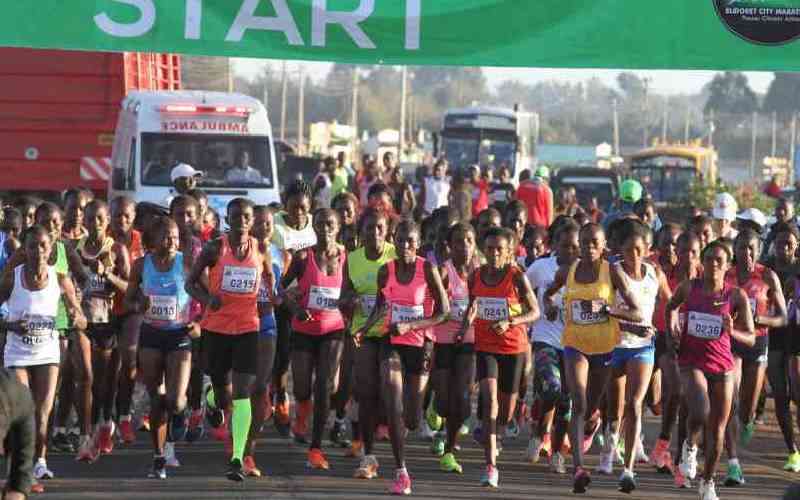
Athletes compete in the 42km women race during the 2nd Eldoret City Marathon in Uasin Gishu County on April 21, 2019. [File, Standard]
Go up to Iten on any ordinary weekday and watch who is actually running. Watch the visitors. The Norwegian who travels with a physiologist. The Briton whose coach carries a tablet full of heart-rate data from the last six weeks. The Japanese group with its own nutritionist and a physiotherapist who goes everywhere they go.
They rent our altitude. They borrow our trails. Then they fly home and beat our athletes using knowledge they collected on our own hills.
Kenya has never lacked talent. Anyone who has stood at the finish line of a county cross country meet knows that much. What we lack is the machinery to turn talent into a long career, and a long career into medals across more than two or three disciplines.
We still find athletes by accident. A boy running to school. A girl who happens to win a county race and happens to be seen by someone who happens to care. Then we lose too many of them to injuries a decent screening programme would have flagged a year earlier.
And when a Kenyan tests positive for doping, we discuss it as a private moral collapse. Sometimes it is. Often it is duller and sadder than that, which is an athlete preparing with no scientific support of any kind, reaching for a chemist's shelf because nobody ever offered him a laboratory.
The countries that overtook us did not have better runners. They had better institutions.
Australia won nothing in Montreal in 1976. Not one gold. The embarrassment led to the Australian Institute of Sport five years later, with coaching science, biomechanics, medicine and nutrition all under one roof. By Sydney 2000, Australia finished fourth in the world.
Britain managed a single gold in Atlanta in 1996 and came 36th. Their answer was brutal, and it worked. Lottery money was pushed through UK Sport into a network of institutes, and funding was tied to results in a way that made officials sweat. 22 later in Rio, they finished second, ahead of China.
Norway has five million people. After a miserable Winter Games in Calgary in 1988, they built Olympiatoppen, and they now top winter medal tables as a matter of routine. Japan opened its Institute of Sports Sciences in 2001 and won 27 golds at home in Tokyo.
We do not even need to look that far. South Africa has run the Sports Science Institute in Cape Town since 1995, wired straight into Springbok rugby, and it is no accident that the Springboks are now the most physically intelligent programme in the world game.
The pattern repeats itself every time. These countries decided that performance was an engineering problem rather than a matter of hope, and then they paid for the engineering.
What frustrates me is that we already own most of the pieces. Kenyatta University and Moi University produce sports science graduates every year who then vanish into jobs unrelated to sport because no federation has ever budgeted for them.
Our altitude camps are a research asset that no one else on Earth possesses, and we lease them out at bed-and-breakfast rates. Government has committed real money to anti-doping, and every shilling of it would work harder if it also bought the science that makes doping pointless.
None of the fix is complicated. Build a national sports science institute with real laboratories, tied to the universities by contract and the federations by law. Make sports science a condition of a coaching licence, so no Division One football coach registers without understanding load management.
Stay informed. Subscribe to our newsletter
Hold data on every carded athlete nationally rather than in a coach's exercise book. Then make federal funding depend on employing qualified staff rather than on how loudly officials shout at press conferences.
We co-host Afcon next year. Harambee Stars will face squads monitored by GPS vests and recovery protocols while ours are still negotiating allowances. Los Angeles follows in 2028.
We can carry on winning by miracle, or we can start winning by design. Only one of those can be planned for.
dgcafrica@gmail.com
Subscribe to our newsletter and stay updated on the latest developments and special offers!


 Prefer the Standard on Google