×
App Icon
The Standard e-Paper
Kenya's Bold Newspaper
★★★★ - on Play Store
Download Now

The pain, poverty and cries of children orphaned by banditry

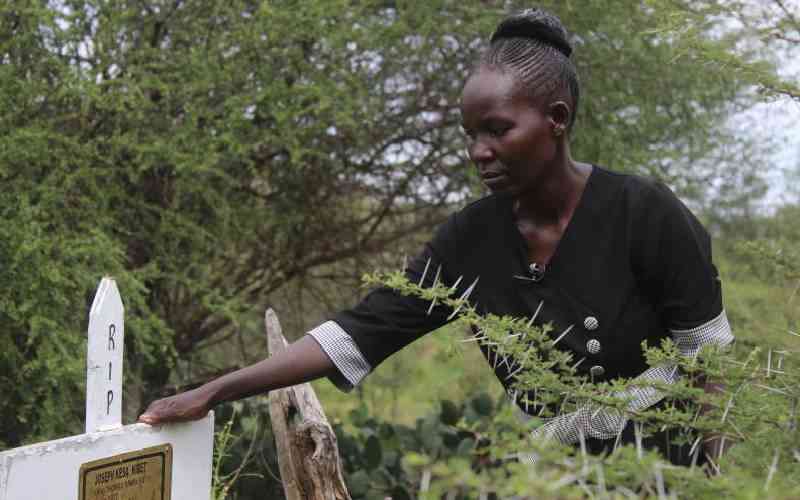
Rebecca Chepsergon whose husband Joseph Kibet was shot dead by bandits at Yatya in Baringo County. [File, Standard]

As the sun sets over the northern plains and rugged terrains of Kenya, a haunting silence settles.

To a traveler in Kapedo, Baringo County, this might appear to be the ordinary tranquility of the countryside.

But for Lilian Ejore, Elizabeth Itur, and Peter Ekaudu, this silence is a reminder of the gunshots that claimed the lives of their loved ones, robbed them of their property, and extinguished their children’s dreams.


According to them, although the guns have “cautiously” gone silent for a moment, the scars of resource wars and livestock raids have left deep wounds, exacerbated by poverty and neglect.

Banditry, marred by indiscriminate killings among communities in the North Rift counties, has for ages made life unbearable for the inhabitants.

Lilian Ejore’s life changed forever on January 11, 2017.

Her husband, then the area chief—driven by a spirit of neighborliness and bravery—volunteered to help fellow villagers whose goats had been raided by bandits.
He never returned alive.

“He left me with four children,” Ejore told The Standard during the publication’s recent visit to the area.

“There is no other way,” she added, her voice trembling under the weight of seven years of grief. “I am struggling with the children; just pray to God that my children get something to eat.”

The lack of a family support system has magnified her burden.

Ejore has no brothers-in-law or sisters-in-law to hold her hand. Her life has become a daily struggle for survival at the tip of a broom.

During intervals of peace, she ventures into the forest to cut branches for broom-making and gather firewood for sale.

But the peace, which appears to have returned, has been like smoke for the better part of her life—when it vanishes, even the forest becomes an enemy.

“Since my husband died, I went to Nairobi to follow up on the savings he had kept, but to this day, I haven’t been able to get anything,” she laments, describing the frustrations that have engulfed her search for her husband’s pension.

Currently, her only hope lies in relief food and the police vehicle, which is often the only means of transport to Nginyang’ market, 80 kilometers away.

In her village, electricity is a distant dream. “We rely on a small M-KOPA solar kit to light the darkness of the night,” she says.

Her plea to the government is one: “Let the government help our children study. We only receive Sh2,000 a month from the Inua Jamii programme—an amount that cannot meet basic needs.”

Recently, the government launched a voluntary disarmament drive to withdraw guns from the hands of civilians wreaking havoc in the region.

The initiative is a multi-agency mission involving the National Police Service (NPS) and the Kenya Defence Forces (KDF).

It followed “Operation Maliza Uhalifu,” launched in February 2023, after the government declared six counties—Baringo, Turkana, Samburu, Elgeyo Marakwet, West Pokot, and Laikipia—“disturbed and dangerous” zones.

Those interviewed told The Standard that the conflicts began in the early 1980s, as communities battled over grazing fields, boundaries, and bragging rights.

For Elizabeth Itur, poverty is not just a state of being, but a chain forged by endless conflict.

Itur, an elderly woman, weaves baskets and makes brooms, but her market is barricaded by poor infrastructure.

“Previously, we often failed to take the baskets to the market because of the lack of peace,” Itur says.

But even with the return of peace—which they hope will last—these goods that could have lifted her economically now rot in the village due to limited means of transportation.

Every time a new conflict erupts, social relations break down, and communities clash again, undoing all development efforts.

Elizabeth lost her biological father and brother in these wars.

“Children have been left as orphans, women have been left as widows,” she says sadly.

To her, the solution lies not just in disarmament, but in uniting the community. She urges the government to address the root causes: cattle rustling, natural disasters, and boundary disputes.

“Let the government do something meaningful—unite us and remove us from poverty.”

While Lilian and Elizabeth represent the pain of those left behind, Peter Ekaudu embodies the agony of many who survived but were left with lifelong disabilities.

In 2012, Peter was shot in the leg and seriously injured by bandits.

Although he received treatment at Kenyatta National Hospital (KNH), the injury left him disabled and stripped him of his ability to provide for his family.

“My wife and children had to leave and return to their paternal home in Isiolo because I could no longer provide for them,” Peter narrates sorrowfully.

The raid did not just steal his ability to walk or work; it dismantled his family.

Peter is a living example of how banditry has destroyed dignity and broken the foundations of society.

The stories of Lilian, Elizabeth, and Peter mirror the lives of thousands affected by insecurity in the North Rift.

They are narratives of extreme poverty, lack of education, poor healthcare, and the constant fear of raids.

According to the survivors, peace-building efforts by several non-state actors, including Interpeace International Organisation, laid the foundation for the relative peace communities enjoy today.

Data from the Ministry of Interior shows that at least 1,200 illegal firearms owned by locals have been recovered.

Ejore’s plea for her children’s education is a cry to break the cycle of poverty; Itur’s call for unity is a demand for lasting peace; and Peter’s condition is a reminder that the wounds of war require more than bandages—they require justice, development, and healing.

Without decisive action, locals fear these regions will remain “graveyards of dreams,” where brooms and baskets wait for markets that never arrive, and orphans gaze skyward, hoping that one day a police vehicle will not be their only means of transport—but a symbol of genuine peace.

Residents now urge the government that when the guns go silent, it should not only deploy soldiers and police officers, but also build and reconstruct schools, hospitals, roads, and other development projects to alleviate poverty.