×

The Standard e-Paper
Smart Minds Choose Us
 The Standard Group Plc is a
multi-media organization with investments in media platforms spanning newspaper
print operations, television, radio broadcasting, digital and online services. The
Standard Group is recognized as a leading multi-media house in Kenya with a key
influence in matters of national and international interest.
The Standard Group Plc is a
multi-media organization with investments in media platforms spanning newspaper
print operations, television, radio broadcasting, digital and online services. The
Standard Group is recognized as a leading multi-media house in Kenya with a key
influence in matters of national and international interest.

Audio By Vocalize
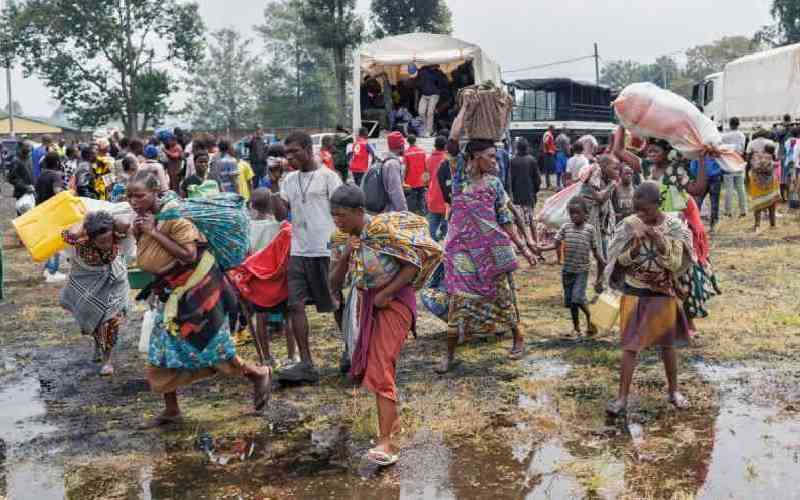
Congolese refugees fleeing clashes in Eastern Democratic Republic of Congo arrive at the Rugerero transit camp in Gisenyi on January 28, 2025. [AFP]
Congolese minister of Regional Integration Floribert Anzuluni recently presented an official protocol for the ‘demobilisation and disarmament’ of FDLR militia to international interlocutors.
The protocol was countersigned by the militia's political leader, Gaston Iyamuremye, alias Victor Byiringiro framing the move as a ‘voluntary surrender’ that strips Rwanda of its security justifications in the region.
Kinshasa demands that to ‘fully implement’ the Washington peace process, Kigali must enter into direct political dialogue with the militia after what the Congolese side presented as the culmination of a process of voluntary surrender of their partners.
Clearly, this is a tactic by Kinshasa to distract from its primary obligation to neutralise the militia group founded by perpetrators of the 1994 Rwandan genocide. Those who know President Félix Tshisekedi’s modus operandi understand that this is a calculated move to impede and subvert the Washington peace process, which commits the regime to a time-bound, intensified military operations to completely FDLR.
The move comes after Washington exerted pressure on Kinshasa to demonstrate concrete progress toward its strict obligation to neutralize FDLR. For decades, Kinshasa has struggled to dismantle the very militia it has historically supported and embedded within its own national security and political systems.
Confronted by mounting international pressure, Kinshasa has opted to substitute the Washington peace agreement with its own invented approach, designed to shield its long-term partners while creating a false narrative that Kigali is the party failing to reach an understanding with FDLR.
However, FDLR is not a conventional rebel movement or a standard insurgent group; it is a US and UN – sanctioned terrorist group, founded and led by perpetrators of the 1994 Genocide against the Tutsi in Rwanda. The primary argument against any political engagement with FDLR genocidaires remains firmly anchored in the 1948 UN Genocide Convention.
Article I establishes an absolute, non-negotiable duty for signatory states to prevent and punish the crime of genocide. Substituting criminal prosecution with political negotiations would undermine the international legal principle of the obligation to extradite or prosecute.
Rwanda’s domestic legal framework and its history of compliance with customary international law mandate the judicial accountability of all individuals linked to the 1994 genocide. To legitimise them at a negotiating table under the guise of a manufactured peace process would render the state complicit in subverting global justice.
The principle of non-complicity forbids third-party states from aiding, enabling, or tolerating genocidal groups within their borders. Attempting to force a sovereign nation into dialogue with such an entity effectively validates state-sanctioned safe havens for mass killers, flying in the face of international humanitarian law. Unfortunately, FDLR backed by Kinshasa continues to preserve, defend, and actively propagate the same anti-Tutsi genocidal ideology that fueled the atrocities of 1994.
Opening a dialogue with such an entity, or treating its political signatures as valid currency, would signal to the global community that genocide can be used as a legitimate bargaining chip for political relevance. It would normalise the militia’s foundational philosophy and violate the spirit of ‘Never Again.’ International law functions to deter mass atrocities by completely removing the possibility of political survival or impunity for perpetrators.
While Kinshasa attempts to utilise this new protocol to disrupt the Washington framework and shift the diplomatic narrative, the internationally backed mechanisms for regional peace reject the premise of political accommodation. The Washington peace agreement does not call for dialogue with FDLR. It explicitly demands the group's irreversible and verifiable neutralisation and disarmament.
-The author is a survivor of the Genocide against the Tutsi of Rwanda
Stay informed. Subscribe to our newsletter
Subscribe to our newsletter and stay updated on the latest developments and special offers!

 Prefer the Standard on Google





 join
join