×

The Standard e-Paper
Kenya’s Boldest Voice
 The Standard Group Plc is a
multi-media organization with investments in media platforms spanning newspaper
print operations, television, radio broadcasting, digital and online services. The
Standard Group is recognized as a leading multi-media house in Kenya with a key
influence in matters of national and international interest.
The Standard Group Plc is a
multi-media organization with investments in media platforms spanning newspaper
print operations, television, radio broadcasting, digital and online services. The
Standard Group is recognized as a leading multi-media house in Kenya with a key
influence in matters of national and international interest.

Audio By Vocalize
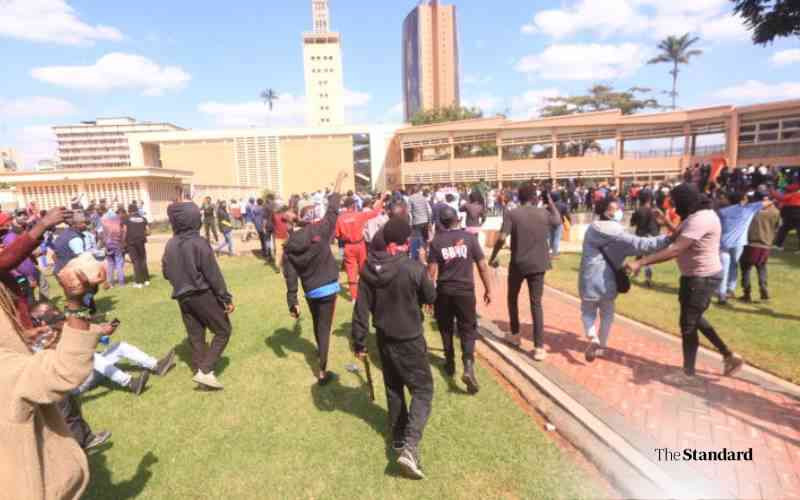
There is a kind of memory the powerful fear most. Not the vague, blurring kind that softens with years and eventually fades into sentiment. No — they can survive that. What they cannot survive is the sharp, graphic, unsparing kind. The kind that remembers not only what happened, but how it happened, who made it happen, and what has continued to unfold in its long and bitter wake. That is the memory that is now living rent-free in the conscience of this nation. And the system is not comfortable. It was not supposed to be remembered this clearly.
June 25, 2024 was supposed to become fog. The broad-based government — that curious political architecture assembled on the promise of inclusion and national healing — expected that time, political noise, and strategic distraction would do their usual work. They expected people to grow weary of grieving. They underestimated the dead.
Sixty-five young Kenyans fell. They had no guns. They had bottles, phones, and flags. They crossed a line because their lines had already been crossed — by corruption so brazen it had become policy, by a political class that had turned governance into personal accumulation, by a budget that asked the poorest citizens to fund the extravagance of the richest institutions. They came into the streets because their futures had already been stopped. The state responded with bullets. The state has never satisfactorily explained why.
This is a theological problem before it is a political one. In the moral architecture of every serious religious tradition, the blood of the innocent cries out. It does not whisper. It does not negotiate. It cries. The Hebrew scriptures understood this with terrible clarity: Abel's blood called from the ground. The prophets named it plainly — you cannot build a nation on the corpses of children and call it blessed. You cannot kill young people who are legitimately resisting oppression and then invoke the language of "security threats" as though the true threat was not to the people but to the powerful. God is not mocked by semantics.
What makes June 25 an enduring moral wound is not just what happened that day but what happened after. The language from the government was never remorse. It was threat. It was reframing. It was the audacity of co-optation — the attempt by some in the broad-based arrangement to claim that the Gen Z uprising was merely an extension of their own political movement. To take the moral authority of young people who stood in the streets, who bled, who buried their friends, and to harvest it as partisan capital — that is not just dishonest. It is a desecration.
And here is where the church must also sit in the dock. Because some of the children who were buried were buried by churches that had endorsed the very government whose bullets ended them. They were given God's blessing and the state's mandate in the same breath. "God-given" was the language deployed. The dead were then brought to altars that had, weeks earlier, prayed for the government. That is a memory too. History is not selective in its witness. It remembers the church's endorsements alongside the state's executions. Both belong to the record.
The broad-based government has never recovered from June 25. That much is plain to any clear-eyed observer of Kenyan politics. The Gen Z moment did not end on that day — it inaugurated an era. We now live in what can only be called the post-Gen Z demonstrations era, a period in which young people are simultaneously respected and loathed, celebrated and surveilled, praised in speeches and menaced in the streets. The political terrain has been permanently altered. Those who try to pretend otherwise are not being strategic — they are being delusional.
The broad-base has confused possession with purpose. Drunk on power and drowning in resources, it has abandoned the most elementary duty of governance: relationship with the governed. The people are not blind — they see the layers of greed wrapped inside every development project. They have learned to speak back in the only language the system understands: give us money. But a government that buys crowds has not won hearts. And money, for all its power, cannot purchase legitimacy. Even wealth has a ceiling.
And then there is this specific irony, which must be named: if there is any wing of this broad-based arrangement that should be loudest in championing the right to peaceful demonstration, it is the ODM faction. They owe their current political relevance, in no small measure, to the moral energy that Gen Z released into the public square. It is a debt that demands honesty, not strategic silence.
The system would make the memory of June 25 illegal if it could. But here is the good news — and it is genuinely good news — the system does not have total power. They can do much. They cannot do everything. They can intimidate. They cannot silence conscience. They can deploy force. They cannot manufacture forgetting. A government that portrays itself as limitless must be reminded, with the calm clarity of moral truth, that it has limits. The arrogance of assumed omnipotence is its own kind of corruption.
There is a spiritual principle at work here that transcends politics: you cannot force people not to remember. The more pressure applied to suppress a memory, the more vivid it becomes. The more you push it underground, the more it surfaces in unexpected places — in songs, in silences, in the eyes of a generation that watched the state kill its peers. Memory pressed becomes memory sharpened. The blood of the sixty-five is now part of Kenya's moral vocabulary, and no amount of political noise will bleach it out.
Every system must reckon with its full history — not only its crowns but its crimes. A system that only remembers its achievements is prideful. A system that buries its atrocities is hypocritical. And a system that uses its accomplishments as a running escape from its spectacular failures is simply not serious about governance. The broad-based government has operated with a certain do-no-wrong posture — a kind of political infallibility it does not possess and cannot sustain. The gaps between its promises and its performance are not hairline fractures. They are chasms. And they are visible. Any attempt to fill them with spin only exposes how wide they are.
June 25 is a conscience matter. National conscience cannot be managed by press releases. It is tended by truth-telling, by accountability, by the willingness to say — plainly and without political calculation — we were wrong, and those young people deserved better. Until that day comes, the memory will remain exactly what it is: a judgment on a nation that killed its children and then asked to be trusted with their future.
No soap can wash that off. Any attempt to bleach it only makes it brighter.
Stay informed. Subscribe to our newsletter
Subscribe to our newsletter and stay updated on the latest developments and special offers!

 Prefer the Standard on Google








 join
join