×

The Standard e-Paper
Home To Bold Columnists
 The Standard Group Plc is a
multi-media organization with investments in media platforms spanning newspaper
print operations, television, radio broadcasting, digital and online services. The
Standard Group is recognized as a leading multi-media house in Kenya with a key
influence in matters of national and international interest.
The Standard Group Plc is a
multi-media organization with investments in media platforms spanning newspaper
print operations, television, radio broadcasting, digital and online services. The
Standard Group is recognized as a leading multi-media house in Kenya with a key
influence in matters of national and international interest.

Audio By Vocalize
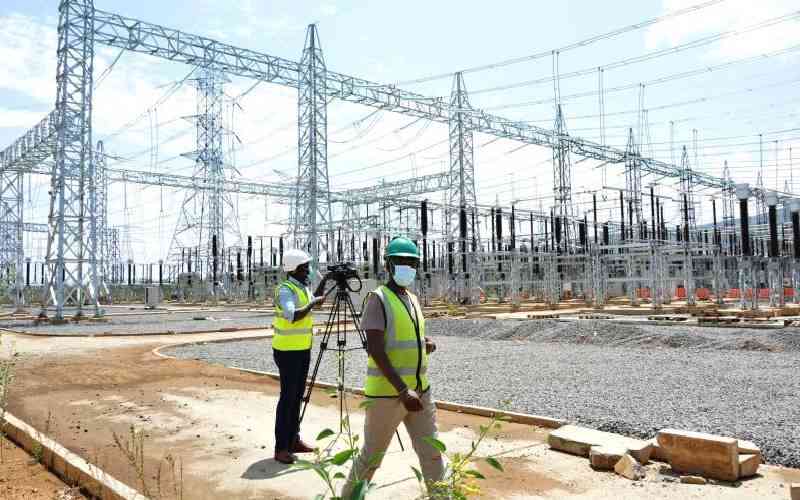
Electricity is often spoken about in terms of megawatts, power lines and sub-stations. Yet for millions of Kenyans, its true value is felt not in technical terms, but in lives saved, businesses sustained, knowledge unlocked, and dignity restored.
It is felt in the operating theatre when a life is saved without interruption. It is heard in the hum of a milk chiller preserving a farmer’s produce and in a workshop where youth earn a living instead of drifting into despair.
The completion of the Lessos–Kabarnet Transmission Line by the Kenya Electricity Transmission Company (KETRACO) is a testament of the impact to be felt now that electricity has been extended in that region. This is not just an engineering milestone, it is a line that carries with it opportunity, and promise of inclusive growth. It is a statement about the kind of development the government is undertaking: people-focused, inclusive, and built to last.
This project is an illustration of how strategic infrastructure underpins economic transformation, not in theory, but in lived reality. The line stretches for about 65km, linking the 220/132kV Lessos sub-station in Nandi Hills to a newly constructed 132/33kV one in Kabarnet. The line traverses Nandi, Uasin Gishu, Elgeyo Marakwet, and Baringo counties.
It does three strategic things simultaneously. First, it replaces the overstretched 33kV supply from Lessos with a robust high-voltage backbone, dramatically improving voltage quality and reducing outages. Second, it strengthens grid stability in the North and Central Rift. Third, it prepares the region for future, integrating seamlessly with the planned 132kV Kabarnet–Rumuruti Transmission Line, which will link this corridor to the Mt Kenya network and enable power flows from geothermal plants, the Seven Forks hydropower complex, and wind power from Loiyangalani.
In energy planning, foresight is critical. Transmission lines are not built for the present alone; but for future generations as well. For residents of Baringo and its environs, stable power has been more of an aspiration than reality.
Small and medium scale manufacturers have faced high operational costs that have limited their growth and opportunities for job creation. The arrival of reliable transmission infrastructure changes this equation fundamentally.
Nowhere is the human value of electricity clearer than in healthcare. For years, hospitals in Baringo and Elgeyo Marakwet counties operated under constant uncertainty, relying heavily on diesel generators.
The cost has been high, the risks even higher. With the new line, institutions such as Kabarnet County and Koibatek Sub-County Referral Hospitals, Marigat and Mogotio Sub-County Hospitals, Chemolingot Hospital in Tiaty, and Kabartonjo Hospital in Baringo North can now depend on a stable grid power.
Operating theatres, maternity wards, nurseries for newborns, laboratories, imaging equipment, vaccine cold chains, and digital health systems can function reliably and affordably. When hospitals function efficiently, families avoid catastrophic health costs. In this context, electricity is not merely energy infrastructure but a social infrastructure. This is development aligned with the Bottom-Up Economic Transformation Agenda. It is a clear expression of President William Ruto’s vision of transforming Kenya into a modern, first-world industrial economy.
County-driven industrial initiatives - among them the Baringo Cha Coffee Mill; the Kerio Valley mango processing plant; Salawa cotton ginnery, Sabakia dairy cooperative, and the Mogotio Sisal Factory - can now operate uninterrupted to supply local, regional, and international markets. This is how rural economies industrialise.
Small enterprises will be among the biggest winners. Barbershops, salons, welding workshops, schools, hotels, retail outlets, and other businesses that could not afford diesel generators now have access to a stable, affordable energy lifeline.
The region’s natural resources tell another story of untapped potential. Baringo - often called Kabarmawe, the land of stones, has abundant raw materials for stone crushing, ballast production, clinker, and cement manufacturing. This aligns with the vision of investors such as Devki Group, which has expressed interest in establishing cement factories across counties.
Mining and processing activities - including diatomite operations in Tiaty and Baringo North and the potential revival of the Kenya Fluorspar Company in Elgeyo Marakwet - depend on reliable power. With stable electricity, Baringo and Elgeyo Marakwet can move from exporting raw materials to producing finished goods, including clinker and cement, whose demand has been growing.
Stay informed. Subscribe to our newsletter
Reliable power also reshapes livelihoods. Facilities such as the Maoi Abattoir, long underutilised, can now be modernised to handle integrated meat processing, as well as the handling and value addition of hides and skins. Value addition in meat and leather will create more jobs, support exports to markets such as the Middle East, and strengthen food security in the region. Livestock markets like Kimalel Goat Auction - supported by President William Ruto - can evolve from periodic events into year-round export-oriented industries.
Education and research institutions will now have the robust power backbone backed up with digital connectivity, since KETRACO’s transmission lines also carry fibre optic cables. From Kerio Valley to Kabarak Universities; from Baringo National Polytechnic to Eldama Ravine Technical Training Institute, and other TVET centres across the region, learning centres can now become digital hubs, unlocking skills development, innovation, and applied research.
All these developments matter in a region once associated with insecurity. And as peace takes root, electricity will power the shift from banditry to business, and from survival to dignity. Although transmission lines rarely make headlines, they quietly determine whether nations succeed socially and grow economically.
The commissioning of the Lessos–Kabarnet Transmission Line sends a powerful signal that Kenya understands infrastructure as a catalyst for opportunity, one that will underpin the country’s transformation.
Subscribe to our newsletter and stay updated on the latest developments and special offers!







 join
join