×
App Icon
The Standard e-Paper
Join Thousands Daily
★★★★ - on Play Store
Download App

No water, no hospital, no network: Bori residents face displacement over neglect

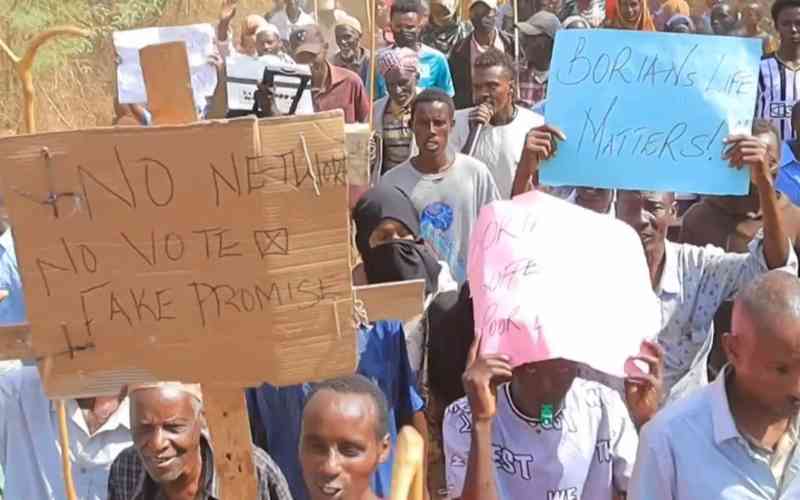
Bori residents hold protests, accusing  national and county governments of long-standing neglect. [Bruno Mutunga, Standard]

Residents of Bori Location in Moyale Sub-County, Marsabit County, have accused successive national and county governments of long-standing neglect, warning that the continued lack of basic social amenities is pushing the community toward displacement.

The residents, who staged protests, say their fundamental rights  have been ignored as Bori remains without clean water, a functional health facility, passable roads, or mobile and internet connectivity. They warn that conditions have deteriorated to a point where families are now contemplating abandoning their ancestral homes in search of basic services elsewhere.

More than 2,000 people in Bori Location have lived without a reliable water source for the past four years after pipelines supplying the area were destroyed by floodwaters following heavy rains. Despite repeated appeals to authorities, the damaged infrastructure has not been repaired, forcing residents to depend on unsafe and distant water points.


“The government has abandoned us,” residents said during the protests. “We are being forced to choose between leaving our homes or risking our lives.”

Healthcare in the area is equally dire. According to Wario Gufu Jillo, a resident of Bori, the growing population urgently needs a fully equipped health centre, yet the community relies on a single dispensary staffed by only one nurse and frequently short of essential medicines.

“Pregnant women, the elderly, and children suffer the most,” Wario said. “In emergencies, people have to travel long distances on bad roads to reach better facilities, and sometimes they do not make it.”

The health crisis has been worsened by staffing challenges across Marsabit County, where several health workers have reportedly quit due to delayed or unpaid salaries. Residents say this has left facilities such as the Bori dispensary operating far below capacity.

Education, often seen as the community’s last lifeline, is also under threat. Bori Primary School, which serves more than 700 pupils, has no access to clean water. Residents fear the continued water shortage could soon force the school to shut down.

“If the school closes, our children’s future will be destroyed,” said Wario. “Education is the only hope we have.”

Bori’s location along the Kenya–Ethiopia border has further compounded its marginalisation. Residents say the area has been neglected since independence, despite its strategic position.

“Sometimes we wonder whether we are Kenyans or refugees,” Wario lamented. “We vote like other citizens, but we are treated as if we do not exist.”

Area elder Adan Ali narrated how politicians routinely visit the area during election campaigns, making promises that are never fulfilled.

“They come here asking for votes, promising water, roads, and hospitals,” he said. “After elections, they disappear. We are left suffering.”

The community’s isolation is intensified by a complete communication blackout. Bori has no mobile network coverage, forcing residents to walk at least 10 kilometres to access a signal. As a result, news from the rest of the country reaches the area days or even a week late.

“When you enter Bori, you disappear from Kenya,” said Ibrahim Abduba Ali, a local opinion leader. “The world switches off.”

Residents say the lack of connectivity has serious implications, including delayed emergency responses, limited access to information, and economic exclusion.

With living conditions continuing to worsen, many families are now considering relocating to other areas where they can access water, healthcare, education and communication services.

The residents have appealed directly to the national government, calling on President William Ruto to intervene and address what they describe as a growing humanitarian crisis in the border community.