×

The Standard e-Paper
Kenya’s Boldest Voice
 The Standard Group Plc is a
multi-media organization with investments in media platforms spanning newspaper
print operations, television, radio broadcasting, digital and online services. The
Standard Group is recognized as a leading multi-media house in Kenya with a key
influence in matters of national and international interest.
The Standard Group Plc is a
multi-media organization with investments in media platforms spanning newspaper
print operations, television, radio broadcasting, digital and online services. The
Standard Group is recognized as a leading multi-media house in Kenya with a key
influence in matters of national and international interest.

Audio By Vocalize

Uncertainty over Kenya’s abortion laws is raising concerns over the ability of women and girls to obtain timely reproductive healthcare, with civil society groups calling for clearer rules to protect patients and guide healthcare providers.
The groups say the legal ambiguity comes at a time when abortion remains a significant public-health issue, with an estimated 792,694 induced abortions recorded in Kenya in 2023 alongside 1.44 million unintended pregnancies.
They argue that the figures expose the gap between the law, healthcare realities and the experiences of women and girls seeking reproductive services, particularly those in poor, rural and underserved communities.
Sharon Amanda of the Reproductive Health Network Kenya said women should not be forced to navigate a complicated legal and healthcare system when seeking information or treatment.
“Women and girls need clear information and services that respond to their health needs without fear, stigma or unnecessary delays. Legal uncertainty should not become a barrier to care,” Amanda said.
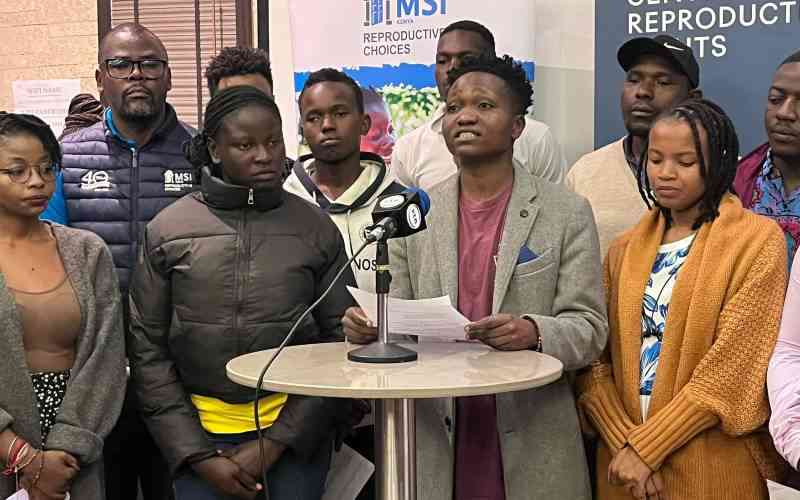
The concerns have been amplified by the changing interpretation of Kenya’s abortion laws, with Article 26(4) of the Constitution providing specific circumstances under which abortion may be permitted, while sections 158, 159 and 160 of the Penal Code contain criminal provisions relating to abortion.
A Court of Appeal decision delivered in April 2026 further altered the legal landscape by holding that abortion is not a fundamental constitutional right, while recognising the circumstances provided for under Article 26(4).
David Omega of the Centre for Reproductive Rights said the competing provisions have implications beyond courtrooms, particularly for doctors who must make decisions about patient care.
“The law must be understood in its entirety. Article 26(4) sets out circumstances in which abortion may be permitted, while the Penal Code contains criminal provisions. That tension needs to be addressed so that patients and healthcare providers are not left navigating uncertainty,” Omega said.
The organisations are asking Parliament to examine whether the existing Penal Code provisions are sufficiently aligned with the Constitution and consider proposed amendments, including the proposed insertion of Section 160A.
The provision would create a defence for actions undertaken in accordance with Article 26(4), an issue the groups say is relevant to healthcare providers operating within the constitutional framework.
But the debate extends beyond the question of whether abortion is permitted.
The organisations say Kenya’s health system must also be equipped to prevent unintended pregnancies, provide reproductive-health information, manage complications and offer post-abortion care.
The latest national abortion study found gaps in the capacity of health facilities to provide comprehensive post-abortion care, raising concerns about the ability of the health system to respond to complications.
Rackel Otieno of Raise Your Voice CBO said the discussion should focus on the people affected by the country’s legal and health systems.
Stay informed. Subscribe to our newsletter
“We are asking for a conversation based on evidence rather than misinformation. Behind these numbers are women, girls and families who need timely healthcare, and the health system must be prepared to respond,” Otieno said.
Adolescents are among those facing additional barriers. The Kenya Demographic and Health Survey 2022 found that 15 per cent of girls aged 15 to 19 had begun childbearing.
The groups said young people need access to accurate sexual and reproductive health information, contraception, confidential services and appropriate care for unintended pregnancies and complications.
They also called for better training of healthcare workers on the legal and policy framework, stronger referral systems and adequate reproductive-health commodities, particularly in rural and underserved facilities.
For the organisations, the question before Parliament is therefore not only whether existing laws are constitutionally coherent, but also whether the health system can translate those laws into safe and timely care.
They urged policymakers to provide clear public information on the constitutional, statutory and judicial framework governing abortion while strengthening the capacity of healthcare facilities to respond to reproductive-health needs.
The groups said reducing misinformation and legal uncertainty would help patients, healthcare workers and the public better understand the framework under which reproductive healthcare is provided in Kenya.
Subscribe to our newsletter and stay updated on the latest developments and special offers!

 Prefer the Standard on Google







 join
join