
 The Standard Group Plc is a multi-media organization with investments in media
platforms spanning newspaper print
operations, television, radio broadcasting, digital and online services. The
Standard Group is recognized as a
leading multi-media house in Kenya with a key influence in matters of national
and international interest.
The Standard Group Plc is a multi-media organization with investments in media
platforms spanning newspaper print
operations, television, radio broadcasting, digital and online services. The
Standard Group is recognized as a
leading multi-media house in Kenya with a key influence in matters of national
and international interest.


First Lady Rachel Ruto has said the fight against HIV, adolescent pregnancy and sexual and gender-based violence, dubbed the triple threat, must move beyond warnings and statistics to protect children from risks.
Speaking at Mawego National Polytechnic in Homa Bay County during a mentorship and advocacy engagement with adolescents and young people, the First Lady said there was a need for stakeholders to work together to end the triple threat.
Mrs Ruto regretted that children, particularly adolescent girls, are often exposed to exploitation because of poverty, unsafe environments and adults who take advantage of their vulnerabilities.
“Teenage pregnancies, HIV and sexual and gender-based violence are still a serious challenge among our adolescents. We must treat the triple threat with the urgency it deserves to end it,” she said.
She described the reality facing a girl growing up in Homa Bay, where a boda boda rider may offer her a lift in exchange for sexual favours, an older man may lure her with money, or an adult known to her family may exploit her trust.
While children have repeatedly been warned about HIV and teenage pregnancy, she said many need more than lectures. They need adults who listen, protect and walk with them.
“The shift from talking at our children to sitting with them. From warning them to walking with them,” said Mrs Ruto. “Sometimes, our children do not need another warning. They need someone to walk with them.”
- Healthcare gaps leave 70 of epilepsy patients neglected
- Too young to be mothers: Inside Kenya's teenage pregnancy crisis
- Curbing HIV Transmission
- Of teen pregnancies and lost dreams; inside the lone burden
Keep Reading
Homa Bay is among counties documenting high cases of unwanted pregnancies, gender-based violence and HIV infections among adolescents.
According to the National Syndemic Diseases Control Council (NSDCC), Homa Bay carries one of the highest HIV burdens in the country, with prevalence estimated at 11.6 per cent.
The 2026 data shows that at least 997 new HIV infections were reported, among them 133 in children aged between 10 and 14 years, and 288 among those aged between 15 and 19 years.
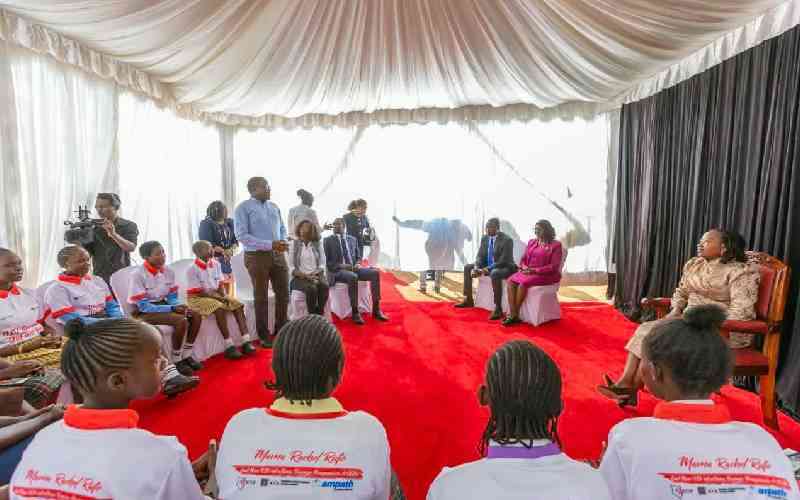
Mrs Ruto urged adolescents to speak out whenever they are exposed to the triple threat.
“Let each person in society be committed to protecting children against the triple threat,” she said.
“Adolescent pregnancy and sexual and gender-based violence remain other major threats to children’s safety, education and future. But many cases of abuse remain unreported and perpetrators unpunished,” she added.
Homa Bay Governor Gladys Wanga said the triple threat is a matter close to her heart because children carry a very big burden that is not necessarily supposed to be theirs.
“If you think of new HIV infections when the parents are living with HIV, are infected and have to go to hospital, the burden is felt on children,” said Wanga.
“When the parents die early, again children become heads of households in many homes,” added the Governor.
She said sometimes children are infected with HIV without their knowledge.
Wanga said there has been progress in reducing HIV infections and pregnancies among adolescents and young people.
For example, in 2022, Homa Bay recorded 14,000 cases of teenage pregnancies, a figure that has dropped to 7,000.
“Thinking of GBV, a lot of adolescents are getting violated, and when this is reported within the house, there is no peace for the child, who too turns out to be a victim. On teenage pregnancies, they cease to be statistics when you walk into a facility and find a child bearing a child,” said Wanga.
“In maternity wings, we find children having children. It is a heavy burden. This is why mentorship is key, because a mentored person is focused and empowered, and has their life changed,” she said.
NSDCC Chief Executive Officer (CEO) Douglas Bosire said the country has made progress in the response towards ending AIDS as a public health threat over the years.
For instance, in Homa Bay, at least one out of three people was living with HIV, a figure that has gradually reduced over the years to the current 15 per cent.
The burden of the disease in other counties in the Nyanza region has also dropped, according to Bosire.
However, he said HIV infections remain high among adolescents and young people, making ending the triple threat a key priority.
“Reducing infections of HIV and AIDS is a beacon of hope. We have learnt lessons, but we cannot keep on mopping the floor when the tap is running. This is why ending the tap of new HIV infections matters a lot,” said Bosire.
Out of 13,996 new HIV infections reported in the 2026 data, at least 41 per cent occurred among individuals aged between 15 and 24 years.
“This is a virus affecting predominantly young people. This is why we have a discussion on ending the triple threat,” said Bosire.
Additionally, pregnancies among children remain high. For example, each day, at least 346 girls aged between 10 and 19 years were seen at antenatal clinics (ANC) in 2025.
The head of the National AIDS and STI Control Programme (NASCOP), Andrew Mulwa, said new infections remain a major hindrance to ending HIV and AIDS by 2030.
“New HIV infection is a challenge in attaining global AIDS targets of ending HIV by 2030. In Kenya, individuals in the age bracket of 15 to 25 years are highly affected by new HIV infections,” said Dr Mulwa.
Data shows that at least 1.4 million people are living with HIV in Kenya, among them 1.25 million who are on antiretroviral (ARV) treatment.
Mulwa added that more emphasis has been put on ensuring Kenyans know their HIV status, are enrolled on treatment and have suppressed viral loads, which stand at 93, 91 and 87 per cent, respectively.
In 2023, the First Lady launched the national campaign under Kenya’s Commitment Plan to End the Triple Threat 2023–2030, in partnership with the Organisation of African First Ladies for Development (OAFLAD).
This second phase of the campaign, dubbed End Triple Threat by 2030, covers Homa Bay, Samburu, West Pokot and Uasin Gishu. The first phase covered Meru and Narok.
The First Lady said the programme also involves training health workers on how to offer adolescent-friendly services. At least 200,000 health workers have been trained across the counties.
Further, she called on communities to protect children rather than perpetrators and urged young people to support their peers. She also urged boys and girls to stay in school, protect their dreams and speak up when they encounter abuse or exploitation.
“Do not allow anyone to convince you that your future is the price you must pay for money, acceptance or affection. Your body is yours. Your future is yours. And your dreams are worth protecting,” she advised.
At the same time, she challenged parents and guardians to begin real conversations with their children to help eliminate the triple threat, rather than waiting for them to become victims of early pregnancies and HIV infections.
Medical Services PS Ouma Oluga assured that the government will continue to support the fight against the triple threat.
Dr Oluga announced that the Government, through the Social Health Authority, had allocated Sh1 billion to support teenage mothers.
“Teenagers undergo serious trauma when affected by the triple threat. The allocation will improve their lives,” he said.
At the same time, he called for the need to boost antenatal care (ANC) to avert maternal and child deaths.
“We want to ensure we increase the number of women attending ANC from the current 58 per cent to 90 per cent,” said Oluga.
“We need all mothers to attend ANC so that problems can be identified early, like blood pressure and anaemia, to end complications before childbirth,” he added.
ANC attendance in Homa Bay stands at 61 per cent, against 58 per cent nationally.






 join
join