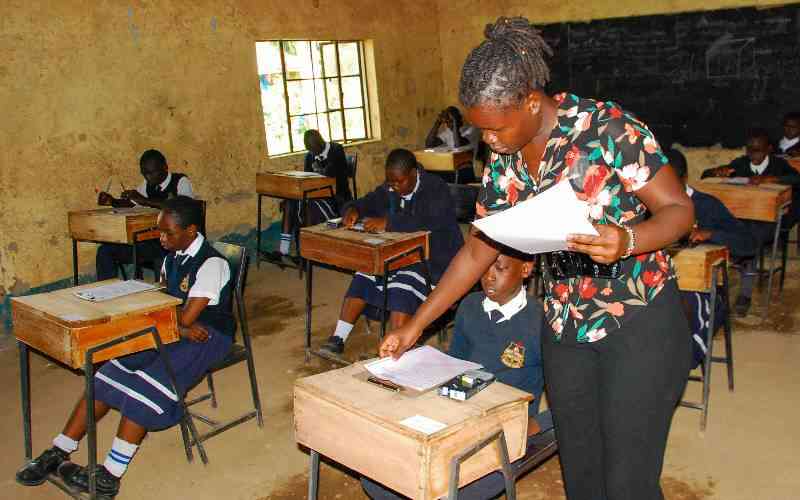
Learners sit for KJSEA at Bondo Township School, October 27, 2025. [Michael Mute, Standard]
A day after Grade Nine learners were placed in senior schools and assigned the pathways they will follow from January, the government has moved swiftly to ease rising anxiety among parents and students, assuring them that all concerns will be addressed through a flexible and learner-centred process.
The reassurance comes amid widespread debate over the first-ever placement of learners under the Competency-Based Education (CBE) system, following the recent release of the Kenya Junior Secondary Education Assessment (KJSEA) results.
According to the Ministry of Education, 49 per cent of the nearly 1.1 million Grade 9 learners have been placed in the Science, Technology, Engineering and Mathematics (STEM) pathway, while 40 per cent joined the Social Sciences pathway and 11 per cent were assigned to Arts and Sports Science.
Education Cabinet Secretary Julius Ogamba acknowledged that the transition may not be flawless but insisted that the ministry has put in place mechanisms to address every concern raised by parents and learners.
“This is the first time we are carrying out this placement. Once the portal opens and the process begins, it will remain accessible so that any questions or challenges from parents or students can be addressed. If anyone feels they have been placed in the wrong pathway or school and wishes to transfer or make a change, the option will be available,” Ogamba said.
Parents and learners will have five days to request changes via the KJSEA revision portal.
However, the process is tedious to parents as the requests must be submitted digitally through the Head of Junior School using the student’s unique KJSEA assessment number that was used for the 2025 examinations, with approvals based on available capacity in senior schools.
The desired senior school must first declare available slots through its respective County Director of Education or the Sub-County Director of Education before the parent makes a request.
The KJSEA result slip will be required to serve as proof of assessment results and will be derived from previous performances.
Additionally, parents and learners will need to provide a birth certificate to verify identity when updating student profiles, as well as a formal transfer request. The student seeking a placement transfer must submit this request through the head of the junior school they attended.
For subject combination selection, applicants must provide documentation of their preferred learning pathway—STEM, Social Sciences, or Arts and Sports—along with the subject combinations they chose and were tested on during the Grade 9 KJSEA examinations.
To obtain a placement transfer, students or their parents and guardians must follow specific steps to ensure a smooth process.
Parents are required to submit a formal request through the Head of the Junior School at least two weeks before the reporting date, scheduled for January 12, 2026.
Transfer approvals will depend on the senior school’s capacity and the learner’s performance, with priority given to students who had initially selected that school. This aims to prevent confusion, avoid overburdening schools and minimize parent disappointment over available slots.
Placement transfers
Once a transfer is approved, the Ministry will issue joining instructions online, as schools are now strictly prohibited from issuing printed letters for replacement cases.
All approvals will be updated in the Kenya Education Management Information System (KEMIS).
The government emphasizes that flexibility, dialogue and stakeholder engagement will guide the process.
“This is a learner-centred assessment. The learner takes first place in every decision we make,” Ogamba said.
He added that the placement revision window will remain open for at least two weeks, including after learners report to senior schools in January.
“Even after joining in January, we will keep it open to ensure that each and every question and challenge is addressed and each learner is taken care of to their satisfaction. “We know there could be some hiccups since this is the first time, but the teams we have set up will be available,” he added.
Ogamba emphasised that the new placement system is learner-based, unlike the former 8-4-4 system that relied heavily on a single final examination.
Under CBE, a learner’s placement is informed by a weighted assessment model 60 per cent from KJSEA, 20 per cent from KPSEA (Grade 6), and 20 per cent from School-Based Assessments in Grades 7 and 8.
“The build-up helps us understand what their competencies are and where their interests are. “This system ensures progression. A child who has been performing well in Mathematics cannot suddenly fail without explanation. It also helps remove issues of cheating,” Ogamba said.
Kenya National Examinations Council (KNEC) CEO David Njengere said confusion among parents stems from comparing the new system with the former KCPE and 8-4-4 structure.
“Under 8-4-4, all learners studied the same subjects, and placement depended on a total score out of 500. In the CBE system, learners move to senior school to specialise. What matters is their strength in the chosen pathway, not aggregated scores,” Njengere said.
“The learner has been assessed in Grade 6, 7, 8 and 9. There is already a long track record. Repeating Grade 9 defeats the spirit of nurturing every learner’s potential,” he said.
Basic Education Principal Secretary Julius Bitok defended the placement outcomes, saying the government adopted the County Revenue Allocation (CRA) formula to ensure equity across the country.
“All the 1.1 million learners selected 12 schools in May. To place them equitably, we used a formula that considers population, poverty levels and regional balance. A child from Northern Kenya should have the same opportunity as one from Western,” Bitok said.
The PS said that while many learners have been placed in their schools of choice, some parents and candidates had expressed dissatisfaction with the placements.
“This is largely attributable to high competition and limited admission slots in popular schools, misaligned communication between parents, learners and heads of institutions on selected schools and variance between selected pathways and assessment outcomes.”
He said all learners will have a seven-day revision window from December 23, similar to the KUCCPS university placement process.
“By Christmas, every learner should know their placement. We expect a 100 per cent transition by January 12. With 1.5 million declared spaces for 1.1 million learners, no child will be left out,” he said.
Kenya Private Schools Association (KPSA) chair Charles Ochome welcomed the ministry’s decision.
“There is no reason to worry. Learners have an opportunity to express dissatisfaction. This transfer window is a rare opportunity that did not exist before,” he said.
Pathway suitability
Education stakeholders have urged parents to focus less on elite schools and more on pathway suitability.
Career coach Dr Mercy Igoki cautioned parents against rushing into transfers.
“The career pathway is the priority, followed by the school choice. Transfers are digital, allowed once only and irreversible. Parents must clearly understand why they want to change,” she said.
She added that Kenyans’ obsession with a few national schools is misplaced and should change under the new education system.
“Parents are still chasing Alliance, Kenya High and others. Let us lobby for schools to be equipped instead,” she said.
Education analyst Dr Songa Wangatya noted that competition for top schools is national, not county-based.
“The system ensures national allocation. Chances of living in Nairobi and getting a C1 school in Nairobi are very minimal. Parents should consider schools outside their home counties,” he advised.
Martha Omollo, a teacher in Nairobi stressed that placement under CBE is driven by pathway-specific subject performance, not total points.
STEM, which accounts for 65 per cent of available slots, absorbs the largest number of learners. However, selection into top schools depends on strong scores in pathway subject combinations, not overall marks.
Arts and Sports pathways, though less popular, may offer better opportunities due to lower competition and specialised infrastructure.