×

The Standard e-Paper
Smart Minds Choose Us
 The Standard Group Plc is a
multi-media organization with investments in media platforms spanning newspaper
print operations, television, radio broadcasting, digital and online services. The
Standard Group is recognized as a leading multi-media house in Kenya with a key
influence in matters of national and international interest.
The Standard Group Plc is a
multi-media organization with investments in media platforms spanning newspaper
print operations, television, radio broadcasting, digital and online services. The
Standard Group is recognized as a leading multi-media house in Kenya with a key
influence in matters of national and international interest.

Audio By Vocalize
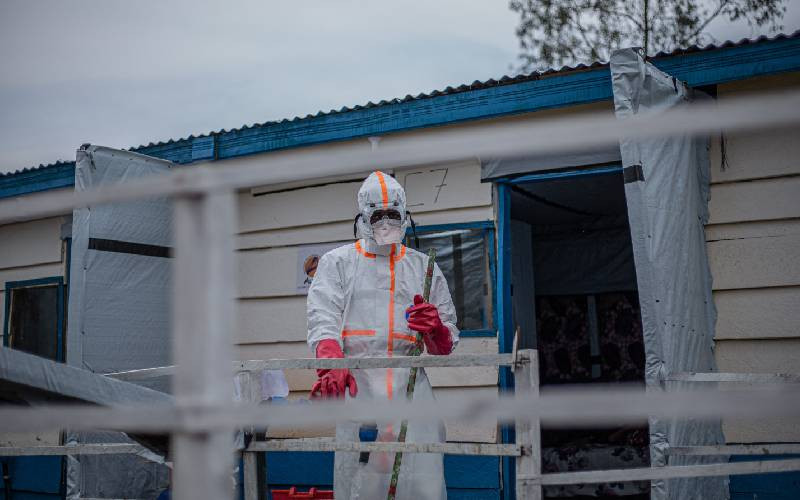
A physician at the Ebola Treatment Center of Rwampara General Hospital, in Bunia, Ituri, in the east of the DR Congo on July 13, 2026. [AFP]
The Democratic Republic of Congo's Ebola outbreak has claimed more than 900 lives, with health authorities reporting continued transmission across five provinces as the World Health Organisation (WHO) warns that the epidemic is spreading faster than response efforts can contain it.
According to the DRC Ministry of Health, the country has recorded 2,344 confirmed Ebola cases, including 930 deaths, 466 recoveries, and 724 patients currently in isolation or receiving treatment. The outbreak's case fatality rate stands at 39.7 per cent, while 85.8 per cent of identified contacts are being successfully traced.
Health authorities said response teams remain fully deployed in the five affected provinces of Ituri, Haut-Uélé, Nord-Kivu, Sud-Kivu and Tshopo, where surveillance, case management and contact tracing are continuing to curb transmission.
"Ituri remains the epicentre of the epidemic and continues to strengthen its response," the ministry said, noting that 83 new confirmed cases had been detected nationwide since the previous update.
The ministry added that treatment centres had recorded 22 new recoveries, while Sud-Kivu and Tshopo remained stable, reporting no newly affected health zones.
However, the WHO says the outbreak remains deeply concerning, particularly in Ituri province, where transmission continues to evade surveillance systems.
"So far, 2,073 cases have been reported with 796 deaths. By comparison, the 2018-2019 Ebola outbreak in DRC took more than 10 months to reach 2,000 confirmed cases," said Dr Mike Ryan of WHO's Health Emergencies Programme during a media briefing.
WHO warned that more than 80 per cent of new infections in Ituri are being detected outside known contact lists, an indication that many chains of transmission are still being missed.
"Intense transmission in the province of Ituri remains our biggest concern. More than 80 per cent of new cases are being detected outside known contact lists, showing that transmission chains are still being missed," Ryan said.
He added that about two-thirds of Ebola deaths are occurring within communities, with patients dying before reaching treatment facilities.
"About two-thirds of deaths are occurring in communities among people who never receive care in health facilities," he said.
Despite the absence of approved vaccines and specific treatments for the Bundibugyo strain driving the current outbreak, WHO said survival remains possible when patients receive early diagnosis and supportive care.
"Even without approved vaccines and treatments, 377 people have recovered, showing that with early diagnosis and safe care, this disease can be survived and stopped," Ryan said.
Stay informed. Subscribe to our newsletter
WHO also highlighted the contrasting situation in neighbouring Uganda, where the last confirmed Ebola patient has been discharged, leaving the country in its 42-day surveillance period before it can be declared Ebola-free.
Security challenges continue to undermine the response in eastern DRC, where ongoing armed conflict has limited access to affected communities.
"Active armed conflict is hampering access to the affected areas and hindering the response. Just yesterday, a treatment centre in Bunia was attacked," Ryan said.
He stressed that beyond technical interventions, political support is urgently needed to expand access to affected areas and strengthen outbreak control.
WHO and the Africa Centres for Disease Control and Prevention (Africa CDC) also warned that the continental Ebola preparedness and response plan remains critically underfunded.
"We still face a shortfall of more than US$400 million in the joint WHO-Africa CDC continental preparedness and response plan. We urge donors to fill this gap and to help us control this outbreak as quickly as possible," Ryan said.
He concluded with a stark appeal to the international community.
"This is not charity. It's an investment in national security."
The outbreak is one of the largest Ebola epidemics recorded in the DRC in recent years, with health authorities racing to contain transmission before the virus spreads further across the region.
Subscribe to our newsletter and stay updated on the latest developments and special offers!

 Prefer the Standard on Google







 join
join