×

The Standard e-Paper
Join Thousands Daily
 The Standard Group Plc is a
multi-media organization with investments in media platforms spanning newspaper
print operations, television, radio broadcasting, digital and online services. The
Standard Group is recognized as a leading multi-media house in Kenya with a key
influence in matters of national and international interest.
The Standard Group Plc is a
multi-media organization with investments in media platforms spanning newspaper
print operations, television, radio broadcasting, digital and online services. The
Standard Group is recognized as a leading multi-media house in Kenya with a key
influence in matters of national and international interest.

Audio By Vocalize
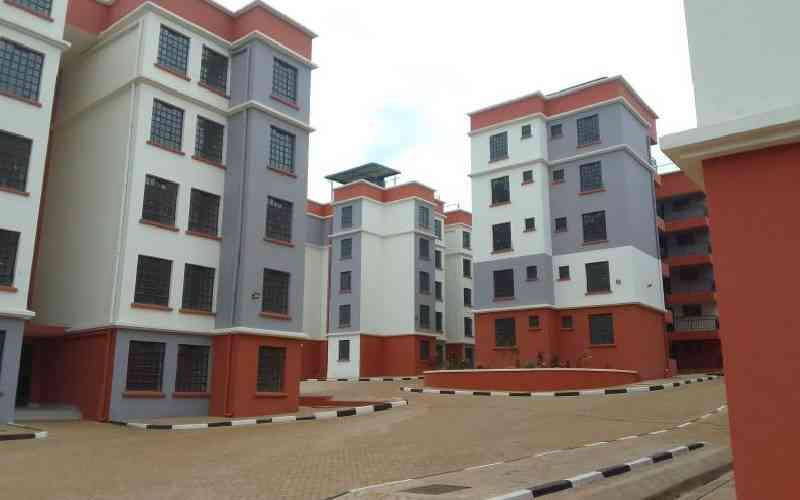
For decades, many of Kenya’s informal settlements existed in plain sight yet remained invisible in official planning. Entire communities raised families, ran businesses and built neighbourhoods in places that rarely appeared on city maps or featured in development plans.
The consequences of that invisibility are becoming more apparent as climate change intensifies. Heavy rains flood homes, poor drainage turns streets into rivers, burst sewer lines contaminate neighbourhoods and overcrowded housing amplifies health risks.
While climate discussions often focus on cutting carbon emissions, a growing number of urban planners, researchers and community leaders argue that one of the country’s most effective climate solutions begins much closer to home: where and how people live.
Geoffrey Ongaya, General Manager of Buxton Point, believes housing has been overlooked in climate conversations despite being where climate impacts are felt most directly.
“Housing is where the bill comes due,” Ongaya says. “Affordable housing remains a peripheral concern and simultaneously the arena where climate risk, public health, inequality and economic productivity collide.”
He argues that climate resilience should not be measured only through renewable energy projects or carbon reduction targets, but also by whether neighbourhoods have reliable drainage, proper sanitation, green spaces, affordable transport and decent housing that protects families from increasingly frequent climate shocks.
Few people have witnessed that reality for as long as Prof Peter Ngau, an urban and regional planning expert who has spent more than three decades researching informal settlements.
“If you go to the maps of the city, those places where they are, they are blank,” said Prof Ngau. “Because the land doesn’t belong to them, the land is considered to be blank, but there are people there. They have families, they have economic activities, and they are living their lives.”
Working alongside Muungano wa Wanavijiji for more than 20 years, Prof Ngau helped develop settlement profiles documenting population density, access to water, sanitation, roads and other basic services. The information gave communities evidence they could use to engage government and development partners.
For years, he said, many residents paid significantly more for water purchased from kiosks than households connected to municipal supplies. Most had no sewer systems, forcing families to rely on pit latrines or unsafe alternatives, while poor roads, inadequate lighting and limited public services reinforced decades of exclusion. The simple act of counting people and documenting how they lived fundamentally changed the conversation.
“You cannot plan for people you cannot see. You cannot plan for people you cannot count,” said Mike Wera, a federation leader, underscoring the importance of community-led data in shaping urban policy.
Joseph Muturi, President of Slum Dwellers International (SDI) Kenya, says that data has done more than describe problems. It has enabled communities to negotiate solutions.
“What SDI does is to empower communities so that they can be able to push their own agendas,” Muturi said. “We work with planners, architects and academia to collect information about informal settlements. With this data, communities are able to prioritise what they need and use that information to push for projects.”
He pointed to initiatives such as the Mukuru Special Planning Area, where community-generated data helped shape infrastructure planning, improve access to roads, sanitation and water, and strengthen collaboration between residents, government and technical experts. Muturi though, cautioned that building houses alone will not solve urban inequality.
“When we are looking at slum upgrading, let us look at housing. Let us look at public spaces. Let’s also look, most importantly, at livelihoods,” he said. “Have we improved the livelihoods of the people that we are putting in new, fancy, sparkling houses?”
Stay informed. Subscribe to our newsletter
He warned that relocating families into better housing without improving incomes risks placing additional financial pressure on households already struggling to survive.
“The community should not be looked at as recipients or beneficiaries of these housing projects,” Muturi said. “The community should be involved in designing, dreaming and even constructing these houses. They should be looked at as co-producers.”
Climate change, he added, has exposed just how unequal cities have become. Communities in informal settlements often suffer the worst flooding, not because they caused it, but because decades of poor planning have left them living downstream of failing infrastructure.
“The challenges they face have got nothing to do with the activities happening in Mathare,” Muturi said. “These are activities happening upstream where all the water and burst sewers in Nairobi end up in Mathare.”
The discussion is also increasingly shifting from housing as a construction project to housing as a matter of justice. Dr Linda Nkatha Gichuyia, an urban housing specialist and federation leader, said housing policies must move beyond speculative, market-driven approaches and recognise communities as central to shaping their own environments.
“True inclusion is only achieved when community-led processes are budgeted for and supported in law,” she said.
Dr Gichuyia said conversations about housing must also recognise unequal access to land and housing, unpaid care work carried largely by women, and the need for climate justice for communities that contribute least to global emissions yet experience some of the harshest impacts. Those realities became even more apparent during the Covid-19 pandemic.
Christine Muthoni, a community leader involved in the Roof Over Our Heads campaign, said women identified housing challenges that extended far beyond the condition of their homes. Leaking roofs, flooding, insecurity, transport, disease outbreaks and the safety of children all emerged as priorities.
“When flooding starts affecting us, who is most affected? It is the woman who is inside that house,” she said. “Sometimes water enters the house. Who is supposed to take care of the children? Where do you put them? Housing is much broader than many people think.”
The campaign has since brought together women, researchers, universities and technical experts to develop practical improvements using locally available and affordable building materials while strengthening resilience in informal settlements. Ongaya believes this broader understanding of housing is what Kenya’s cities need as they prepare for a warmer, more unpredictable future.
He argues that well-designed neighbourhoods can lower transport costs, improve public health, reduce emissions, create opportunities for young people and protect household incomes. Affordable housing, he says, should not be viewed as a social programme but as essential infrastructure that supports economic resilience and climate adaptation.
The challenge facing Kenya is therefore not simply to build more houses. It is to build neighbourhoods where people can live safely, access clean water and sanitation, earn a decent living, withstand climate shocks and help shape the places they call home.
For decades, informal settlements were treated as blank spaces on city maps. Today, the growing consensus among researchers, planners and communities is that they are anything but invisible.
They are proving that the future of climate-resilient cities will depend not only on engineering solutions or government policy, but on recognising the knowledge, experience and leadership that already exists within the communities most affected by climate change.
Subscribe to our newsletter and stay updated on the latest developments and special offers!

 Prefer the Standard on Google









 join
join