×

The Standard e-Paper
Join Thousands Daily
 The Standard Group Plc is a
multi-media organization with investments in media platforms spanning newspaper
print operations, television, radio broadcasting, digital and online services. The
Standard Group is recognized as a leading multi-media house in Kenya with a key
influence in matters of national and international interest.
The Standard Group Plc is a
multi-media organization with investments in media platforms spanning newspaper
print operations, television, radio broadcasting, digital and online services. The
Standard Group is recognized as a leading multi-media house in Kenya with a key
influence in matters of national and international interest.

Audio By Vocalize
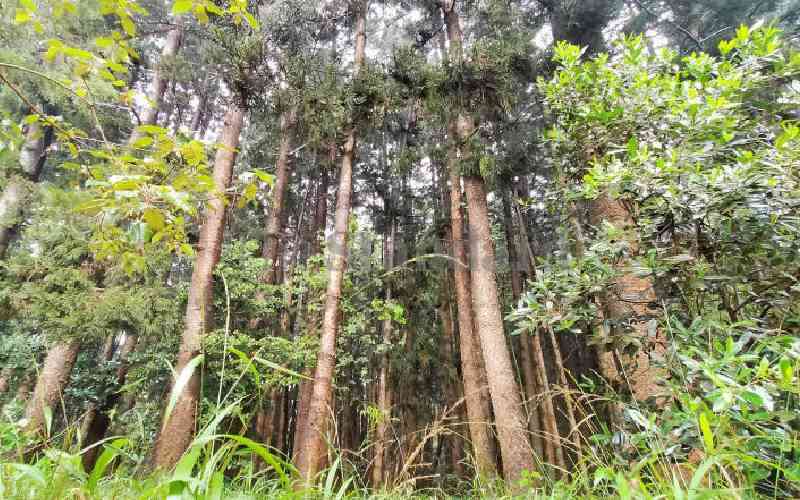
At the edge of Nairobi’s rapidly expanding skyline, where roads, buildings and concrete continue to advance, Ngong Forest is struggling to preserve what remains of one of the city’s most important green spaces.
What was once a continuous indigenous forest belt has gradually shrunk from an estimated 2,926 hectares at gazettement to about 1,224 hectares today. Urban expansion, land encroachment, and increasing human activity have steadily reduced its ecological footprint, turning the forest into a symbol of a city growing faster than its natural systems can withstand.
Yet on the forest floor, a different story is unfolding, one of restoration and renewal.
In a coordinated exercise led by Global Green Initiative (GGI), alongside conservation partners, government agencies and community groups, replanting efforts have begun across degraded sections of the forest in an attempt to restore what has been lost, one seedling at a time.
Restoration efforts
GGI Project Manager Kennedy Onyango Luther said the initiative focuses on long-term ecological restoration and climate resilience rather than one-off tree-planting campaigns.
“This is about practical climate solutions that create long-term impact. We are committed to ecosystem restoration, biodiversity conservation, renewable energy access, circular economy approaches and building community resilience across Africa,” said Luther.
The exercise brought together environmental stakeholders, youth volunteers, community members, conservation partners, the Kenya Forest Service (KFS) and the Community Forest Association (CFA). Together, they planted 224 indigenous and exotic tree seedlings as part of ongoing ecosystem rehabilitation efforts.
Among those participating was Sam Mwezezo Mahamoudi, founder of Global Green Initiative in the Democratic Republic of Congo, who said the exercise carried both personal and environmental significance.
Mahamoudi said growing up in a country that hosts the Congo Basin, one of the world’s largest tropical forests, instilled in him a strong sense of environmental responsibility. “For me, protecting nature is not a choice; it is a duty we owe to our communities, our continent and future generations,” he said.
Shared responsibility
He noted that the exercise provided an opportunity to learn from Kenya’s conservation approach. “What inspired me is how environmental action here is organised around partnerships and local ownership. When communities are actively involved, conservation becomes more sustainable and effective,” he said.
“Ngong Forest contributes to biodiversity, climate regulation, soil protection and water systems that support surrounding communities. Restoring it is about protecting a natural asset that supports the environmental security of Nairobi and neighbouring areas,” he said.
According to Mahamoudi, local communities must remain at the centre of conservation efforts.
Stay informed. Subscribe to our newsletter
“They can help identify threats early, protect young trees, discourage destructive practices and strengthen environmental awareness. No conservation effort can succeed permanently if communities are not fully involved,” he added.
Ngong Forest remains one of Kenya’s most important urban forest ecosystems, serving as a critical water catchment area for Nairobi and Kajiado counties.
The forest helps regulate water flow, supports groundwater recharge and contributes to rivers that sustain communities and economic activities downstream. It also acts as a natural carbon sink, absorbing greenhouse gases while helping moderate temperatures in a city increasingly affected by urban heat and air pollution.
Its ecological value extends beyond water and climate regulation. The forest provides habitat for indigenous tree species, birds and other wildlife, making it a vital biodiversity refuge within the rapidly expanding Nairobi metropolitan region.
Conservationists warn that continued loss of forest cover could undermine these environmental services at a time when cities are becoming increasingly vulnerable to climate-related challenges.
Luther said the project is targeting at least a 70 per cent survival rate for the newly planted seedlings through community support, site security and a structured after-care programme developed jointly with KFS and the CFA. “Our discussions with the Kenya Forest Service and the Community Forest Association ensured that we established an after-care plan that empowers the local community through site maintenance. The maintenance cycles will run monthly until the trees reach maturity,” he said.
According to Luther, Ngong Forest was selected because of its ecological significance and the active involvement of the local community in conservation efforts. “The Ngong community has a vibrant and energetic Community Forest Association that made the planting exercise easy and meaningful,” he said.
The initiative seeks to strengthen the connection between conservation and local livelihoods while ensuring environmental protection generates social and economic benefits. “Starting with Ngong Forest, we are taking conservation to grassroots communities and creating a stronger link between local interests and conservation efforts,” Luther said.
The programme also incorporates a livelihood component. Once the trees mature, plans are in place to establish a community-led beekeeping enterprise within the forest.
The initiative is expected to provide income-generating opportunities while encouraging long-term stewardship of the ecosystem.
“Upon reaching maturity, these trees will provide a suitable environment for launching a community-led beekeeping business. This will create sustainable income opportunities and foster greater community empowerment,” he said.
GGI plans to replicate similar conservation initiatives in other parts of Kenya before scaling up across Africa.
To ensure continuity, Luther said GGI and the Ngong Forest Community Forest Association will jointly oversee the project and replace any seedlings that fail to survive. “When a tree dies, we plan to plant two more. Our focus is to maintain and grow these restoration sites and ensure the impact lasts for generations,” he said.
Luther noted that the initiative’s success will ultimately be measured not by the number of seedlings planted but by the number that survive to maturity and the long-term benefits generated for surrounding communities.
Carbon market consultant and environmental expert Captain Job Kariithi says urban forests such as Ngong play a critical role in regulating temperatures by acting as natural heat buffers.
He explained that forests absorb and redistribute solar energy, reducing the intensity of urban heat islands. As cities continue expanding, the loss of green spaces translates directly into higher surface temperatures, increased energy demand and declining air quality.
“Ngong Forest should be a crucial component of urban climate regulation because forests absorb a significant amount of heat naturally and sustainably. If we protect and maintain them properly, they become part of the city’s natural infrastructure,” he said.
Kariithi argues that forest management should extend beyond conservation to include sustainable utilisation that supports low-carbon urban development.
Future survival
According to him, sustainably managed forests can contribute timber for housing and construction, reducing dependence on high-emission materials such as steel and cement. “In many developed countries, including the United States, timber is widely used in construction because it is adaptable, durable and environmentally friendly when sustainably sourced. Wood also acts as a carbon storage system because it retains carbon dioxide absorbed during growth,” he said.
Kariithi added that integrating carbon dioxide removal and utilisation concepts into forestry could position urban forests as both ecological and economic assets.
He stressed that the long-term survival of forests such as Ngong depends on consistent maintenance, protection and policies that recognise them not only as conservation areas but also as strategic resources for climate resilience and sustainable urban development.
“Urban forests are no longer optional green spaces; they are part of a city’s survival system. If we lose them, we weaken our ability to withstand climate shocks, such as heatwaves, flooding and air pollution. The focus now must shift from simply planting trees to protecting and expanding the ecosystems we already have,” Kariithi said.
Subscribe to our newsletter and stay updated on the latest developments and special offers!

 Prefer the Standard on Google









 join
join