 The Standard Group Plc is a multi-media organization with investments in media
platforms spanning newspaper print
operations, television, radio broadcasting, digital and online services. The
Standard Group is recognized as a
leading multi-media house in Kenya with a key influence in matters of national and
international interest.
The Standard Group Plc is a multi-media organization with investments in media
platforms spanning newspaper print
operations, television, radio broadcasting, digital and online services. The
Standard Group is recognized as a
leading multi-media house in Kenya with a key influence in matters of national and
international interest.

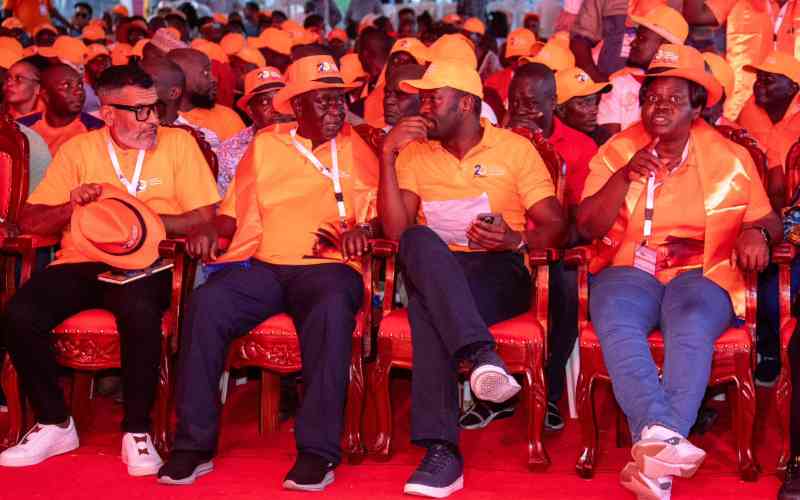
For more than two decades, the Orange Democratic Movement has been the vehicle Odinga’s family has rode on to project political power.
The Odinga family has been mobilising voters, elbowing opponents and shaping national conversations from opposition through the party.
Now, as ODM’s influence shows signs of erosion driven by internal dissent and external influences, the long-standing tradition strains the family’s place in Kenya’s political order.
According to a political analyst Gitile Naituli, the decline of ODM reduces the family’s bargaining power, hence call for political reinvention.
For years, the Odinga family’s political dominance ensured that relatives and allies seeking elective offices were almost assured of party tickets, while others smoothly landed influential government positions.
However, that certainty is fading, hence casting a long shadow over the family’s political future.
Odinga’s sister, Ruth, has served in government since 2013. Her political career started as deputy governor of Kisumu County in 2013. In 2017, she was appointed advisor to the governor, and in 2022, she was elected as the county woman representative.
Winnie Odinga, the last born child of the late party leader Raila Odinga, is an MP in the East African Legislative Assembly (EALA), while Jaoko Oburu, the eldest son of Siaya Senator, was appointed special adviser to President William Ruto.
But according to Prof Naituli of Multimedia University of Kenya, the family’s influence is not irreversibly lost, but its survival depends on who leads the party next and the direction ODM will take.
“The Odinga family can easily reclaim that influence if Winnie removes ODM from her uncle,” said Naituli, claiming that Oburu could ‘take’ the party to Ruto.
“But if she were to take control of the party, within two elections she could actually re-establish the dominance, but once it supports Ruto in this election, then ODM is dead, and so is the influence of the family,” added Naituli.
He argued that if Winnie aligns with the progressive forces, aligning with the foundational philosophy of ODM, by 2032, she will have reclaimed the party, and consequently, the family will retain their relevance in Nyanza.
The weakening of the ODM party has also reopened the unresolved questions of succession, not just within the party but also within the Odinga family itself.
Raila dominated the party since its inception 20 years ago, hence suppressing conversations about generational transition.
The division within the family on the party’s leadership was also evident during the ODM @20 celebrations in Mombasa on November 15 last year.
Winnie challenged the party’s leadership, led by his uncle and the party leader Dr Oburu, and accused a section of the party leadership of “selling” the party.
“ODM is not a party birthed in a bedroom or out of secrecy, and its future will not be treated like pillow talk. I hear some people are with us during the day, but at night, they are selling the party. That will not happen,” Winnie roared in Mombasa.
Winnie questioned the ability and capacity of ODM leadership to steer the party through the broad-based relationship with Ruto’s UDA, emphasizing that it was her father who could manage the association.
“The people of ODM trusted one person with the management of that broad-based relation, and that person was Baba Raila Amollo Odinga. That relationship is complicated,” Winnie added.
“We are looking and we are wondering, those that are taking it upon themselves to manage it now, are they capable of managing that relationship? I don't think that is a question for me to answer. That is a question for the people of ODM to answer,” Winnie said, seemingly challenging his uncle’s leadership.
She called for a National Delegates Convention (NDC), arguing that party members should be given the chance to decide who would take over the party’s leadership and steer its broad-based agenda in the aftermath of her father’s death.
Naituli added that the Odinga family’s political influence has been inseparable from the dominance of ODM for years, adding that party tickets in Nyanza and other ODM-dominated regions were electoral guarantees with automatic access to power, patronage, and relevance.
He argued that the historical dominance of the party meant elections were largely ceremonial rather than competitive and that with the party loosening its grip, voters in the region will experience political freedom for the first time.
Naituli added that for the first time, political legitimacy in the region and other ODM support bases will be earned, not inherited.
“I think an end of Odingaism means freedom for people of Nyanza. It means freedom for them to make a choice about who their leaders are supposed to be. Because Odingaism never allowed them to make that choice,” he argued.




