 The Standard Group Plc is a multi-media organization with investments in media
platforms spanning newspaper print
operations, television, radio broadcasting, digital and online services. The
Standard Group is recognized as a
leading multi-media house in Kenya with a key influence in matters of national and
international interest.
The Standard Group Plc is a multi-media organization with investments in media
platforms spanning newspaper print
operations, television, radio broadcasting, digital and online services. The
Standard Group is recognized as a
leading multi-media house in Kenya with a key influence in matters of national and
international interest.

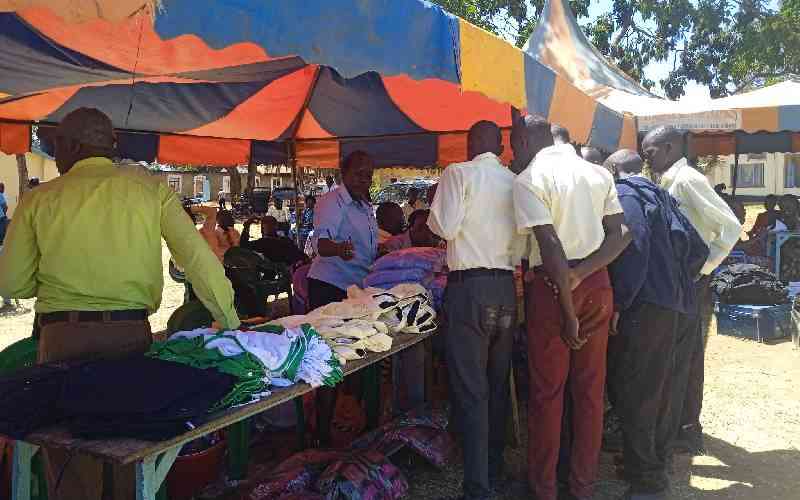
Students during Grade 10 admission at Friends Senior School Bokoli Boys, Bungoma County, on January 19, 2026. [Jackline Inyanji, Standard]
With only a day to the Grade 10 admissions deadline on Wednesday, thousands of learners from vulnerable households remain stranded at home, their dreams hanging in the balance despite excelling in the Kenya Junior Secondary Education Assessment (KJSEA).
Across the country, children who passed the assessment and were competitively placed in national and extra-county schools are unable to report because their families cannot afford the costs.
For 15-year-old Albina Nekesa Swaka, the joy of scoring 65 points at Langata Primary School and securing a place at Butere Girls High School has quickly turned into despair. The total cost of reporting, including Sh53,550 in fees and shopping, is far beyond what her family can raise.
“We have tried all scholarship programmes without success. Our hope is now on the future,” Nekesa said, her voice betraying the fear of losing her slot in one of the country’s top girls’ schools and the dream of pursuing a STEM pathway.
Her mother, Melisa Were, faces the painful reality of keeping her daughter at home after failing to raise the necessary fees, highlighting the growing crisis facing thousands of families nationwide. “We survive hand to mouth on the meagre earnings I earn from cleaning. Some days there is no work at all, There is no guarantee of work each day,we take life as it comes,” she said.
Langata Primary School headteacher Pamela Obiero said the school had done everything possible to support Nekesa through primary and junior secondary school, but the burden has now overwhelmed them.
“Our ability has been stretched. We invite any well-wisher to stand in the gap for this girl to realise her potential,” Obiero appealed.
Stranded students
Similar desperation confronts Mitchele Adhiambo Otieno, who scored 68 points at Heidemarie Mathare North Primary School and was placed at Limuru Girls High School.
“She comes from a single-parent family. Her mother currently stays with her sister, who is a mama fua in Eastleigh,” a village elder said, adding that there is little hope the family can raise the required fees before the deadline lapses.
Martha Wanjiru, 16, faces the haunting possibility of staying home while her peers transition to Grade 10. She scored 68 points in KJSEA, topping her class and earning a coveted slot at Alliance Girls High School.
In Kisumu, Genevy Anyango, 15, sits pensively at Rabuor Primary School, tears rolling down her face. Abandoned by her mother at a young age and relying on a guardian, she has been unable to report to school after failing to secure financial and parental support.
Despite scoring 55 points out of 72, her future is at a crossroads as she may miss out on joining Moi Girls Nyabohanse in Migori. “I did my KJSEA at Rabuor Primary and scored 55 marks, but I cannot join Grade 10, because I do not have anyone to support me,” Genevy said, adding; “My guardian has other children to care for and no stable job. Seeing my friends go to school while I remain behind breaks my heart and discourages me. I am pleading for any support.”
Rabuor Comprehensive headteacher Dick Awuonda described Genevy as disciplined and hardworking. “Genevy has been with us since primary school and performed very well in her assessment. She deserves to continue her education,” he said. He appealed to well-wishers and education stakeholders to support her.
With Wednesday, January 21, set as the final reporting day, Wanjiru’s father, Daniel Muchoki, a small-scale trader at Gikomba Market, struggled to hold back tears. “I have been pushing myself, but business has been very difficult. I was once robbed while servicing a loan, which made things worse. Every day I hope something will change,” he said.
In Mwingi, Niserah Kiambi Mbuvi scored 66 points and was admitted to Muthale Girls Secondary School, only to be turned away after reporting with her mother’s last Sh2,000 against a required Sh53,000. Her mother, Mary Mathuva, a single parent, suffers from injuries caused by a cobra bite that left her unable to work consistently.
Niserah also missed out on the Elimu Scholarship after assessors assumed her family was well-off because she attended a private primary school, unaware she had been on a scholarship.
Matungulu Girls Senior School principal Juliana Musaba noted that some school heads are forced to admit students based on need. “The girls are bright, but families are unable to pay fees. Some have come in with nothing. We weigh cases and admit them, hoping well-wishers will step in,” Musaba said.
Cecilia Kerubo, who topped from Kitutu Masaba with 68 points and was selected to join AIC Litein Girls National School, is also stranded at home due to lack of funds.
Education stakeholders warn that these cases reflect a national crisis beneath the government’s 100 per cent transition policy. By the end of the first week, only about 550,000 of 1.13 million placed learners had been captured in the admissions portal, leaving nearly 400,000 unaccounted for. The Ministry of Education extended the reporting deadline to Wednesday, January 21.
Financial barriers
James Thari, who scored 58 points, was expected at Heroes Boys High School in Bahati, but could not report due to logistical and financial challenges. “We survive on casual labour. I have tried, but I cannot raise the fees. I am asking for help,” said his mother, Mary Leposo.
In Webuye West, Melisha Shakilo, admitted to St Cecilia Girls High School, Misikhu has turned to menial jobs, including laundry, to raise fees. Her mother, Emily Muyayi, earns barely enough to meet the family’s basic needs.
At Friends Senior School Bokoli Boys, only 260 students had been admitted by Monday noon against an expected 392, according to Deputy Principal Gilbert Musungu.
“Admissions are very low. We are willing to accept in-kind payments , such as maize, beans and firewood. Bring the learners to school so they can acquire skills,” said Sirisia Bok Secondary School principal Kennedy Sikuku.
Similarly, Milo Boys High School admitted 60 students against a capacity of 400, while St Mary’s Bokoli recorded 100 out of 180. Nyamira’s Nyakongo Boys admitted 500 of 600, and Nyambaria Boys reported 750 out of 850. Hema Secondary Chitago in Kisii had only 270 of 400 students reported.
Principal Meshack Orure said many parents arrived unprepared. “School fees is the biggest challenge. Many parents are requesting time to report later when they are ready,” he said.
Some schools, including Mama Ngina Girls, Shimo La Tewa, and Kwale, allowed children to report with a promise to pay remaining fees later. Mama Ngina chief principal Mwahamisi Omar confirmed a strong registration turnout.
While national schools are recording above 90 per cent turnout, extra-county schools are at about 50 per cent, and sub-county schools below 40 per cent.
Education stakeholders warn that without urgent intervention, many deserving learners risk losing their places due to poverty rather than poor performance.
National Parents Association chairman Silas Obuhatsa said finances remain the main barrier. “Most cases are struggling parents. Given opportunity, learners are ready to change their families’ lifestyle,” he said. He added that uniforms, bedding, textbooks, and subject-specific equipment push reporting costs by Sh20,000 to Sh50,000.
School costs
Parents are selling livestock and land at low prices to raise fees. “It is not refusal to take children to school; it is sheer inability,” Obuhatsa said.
Kenya Secondary School Heads Association (KESSHA) chairman Willie Kuria said principals are caught between policy and reality. “We are under instructions to admit learners, but schools rely on fees to operate. Flexibility is needed, allow children to report while payment plans and bursaries are pursued,” he said.
The Ministry of Education has initiated a mop-up exercise to ensure 100 per cent transition. Education Cabinet Secretary Julius Ogamba said the ministry is working with county governments to unlock bursary funds, including NG-CDF allocations, and directed chiefs and local administrators to trace learners who have not reported. “We are confident that by the end of this process all students will be placed. We shall have 100 per cent transition because we have enough spaces,” he said, noting that Category Four schools have the largest capacity.
Usawa Agenda director Dr Emmanuel Manyasa said although Cluster 1 and 2 schools have good enrolment, many slots are taken by well-endowed families. “Unless urgent interventions are rolled out, a generation of bright learners risks losing an entire academic year. This is why we see Grade E in national schools and As in sub-county schools,” he said.
Report by Mike Kihaki, Daniel Chege, Jackline Inyanji, Stanley Ongwae, Willis Oketch and Rodgers Otiso




