×

The Standard e-Paper
Smart Minds Choose Us
 The Standard Group Plc is a
multi-media organization with investments in media platforms spanning newspaper
print operations, television, radio broadcasting, digital and online services. The
Standard Group is recognized as a leading multi-media house in Kenya with a key
influence in matters of national and international interest.

Audio By Vocalize
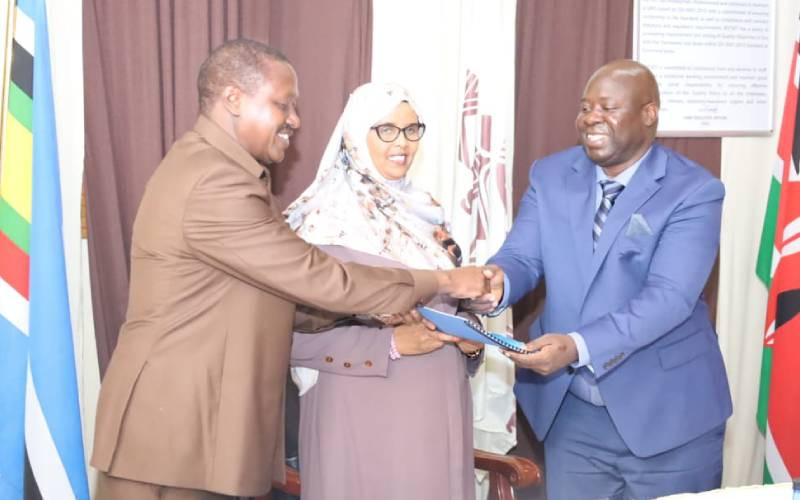
Commonwealth of Learning Education specialist Robert Okinda (right), hands report on the new African Regional Centre for Open TVET to the Secretary TVET Maryan Abdi and KSTVET CEO Dr Edwin Tarno on October 27, 2026. [Courtesy]
Kenya’s technical and vocational education and training (TVET) sector has received a major boost following the launch of the African Regional Centre for Open TVET (ARCOT) in Nairobi, an initiative aimed at expanding access to flexible, affordable and technology-enabled skills training across Africa.
Hosted by the Kenya School of TVET (KSTVET), the virtual centre is expected to strengthen open, distance and technology-enabled learning, enabling more learners to acquire practical skills without the limitations associated with conventional classroom-based training.
The centre is also expected to promote innovation, research, gender equality and the adoption of digital solutions in technical training, particularly for learners in marginalised and underserved communities.
Speaking during the launch, Principal Secretary in the State Department for TVET Dr Esther Muoria described ARCOT as a significant milestone in advancing open and inclusive learning systems that respond to Africa’s changing skills needs.
“Born out of a partnership between the Commonwealth of Learning (COL) and KSTVET, ARCOT will serve as a Centre of Excellence in open, distance and technology-enabled learning for blended Competency-Based Education and Training,” said Dr Muoria in a speech read on her behalf by State Department for TVET Secretary Maryan Hassan Abdi.
Muoria emphasised the importance of embracing digital transformation and artificial intelligence (AI) to improve access to quality training, strengthen assessment systems and equip trainers and trainees with skills relevant to the modern workplace.
“As TVET continues to evolve, embracing digital solutions and AI is critical to expanding access, improving the quality of training and assessment, and equipping trainers and trainees with skills that respond to the demands of the modern world,” she said.
The launch also highlighted opportunities for deeper collaboration in the digitisation of assessments and capacity building for trainers, particularly in the responsible and effective use of artificial intelligence technologies.
The integration of such technologies is increasingly important as training institutions seek to respond to evolving industry requirements while ensuring that graduates possess competencies that match the needs of employers and emerging economic sectors.
Muoria noted that Africa’s youthful population presents enormous potential, but unlocking it requires investment in a skilled and adaptable workforce capable of taking advantage of emerging opportunities.
Robert Okinda, an education specialist at COL, said ARCOT would strengthen the capacity of member states to deliver accessible and inclusive technical and vocational education.
He said the virtual centre would provide opportunities to advance innovation, research and gender equity while widening participation in skills development, especially among communities that have traditionally faced barriers to education and training.
“The facility will be key to promoting innovation, research, gender equity and equality through open vocational and technical training, increasing access for more learners, including those from marginalised areas,” said Okinda.
For institutions, the initiative offers an opportunity to expand training beyond physical classrooms through technology-supported learning approaches. This could help reach learners who face geographical, financial or other barriers to accessing conventional TVET programmes.
Stay informed. Subscribe to our newsletter
KSTVET Chief Executive Officer Dr Edwin Tarno said ARCOT would support a transformative approach to human capital development, aligning its work with the African Union’s Continental TVET Strategy 2025–2034, Agenda 2063 and the United Nations Sustainable Development Goals.
The alignment places the initiative within broader continental efforts to strengthen education, improve employability and develop the skills required to drive sustainable economic growth.
COL, headquartered in Vancouver, Canada, works with governments and educational institutions across Africa to expand access to quality learning through the effective use of technology, with an emphasis on affordability and inclusion.
Dr Muoria said as Africa confronts rising demand for relevant technical skills, ARCOT is expected to provide a platform for institutions to share knowledge, build capacity and explore innovative approaches to training.
Subscribe to our newsletter and stay updated on the latest developments and special offers!


 Prefer the Standard on Google