×

The Standard e-Paper
Fearless, Trusted News
 The Standard Group Plc is a
multi-media organization with investments in media platforms spanning newspaper
print operations, television, radio broadcasting, digital and online services. The
Standard Group is recognized as a leading multi-media house in Kenya with a key
influence in matters of national and international interest.
The Standard Group Plc is a
multi-media organization with investments in media platforms spanning newspaper
print operations, television, radio broadcasting, digital and online services. The
Standard Group is recognized as a leading multi-media house in Kenya with a key
influence in matters of national and international interest.

Audio By Vocalize
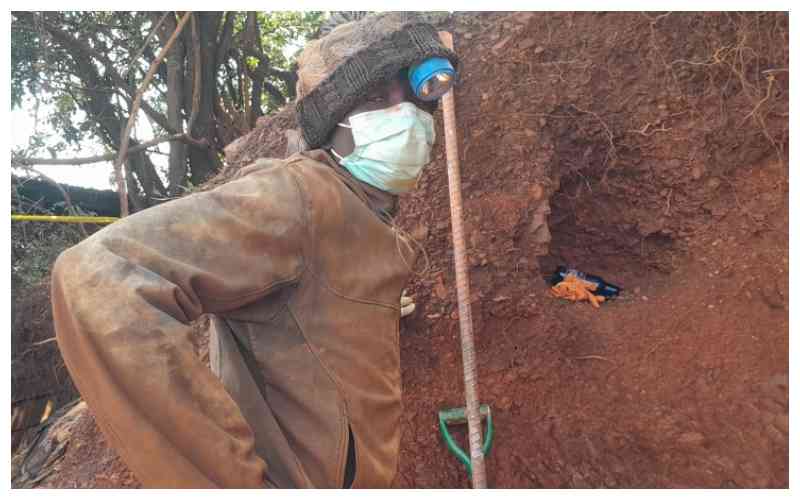
A visit to the Lolgorian area of Trans Mara sub-county in Narok County would lead one to expect signs of wealth when passing through the villages and trading centres on the way to Kilimapesa Gold Mine fields.
If holding large gold deposits were the measure of wealth, residents would be driving flashy cars, living in grand homes, and oozing affluence.
However, the gold deposits in the area are more of a curse than a blessing to the residents.
Recently, five artisanal miners were buried alive after a collapse at a mining shaft.
The disaster struck unexpectedly when dozens of artisanal miners had entered the underground shafts to excavate gold.
A critical section of the tunnel wall suddenly caved in, trapping several workers under tonnes of heavy debris.
The government has since shut down four mining sites in the Lolgorian area to prevent further loss of life.
However, a spot check by the Saturday Standard has revealed that most residents of Lolgorian survive from hand to mouth despite years of extracting the precious mineral from stones and mud.
They sell the mud and stones after extracting some gold to a foreign company and hundreds of brokers, some from as far as central African countries.
The miners use mercury to separate the gold, which exposes them to health risks.
After extracting the quantities they manage, the brokers buy the mud from them for further extraction.
Mercury does about 20 per cent of the work,” says Peter Katam, a member of a local organisation that helps small-scale miners find safer ways of working.
One of the brokers involved in the trade told the Saturday Standard that they help locals earn a living and improve their lives.
“Our money continues to assist the people to pay for school fees, buy food and earn a living. They use the earnings to buy drugs and buy anti-venom medicine, as this area is known for poisonous snakes,” said the broker who spoke on condition of anonymity.
He denied reports that brokers exploit locals by offering them low prices for processed gold before other players entered the scene recently.
Stay informed. Subscribe to our newsletter
“We offered acceptable prices. You don’t expect to get good money when you have processed it by less than 20 per cent,” he said.
However, gold mining in the region is experiencing a dangerous shift.
Children who have been idle during school closures have turned to working in the gold mines.
“Parents and relatives are to blame because they send their children to do odd jobs, including mining, to bring money home,” said Julius Kipeno, a resident of Lolgorian.
Johnston Ouko, a labourer at the pits, said that when schools close, children become a common sight in the area.
“When it rains, the soil becomes loose, which is dangerous. Although rules have been introduced barring children from mining areas, they still find their way into them,” he laments.
When children enter the mines, he explains, they scoop mud and attempt to extract a little gold, and with mercury readily available, they manage to find something to sell.
“We are forced to mobilise people, including area elders and miners, to chase them away,” says Ouko, who migrated to Lolgorian from Awasi in Nyando.
Because of this activity, the township, which is growing faster than Kilgoris, the commercial and administrative centre of Transmara sub-county, hosts people from other parts of the country and some from neighbouring nations.
Mining has also caused land prices to spike. An acre, depending on its proximity to the mining sites, now sells for between Sh3 million and Sh5 million.
Philip Nkadenya, a member of the Lolgorian Small Gold Miners Association, says that members are working with law enforcement agencies to prevent children from accessing the mining fields, adding that most young people involved in gold search are not from the locality.
John Lekishan, an official from an NGO involved in raising awareness about the dangers of gold mining, said that the process of separating gold from stones and mud is arduous and dangerous, making it unsafe for children to be near the mines.
Apart from providing protective gear, the organisation supplies miners with generators for pumping water out of the mining fields, especially during the rainy season, ball mills for crushing stones into powder, pans for smelting, and training on how to safely operate the machinery.
“We train them to do their work safely. We used to rely on mercury, but since the global move to phase out the poisonous metal is underway, we are devising ways for them to extract, process, and obtain the final product without exposing themselves to danger,” says Lekishan.
The Ministry of Mining, in collaboration with the Ministry of Environment, is working with the United Nations Development Programme (UNDP) to help miners shift away from mercury dependence by providing technology for safe gold extraction.
Following a recent accident, Trans Mara South Deputy County Commissioner Stephen Emojong confirmed that the mines had been shut down.
He announced that the mine would remain closed until further notice as investigations are conducted to determine the cause of the incident and to assess safety standards at the site.
“The pit will be closed with immediate effect until we complete investigations. We must ensure that such tragedies do not happen again,” Emojong stated.
Narok County Disaster Management Officer Shadrack echoed these remarks, confirming that five people died in the incident while four others sustained injuries.
He reported that the injured were rushed to Lolgorian Level 4 Hospital for treatment and were later discharged.
Some residents who volunteered to enter the pit during the operation said they only managed to find clothes and blood-stained sacks, but no bodies.
“We went deep inside hoping to find someone alive or even the bodies, but all we found were clothes and sacks with blood. It was painful,” said one of the residents.
Security has since been increased around the mine as police and county officials restrict access.
Meanwhile, the bodies of the five deceased miners have been moved to the Kehancha Referral Hospital mortuary, where they await post-mortem examinations before being released to their families for burial.
County officials have advised miners in the region to adhere to safety guidelines and to cease operations in unlicensed and unsafe pits.
Subscribe to our newsletter and stay updated on the latest developments and special offers!

 Prefer the Standard on Google






 join
join