×

The Standard e-Paper
Smart Minds Choose Us
 The Standard Group Plc is a
multi-media organization with investments in media platforms spanning newspaper
print operations, television, radio broadcasting, digital and online services. The
Standard Group is recognized as a leading multi-media house in Kenya with a key
influence in matters of national and international interest.
The Standard Group Plc is a
multi-media organization with investments in media platforms spanning newspaper
print operations, television, radio broadcasting, digital and online services. The
Standard Group is recognized as a leading multi-media house in Kenya with a key
influence in matters of national and international interest.

Audio By Vocalize
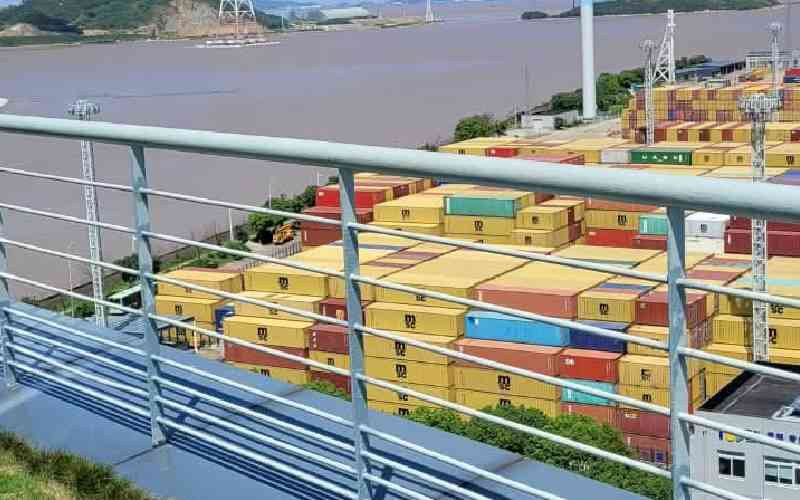
A section of the Ningbo Zhoushan Port in Zhejiang Province. [Joan Mwai, Standard]
Situated at the heart of the Yangtze River Delta economic region, the Ningbo Zhoushan Port in Zhejiang Province boasts a topological advantage, as it is also at the spot mainland meets the Pacific Ocean on the Eastern China coast.
The port serves as a gateway to different parts of the globe, handling over three hundred shipping routes that wind up at more than six hundred ports in the world, thus bridging mainland China and the world.
Initially, the port of Ningbo existed independently. In 2006, it merged with Zhoushan Port to form a mega-port system. The Ningbo-Zhoushan Port ranks as one of the busiest ports in the world.
In 2025, it was ranked as the second largest single container terminal in China, second only to Shanghai. It is ranked as the world’s largest container ship berthing, with over 200 berths for 10,000-tonne vessels and above.
The port also has more than 120 deep-water berths for 50,000-tonne vessels and above. It holds the world record for berths capable of moving 235.6units/hour. The berths span a shoreline of 164.2 kilometres.
The port comprises 20 port cities, or port areas, with each of these areas handling different cargo ranging from oil and gas, timber, coal, iron ore, liquid chemical products, grain, and other general cargo.
In the first half of 2026, the port overtook Singapore to become the world’s second busiest port by cargo tonnage, second to Shanghai, resulting from rising exports and terminal expansion that drove container volumes higher. In a report by Seatrade Maritime News, in the first half of 2026, Ningbo-Zhoushan port handled 22.9 million Twenty-Foot Equivalent Units (TEU), up 8.8 per cent, surpassing Singapore, which recorded 22.7 million Twenty-Foot Equivalent Units (TEUS) and 4.7 per cent growth.
The volume increase has driven Ningbo-Zhoushan to become the world’s second-largest container port in the first half of 2026.
Cargo from mainland China is brought into and out of the Ningbo-Zhoushan Port via the sea-rail intermodal network.
This network, comprising 25 trains for sea-railway combined transport, covers 65 cities, easing movement of goods to and from the coast.
Zhoushan Port boasts the largest container truck team in Zhejiang Province.
These trucks move cargo from the port to various destinations on the mainland. The port is also known for minimal congestion and faster movement of bulk cargo.
To move containers fast and effectively, the port has embraced smart technology. They make use of a remote-controlled system of intelligent bridge cranes and an intelligent container tallying system. Ningbo Zhoushan Port is also the first port to realise paperless documentation for container freight in China.
Stay informed. Subscribe to our newsletter
All the heavy cargo operations, ranging from logistics to shipping, require a similarly heavy investment in power. To supplement the power supply from the national grid, the port has put up massive investment in green energy, capitalising on wind and solar energy.
This was through a cooperation agreement signed in 2023 by Zhejiang Seaport Group, Ningbo Zhoushan Port Group, and State Grid Zhejiang Electric Power Company, to jointly advance green energy.
Port officials say they aim to realise the vision of "carbon peak "- the point where carbon emissions start to decrease over time. The port now also powers almost a third of its operations using green energy.
For a port such as the Ningbo Zhoushan port, a robust workforce is the driving force turning the cogs in the massive shipping ecosystem. The port city boasts a massive workforce of 20,000 workers, working to ease congestion and make the port a world-class shipping facility, powered by intelligent systems and green energy.
Subscribe to our newsletter and stay updated on the latest developments and special offers!


 Prefer the Standard on Google