×

The Standard e-Paper
Smart Minds Choose Us
 The Standard Group Plc is a
multi-media organization with investments in media platforms spanning newspaper
print operations, television, radio broadcasting, digital and online services. The
Standard Group is recognized as a leading multi-media house in Kenya with a key
influence in matters of national and international interest.
The Standard Group Plc is a
multi-media organization with investments in media platforms spanning newspaper
print operations, television, radio broadcasting, digital and online services. The
Standard Group is recognized as a leading multi-media house in Kenya with a key
influence in matters of national and international interest.

Audio By Vocalize
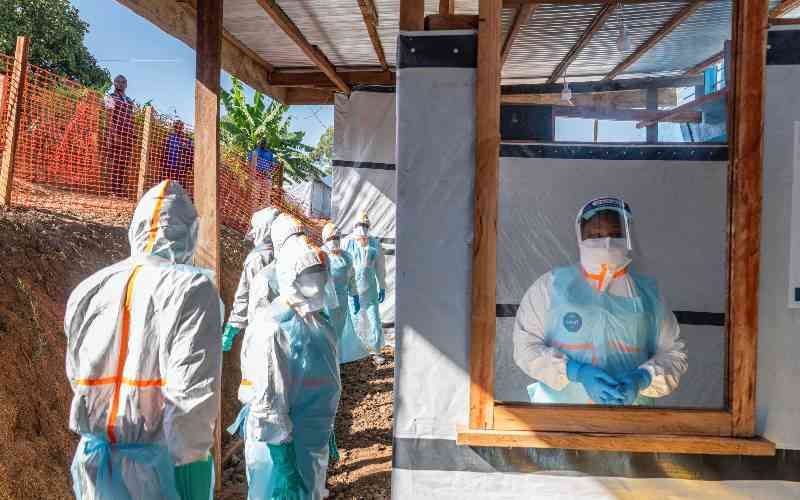
Health workers stand in a new Ebola treatment center during a visit of WHO Director General Tedros Adhanom Ghebreyesus in Bunia, northeastern Democratic Republic of the Congo, on May 31, 2026. [AFP]
The Ebola conversation in Kenya is not just a medical debate. It is a matter of ethics and African sovereignty in global politics. It speaks to human dignity, and constitutional accountability in an African state.
But it is also about omnivorous eating habits within the governing classes of Africa, and incapacity for disgrace in high Africa’s high places. So yes, it is about opening up Kenya to untold health risks. But it is also significantly about leadership that will do anything for the whiff of money.
The High Court has of course temporarily suspended quarantining of American Ebola suspected cases in Kenya. Yet the magnitude of the matter dictates that the discourse must continue. The central moral question is simple. The United States rejects her own citizens, suspected to be Ebola carriers. They are a huge health hazard that cannot be admitted to America. Then consider Kenya eagerly signalling America, saying, “Just give us money and bring that Ebola this way!”
Let us for a moment stay with the health hazard angle. The United States is, without a doubt, the most technologically advanced country in the world. This includes technology in medicine and healthcare. If she rejects her own citizens because they have been exposed to Ebola, what technical capacity does grovelling Kenya have to handle the challenge? What moral high ground does Kenya stand on, to invite Ebola to her soil? Why would it be acceptable to transfer to an Ebola-free Kenya a health challenge whose owners have rejected?
Yet the question is bigger than health. It is about how we see ourselves, and how the world sees us. Historically, powerful societies have transferred danger to poor societies. Imperial powers have always wanted to enjoy the benefits of the empire while passing the burden of risks to their poor subjects. At the height of European colonialism in Africa, dangerous labour, extractive industries – like minerals in DRC – and even military campaigns during World War I and II were exported to Africa, and to other poor peoples around the globe. They still are, in Eastern DRC.
The colony was the space for management of risks that were too inconvenient at home. From Haiti and now to Ebola, does Kenya increasingly present the profile of an overly eager new colony; an American colony? At any rate, the attempt to migrate the American Ebola challenge to Kenya evokes memories of bad neo-colonial relations. These are relations between protected metropolitan USA, on the one hand, and exposed neo-colonial Kenya, on the other.
The relationship between Kenya and the United States has the colour of American slavery Jim Crow laws all over. This time, however, Jim Crow is not limited to the Southern States of America, the colour-based oppressor is migrating to what the French would call “American overseas provinces,” or latter-day Uncle Tom’s Cabin.
It is, accordingly, not a matter of whether or not Kenya has competent medics who can handle the Ebola risk. Of course our universities and colleges are producing some of the most proficient health personnel anywhere in the world. It would have been honourable to hear that this was why America wanted to evacuate her citizens from DRC to Kenya. To be attended to by our high calibre healthcare experts.
Instead US Secretary of State Marco Rubio looks straight in the camera and tells the world that not a single Ebola case will be allowed to enter America. The virus is too deadly for that. That, instead, “a friendly African country” will bear the brunt of the challenge. At this time, Africa must ask herself whether her role in global affairs remains that of recipient of global risks, very often generated by others. The burdens range from climate injustice to being the dumping ground for nuclear waste and other toxins.
Flipped around, Kenya becomes a reckless embarrassment to Africa, as a grasping dish-licker in the international community. While other countries are securing their borders against Ebola, the dish-licker is salivating and eagerly fetching the menace. There has been talk of Sh 1.7 billion in the bargain. Something is overly wrong with Kenya’s international self-image.
Regardless of which kitty, or pocket, the billions end up in, the bounty is an embarrassment to Africa. Africans seek to be respected in the global arena. Yet, the leadership of a country such as Kenya ingratiates itself with foreigners. She is bending backwards over, to carry their grime in exchange for no matter what. Beyond medical and healthcare challenges, we must press our Kenyan head in our hands; in grief and shame. Ours are not leaders, they are dealers, wheeler-dealers.
—The writer is a strategic communications adviser

Subscribe to our newsletter and stay updated on the latest developments and special offers!







 join
join