×

The Standard e-Paper
Kenya’s Boldest Voice
 The Standard Group Plc is a
multi-media organization with investments in media platforms spanning newspaper
print operations, television, radio broadcasting, digital and online services. The
Standard Group is recognized as a leading multi-media house in Kenya with a key
influence in matters of national and international interest.
The Standard Group Plc is a
multi-media organization with investments in media platforms spanning newspaper
print operations, television, radio broadcasting, digital and online services. The
Standard Group is recognized as a leading multi-media house in Kenya with a key
influence in matters of national and international interest.

Audio By Vocalize
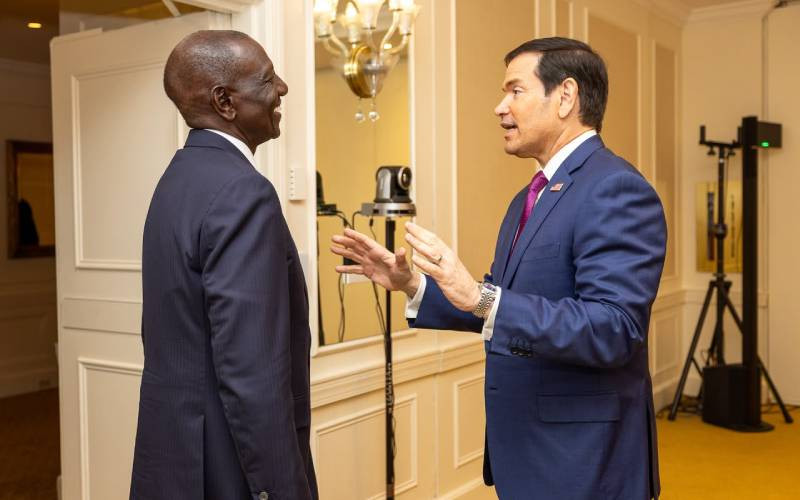
Kenya and the United States are exploring cooperation in critical minerals, with Washington saying the sector could position Kenya as a key player while creating opportunities for US firms to provide value addition.
US State Secretary Marco Rubio and President William Ruto discussed the opportunities during talks on the sidelines of the 81st United Nations General Assembly in New York, according to the US State Department.
“Secretary of State Marco Rubio met with Kenyan President William Ruto to discuss commercial diplomacy and regional peace and security,” the State Department said.
“They spoke about how critical minerals opportunities in Kenya can position the country as a key player in the sector while presenting opportunities for U.S. firms to provide value addition."
President William Ruto Holds Bilateral Talks With U.S. Secretary of State Marco Rubio in New York on Sidelines of 81st UN General Assembly pic.twitter.com/ySuRTya0Di
— The Standard Digital (@StandardKenya) September 22, 2026
Critical minerals are minerals considered important to modern industries and technologies, including electronics, batteries, renewable energy, advanced manufacturing and defence.
Kenya has deposits of minerals that the government classifies as strategic, including niobium and rare earth elements found at the Mrima Hill deposit in Kwale County.
Niobium is used mainly to strengthen steel and is important in the production of high-strength alloys used in infrastructure, transport and energy applications. Rare earth elements are used in products including electronics, permanent magnets, electric motors and other advanced technologies.
The latest discussions build on a preliminary minerals deal between Kenya and the United States announced by President William Ruto in June 2026.
Ruto said at the time that Kenya and the US had agreed that minerals from the Mrima Hill deposit would be processed in Kenya, allowing the country to capture more value from its mineral resources rather than exporting them in raw form.
Apart from the Mrima Hill deposits, Kenya produces minerals including rutile, ilmenite and zirconium.
According to the US Geological Survey, Kenya was the world's fourth-largest producer of rutile in 2024. However, mining at the country's only large-scale titanium mine in Kwale ended in December 2024 after its ore reserves were depleted.
In recent weeks, the US has signalled interest in helping Kenya develop its critical-minerals processing industry through investment and technical expertise.
According to Ruto, the talks also covered cooperation in nuclear energy and artificial intelligence.
Stay informed. Subscribe to our newsletter
“We exchanged views on the responsible governance of rapidly advancing AI technologies and explored opportunities for cooperation in critical minerals and nuclear energy,” he said.
The President said Kenya and the US were also broadening cooperation in AI and its application in health, education and financial services.
On trade, Ruto welcomed the extension of the African Growth and Opportunity Act, saying it would strengthen trade between Africa and the United States and expand economic opportunities.
“Kenya and the United States share a strong and enduring partnership anchored in trade, security, technology and development,” Ruto said.
The two leaders also discussed regional peace and security, including sustaining the security mission in Somalia, supporting stability in Haiti, and addressing the humanitarian crisis in Sudan through efforts toward a ceasefire, political settlement, and continued regional engagement.
The nuclear discussions build on an existing Kenya-US cooperation framework.
The two countries signed a Memorandum of Understanding on Strategic Civil Nuclear Cooperation in December 2022, establishing a framework for cooperation on peaceful nuclear energy.
Subscribe to our newsletter and stay updated on the latest developments and special offers!


 Prefer the Standard on Google






 join
join