×
App Icon
The Standard e-Paper
Kenya’s Boldest Voice
★★★★ - on Play Store
Download App

Carol Koech: The Kenyan engineer lighting the way for African women

Vocalize Pre-Player Loader

Audio By Vocalize

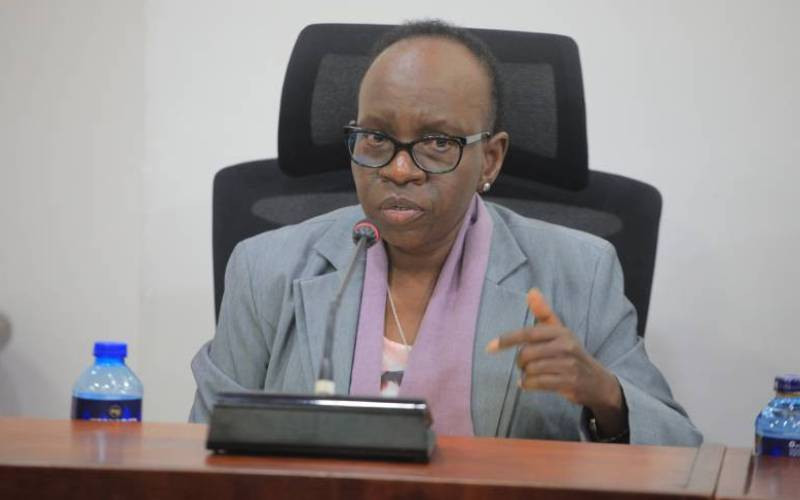
Carol Koeach, Vice President for Africa at the Global Energy Alliance for People and Planet (GEAPP).

On the ninth floor of a Nairobi office building, Carol Koech sits behind a desk framed by glowing computer screens. The door to her office is open. A cool breeze flows in from the window, carrying with it a quiet view of green patches and scattered rooftops below. The air is clean, the room peaceful, almost still.

It is a far cry from the rural village where she once did her homework by the light of a kerosene lamp.

Today, Koech, with 20 years of experience, serves as Vice President for Africa at the Global Energy Alliance for People and Planet (GEAPP), helping shape decisions that could bring electricity to millions across the continent. Yet the memory of growing up without power remains close and continues to guide the work she does in global boardrooms.

"I call myself an energy access and sustainability enthusiast," Koech says. "When I sit on those tables, I feel like I have a bigger stake because I have a lived experience. I can explain. Sometimes I hear people talk, and I'm like, what do you even know about living without electricity access?"

Koech spent nine years at General Electric (GE) building large power plants across sub-Saharan Africa. The irony wasn't lost on her. "I was doing that, but my mother was still in the dark," she recalls. "So it became very clear to me that focusing on real energy access was important."

According to the International Energy Agency (IEA) and UN Sustainable Development Group, nearly 600 million Africans still lack access to electricity, with women carrying the heaviest burden.

"Every time I go to the village, I look at a woman carrying water by the back, a woman by the river washing their clothes, a woman carrying firewood. And those things, for me, all translate to energy," she explains.

More than 50 per cent of those without electricity access are women suffering from what Koech calls "time poverty."

"When you're a woman in a village environment, your job is constantly hustling for your family. If you're not going to the river to get water, you're going to fetch firewood. You're doing chores. So you have no time for yourself as a woman," she says. "But imagine if you had electricity access for those women, you would help solve the time they are losing by doing those things."

Koech's journey to those global boardrooms began in an electrical engineering classroom where she was one of very few women. "Even today, there are still very few women pursuing those courses," she notes. "If you look at the statistics 20 years later, the percentage of women in those classrooms hasn't changed significantly."

She credits her placement in engineering partly to Kenya's merit-based university system, where high achievers are directed toward technical fields.

"Once I was there and there were other people, it was like, OK, if they can do it, I can also do it," she says. The lack of role models didn't deter her. Growing up with parents who were both teachers, she only had one cousin studying civil engineering as a reference point.

Her stellar corporate career took her through KPMG, GE, and Schneider Electric. At Schneider, she found a company with a program called Access to Energy that aligned with her mission. "I really needed to go back to my mission-oriented work," she explains. "When the opportunity for mission work in the development space came, I jumped on it because I had been tangentially doing more of that. I really knew that this is where I could make a significant difference."

Now, Koech is supporting Mission 300, an unprecedented initiative by the World Bank and African Development Bank to electrify 300 million Africans by 2030. It's the first time these two major institutions have worked together on such a scale.

"The reason for that number being constant for the last 20 years is that even though electrification has been increasing, the population has also been increasing at the same pace," Koech explains. "This is the first time the two banks are working together and said, why don't we give ourselves a stretch target of at least electrifying 300 million by 2030?"

The Global Energy Alliance's role is to help governments establish compact development and monitoring units. Governments write national energy compacts outlining their electrification strategies, required reforms, projects, and investment needs. The Alliance then provides technical expertise governments may lack, embedding specialists to support implementation.

Kenya generates over 90 per cent of its electricity from renewable sources one of the highest clean energy shares in the world. Yet access remains uneven, particularly in sparsely populated rural areas where grid extension is costly.

Mini-grids, standalone solar systems and isolated systems are becoming critical solutions. Under Kenya’s National Energy Compact, five million households are targeted for connection through a mix of grid and off-grid approaches.

For Koech, electricity access is about far more than lights in the dark. It's about economic transformation. In Kenya, the Global Energy Alliance runs the Clean Energy Solutions for Women program, enabling women entrepreneurs and small enterprises organised in cooperatives to access productive use equipment through subsidies and partnerships with Cooperative Bank.

"These women are actually buying the equipment," Koech emphasises. "What we are doing is making sure they have access to the right equipment that is of good quality and that they have access to the loan."

Depending on their business, women are buying mills, irrigation pumps, cold storage units, or refrigerators for fishing industries.

In Ethiopia, the Alliance is transforming the coffee value chain. Women farmers receive solar-powered washers and pulpers for processing coffee, paired with biodigesters that convert waste into biogas for cooking.

"If you look at that solution, it's complete," Koech says. "And it is in a remote location where there's no grid power. But these women will have access because the equipment is powered by solar."

Koech’s career has been shaped by bold pivots leaving jobs, asking for opportunities others assumed were unavailable, pursuing further study.

"Your career is in your hands," she says. "If your career is driven by fear, then you will make very little progress. But if you truly believe that you can make a difference to your career, but also to the people that you serve, I don't see why you should not take bold moves."

As one of the few women in senior leadership spaces, Koech has learned to claim her place without losing her authentic voice. "I don't even remember that I'm the only woman in the room, because I bring myself as a qualified member on that table," she says. "I always know that if I'm in this table, I deserve to be here. I'm not here by accident."

The 2026 theme for the International Day of Women and Girls in Science highlights the synergy between AI, STEM, finance and social science. As digital technologies expand, so do risks including online harm against women.

Koech admits she is not an AI ethics expert but sees immense opportunity.

“I’m curious about what new businesses will emerge because of AI,” she says. “Just like e-commerce created Amazons, what will AI create?”

Her concern is that African girls become creators, not just consumers.

“We need to shift from consumption to creation,” she says. “Use AI to build businesses, to grow careers, to innovate.”